
alleen voor onderzoeksdoeleinden
Piceatannol Syk remmer
Cat.nr.S3026
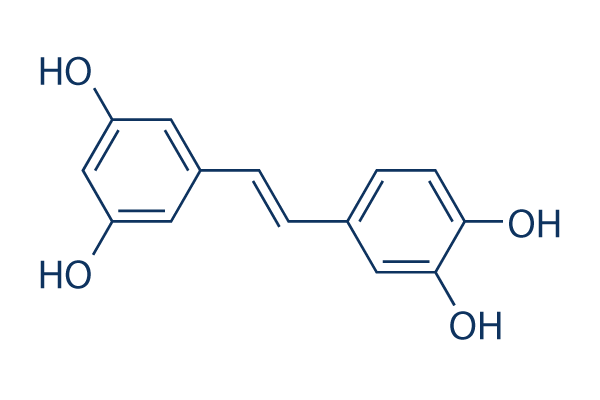
Chemische structuur
Molecuulgewicht: 244.24
Kwaliteitscontrole
| Gerelateerde doelwitten | EGFR VEGFR JAK PDGFR FGFR Src HIF FLT FLT3 HER2 |
|---|---|
| Overig Syk Inhibitoren | R406 R406 (free base) PRT062607 (P505-15) HCl Entospletinib (GS-9973) BAY 61-3606 dihydrochloride PRT-060318 2HCl TAK-659 Hydrochloride Lanraplenib (GS-SYK) RO9021 R112 |
Celkweek, behandeling & werkzame concentratie
| Cellijnen | Assaytype | Concentratie | Incubatietijd | Formulering | Activiteitsbeschrijving | PMID |
|---|---|---|---|---|---|---|
| human lung mast cells | Function assay | Inhibition of SYK in human lung mast cells assessed as reduction in anti-IgE-stimulated histamine release, EC50=25 μM | ||||
| human A2780 cells | Proliferation assay | 2 days | Antiproliferative activity against human A2780 cells after 2 days by Alamar Blue assay, IC50=41 μM | |||
| mouse 3T3L1 cells | Function assay | 10 to 50 μM | 48 h | Reduction in triglyceride level in mouse 3T3L1 cells at 10 to 50 uM after 48 hrs | ||
| Klik om meer experimentele gegevens over cellijnen te bekijken | ||||||
Chemische informatie, opslag en stabiliteit
| Molecuulgewicht | 244.24 | Formule | C14H12O4 |
Opslag (vanaf de datum van ontvangst) | |
|---|---|---|---|---|---|
| CAS-nr. | 10083-24-6 | SDF downloaden | Opslag van stamoplossingen |
|
|
| Synoniemen | Astringenin | Smiles | C1=CC(=C(C=C1C=CC2=CC(=CC(=C2)O)O)O)O | ||
Oplosbaarheid
|
In vitro |
DMSO
: 48 mg/mL
(196.52 mM)
Ethanol : 48 mg/mL Water : Insoluble |
Molariteitscalculator
|
In vivo |
|||||
In vivo formulatiecalculator (heldere oplossing)
Stap 1: Voer onderstaande informatie in (Aanbevolen: een extra dier om rekening te houden met verlies tijdens het experiment)
Stap 2: Voer de in vivo formulering in (Dit is alleen de calculator, geen formulering. Neem eerst contact met ons op als er geen in vivo formulering is in de sectie oplosbaarheid.)
Berekeningsresultaten:
Werkconcentratie: mg/ml;
Methode voor het bereiden van DMSO-moedervloeistof: mg geneesmiddel vooropgelost in μL DMSO ( Concentratie moedervloeistof mg/mL, Neem eerst contact met ons op als de concentratie de DMSO-oplosbaarheid van de batch van het geneesmiddel overschrijdt. )
Methode voor het bereiden van in vivo formulering: Neem μL DMSO moedervloeistof, voeg daarna toeμL PEG300, mengen en verhelderen, daarna toevoegenμL Tween 80, mengen en verhelderen, daarna toevoegen μL ddH2O, mengen en verhelderen.
Methode voor het bereiden van in vivo formulering: Neem μL DMSO moedervloeistof, voeg daarna toe μL Maïsolie, mengen en verhelderen.
Opmerking: 1. Zorg ervoor dat de vloeistof helder is voordat u het volgende oplosmiddel toevoegt.
2. Zorg ervoor dat u het/de oplosmiddel(en) in de juiste volgorde toevoegt. U moet ervoor zorgen dat de verkregen oplossing, bij de vorige toevoeging, een heldere oplossing is voordat u verdergaat met het toevoegen van het volgende oplosmiddel. Fysieke methoden zoals vortexen, ultrasoon of een warmwaterbad kunnen worden gebruikt om het oplossen te bevorderen.
Werkingsmechanisme
| Targets/IC50/Ki |
Syk
(Cell-free assay) Lyn
(Cell-free assay) cAK
(Cell-free assay) 3 μM
PKC
(Cell-free assay) 8 μM
MLCK
(Cell-free assay) 12 μM
CDPK
(Cell-free assay) 19 μM
|
|---|---|
| In vitro |
Piceatannol vertoont een ~10-voudige selectiviteit voor Syk boven Lyn. Behandeling met dit compound in RBL-2H3-cellen remt sterk de antigeen-gestimuleerde fosforylering van Syk en van de meeste andere cellulaire eiwitten, maar niet de β- of γ-subeenheid van de receptor, op een dosisafhankelijke manier. Het is ook een krachtige remmer van histaminerelease in mestcellen. Selectieve remming van Syk door deze chemische stof blokkeert receptor-gemedieerde down-stream cellulaire reacties in mestcellen, inclusief preventie van 1,4,5-IP3-synthese, secretie en membraanruffling en -spreiding. Dit compound remt ook potent PKA, PKC, MLCK en CDPK met IC50 van respectievelijk 3 μM, 8 μM, 12 μM en 19 μM. Het voorkomt selectief de IFNα-geïnduceerde tyrosinefosforylering van STAT3 en -5, maar niet van STAT1 en -2, parallel aan het verlies van Jak1 en IFNAR1 tyrosinefosforylering, maar niet van Tyk2 en IFNAR2. Deze chemische stof induceert krachtig apoptotische celdood in BJAB Burkitt-achtige lymfoomcellen met een ED50 van 25 μM, door de activering van caspase-3 en mitochondriale permeabiliteitstransitie onafhankelijk van de CD95/Fas-signaalroute. Het remt NF-κB-activering geïnduceerd door TNF, H2O2, PMA, LPS, okadaïsch zuur en ceramide. Dit compound onderdrukt de expressie van TNF-geïnduceerde NF-κB-afhankelijke reportergenen en van matrixmetalloprotease-9, cyclooxygenase-2 en cycline D1 onafhankelijk van Syk-kinase, door TNF-geïnduceerde IκBα-fosforylering, p65-fosforylering, p65-nucleaire translocatie en IκBα-kinase-activering te blokkeren. Het bindt direct aan PI3K op een ATP-competitieve manier en onderdrukt PI3K-activiteit met anti-atherosclerotische effecten effectiever dan resveratrol. Deze chemische stof remt androgeen-afhankelijke (AD) en androgeen-onafhankelijke (AI) CaP-celproliferatie, wat gepaard gaat met verminderde expressie van mTOR en zijn belangrijkste effectoren AKT en eIF4EBP-1.
|
| Kinase Assay |
In Vitro Eiwit-tyrosine Kinase Assays
|
|
Recombinant Syk wordt tot expressie gebracht in baculovirus-geïnfecteerde St9-cellen. Assays van recombinante Syk-activiteit worden uitgevoerd met angiotensine I-peptide als substraat. De enzymactiviteiten van recombinante Syk worden gemeten door fosforylering van angiotensine I-peptide in aanwezigheid van verschillende concentraties van dit compound.
|
|
| In vivo |
Orale toediening van Piceatannol induceert een opmerkelijke verbetering van de verstoring van de colonarchitectuur, een significante vermindering van de colonische myeloperoxidase (MPO)-activiteit, en een afname van de productie van inflammatoire mediatoren zoals stikstofmonoxide (NO), prostaglandine (PG) E2 en pro-inflammatoire cytokines bij BALB/c-muizen met dextransulfaatnatrium (DSS)-geïnduceerde colitis. Deze compoundbehandeling remt de stijging van de bloedglucosespiegels in vroege stadia en verbetert de verminderde glucosetolerantie in late stadia bij type 2 diabetesmodel db/db-muizen.
|
Referenties |
|
Technische ondersteuning
Tel: +1-832-582-8158 Ext:3
Als u nog andere vragen heeft, laat dan een bericht achter.

Producten zijn uitsluitend voor onderzoeksdoeleinden. Niet voor menselijk gebruik. Wij verkopen niet aan patiënten.
©Copyright 2013 Selleck Chemicals. Alle rechten voorbehouden.