
alleen voor onderzoeksdoeleinden
BIBF 1120 (Nintedanib) PDGFR/VEGFR-remmer
Cat.nr.S1010
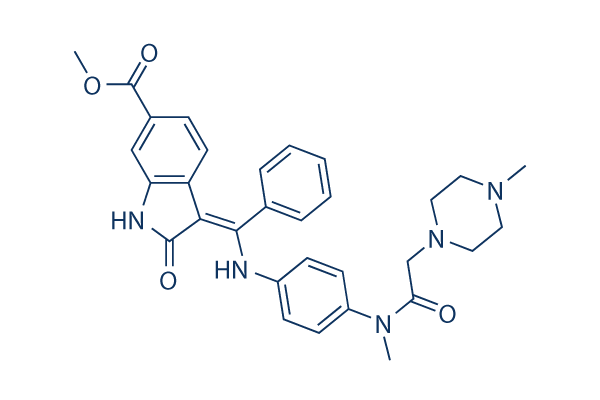
Chemische structuur
Molecuulgewicht: 539.62
Kwaliteitscontrole
| Gerelateerde doelwitten | EGFR PDGFR FGFR c-Met Src MEK CSF-1R FLT3 HER2 c-Kit |
|---|---|
| Overig VEGFR Inhibitoren | SAR131675 SU 5402 Cediranib (AZD2171) Vatalanib (PTK787) 2HCl Anlotinib (AL3818) Dihydrochloride Linifanib (ABT-869) Apatinib (YN968D1) Apatinib (YN968D1) mesylate Ki8751 ZM 323881 HCl |
Celkweek, behandeling & werkzame concentratie
| Cellijnen | Assaytype | Concentratie | Incubatietijd | Formulering | Activiteitsbeschrijving | PMID |
|---|---|---|---|---|---|---|
| SKOV3 | Function Assay | 5 µM | 24 h | DMSO | induces a significant increase in the promoter activities of E-cad, CDH1, and CDH3 | 26061747 |
| A549 | Function Assay | 2/5 μM | 24 h | DMSO | has a general EMT reversal effect | 26061747 |
| T24 | Function Assay | 2/5 μM | 24 h | DMSO | has a general EMT reversal effect | 26061747 |
| Mia-Paca2 | Function Assay | 2/5 μM | 24 h | DMSO | has a general EMT reversal effect | 26061747 |
| A549 | Function Assay | 0.01–5 μM | 24 h | DMSO | induces SFTPD mRNA expression dose dependently | 25843005 |
| A549 | Function Assay | 0.01–5 μM | 72 h | DMSO | enhances SP-D protein expression in a dose-dependent manner at concentrations of up to 5 μM | 25843005 |
| A549 | Function Assay | 5 μM | 0-1 h | DMSO | increases AP-1 activation after 30 min | 25843005 |
| Hep3B | Cell Viability Assay | 0-20 μM | 48 h | decreases cell viability dose dependently | 24657398 | |
| HepG2 | Cell Viability Assay | 0-20 μM | 48 h | decreases cell viability dose dependently | 24657398 | |
| PLC5 | Cell Viability Assay | 0-20 μM | 48 h | decreases cell viability dose dependently | 24657398 | |
| HuH7 | Cell Viability Assay | 0-20 μM | 48 h | decreases cell viability dose dependently | 24657398 | |
| SK-Hep1 | Cell Viability Assay | 0-20 μM | 48 h | decreases cell viability dose dependently | 24657398 | |
| Hep3B | Apoptosis Assay | 0-20 μM | 48 h | induces cell apoptosis dose dependently | 24657398 | |
| HepG2 | Apoptosis Assay | 0-20 μM | 48 h | induces cell apoptosis dose dependently | 24657398 | |
| PLC5 | Apoptosis Assay | 0-20 μM | 48 h | induces cell apoptosis dose dependently | 24657398 | |
| HuH7 | Apoptosis Assay | 0-20 μM | 48 h | induces cell apoptosis dose dependently | 24657398 | |
| SK-Hep1 | Apoptosis Assay | 0-20 μM | 48 h | induces cell apoptosis dose dependently | 24657398 | |
| H1703 | Growth Inhibition Assay | IC50=0.05 μM | 23729403 | |||
| Sf9 | Function assay | 20 mins | Inhibition of mouse GST-fused VEGFR2 expressed in Sf9 insect cells after 20 mins by scintillation counting, IC50 = 0.013 μM. | 18559524 | ||
| Sf9 | Function assay | 20 mins | Inhibition of human GST-fused VEGFR2 expressed in Sf9 insect cells after 20 mins by scintillation counting, IC50 = 0.021 μM. | 18559524 | ||
| NIH3T3 | Function assay | 50 nM | 1 hr | Inhibition of VEGFR2 transfected in mouse NIH3T3 cells at 50 nM incubated for 1 hr measured after 32 hrs washout followed by VEGF stimulation for 10 mins by Western blotting | 18559524 | |
| HT-29 | Antiproliferative assay | 72 hrs | Antiproliferative activity against human HT-29 cells after 72 hrs by MTT assay, IC50 = 4.9 μM. | 28190652 | ||
| SKOV3 | Antiproliferative assay | 72 hrs | Antiproliferative activity against human SKOV3 cells after 72 hrs by MTT assay, IC50 = 28.76 μM. | 28190652 | ||
| BL21 (DE3) | Function assay | 30 mins | Inhibition of His6-tagged MELK catalytic domain (1 to 340 residues) (unknown origin) expressed in Escherichia coli BL21 (DE3) cells using Bcl-GL as substrate measured after 30 mins in presence of [gamma32P]ATP by liquid scintillation counting method, Ki = 0.0056 μM. | 28351607 | ||
| BL21 (DE3) | Function assay | 30 mins | Inhibition of His6-tagged MELK catalytic domain (1 to 340 residues) (unknown origin) expressed in Escherichia coli BL21 (DE3) cells using Bcl-GL as substrate measured after 30 mins in presence of [gamma32P]ATP by liquid scintillation counting method, IC50 = 0.043 μM. | 28351607 | ||
| HT-29 | Antiproliferative assay | 72 hrs | Antiproliferative activity against human HT-29 cells after 72 hrs by MTT assay, IC50 = 0.83 μM. | 28826084 | ||
| MCF7 | Antiproliferative assay | 72 hrs | Antiproliferative activity against human MCF7 cells after 72 hrs by MTT assay, IC50 = 8.28 μM. | 28826084 | ||
| A549 | Antiproliferative assay | 72 hrs | Antiproliferative activity against human A549 cells after 72 hrs by MTT assay, IC50 = 22.62 μM. | 28826084 | ||
| NIH/3T3 | Function assay | 42 hrs | Inhibition of PDGFR in mouse NIH/3T3 cells assessed as reduction in recombinant human PDGF-BB-induced cell proliferation after 42 hrs by cell titer 96 aqueous one solution based assay, IC50 = 0.085 μM. | 29152045 | ||
| Sf9 | Function assay | Inhibition of human VEGFR2 expressed in Sf9 cells, IC50 = 0.005 μM. | 19522465 | |||
| NIH3T3 | Function assay | 1 hr | Inhibition of VEGF-stimulated human VEGFR2 phosphorylation expressed in mouse NIH3T3 cells pretreated for 1 hr measured 32 hrs after drug dose by immunoprecipitation based pulse-chase experiment | 19522465 | ||
| BRP | Apoptosis assay | Induction of apoptosis in BRP cells assessed as caspase-3 cleavage | 19522465 | |||
| BRP | Antiangiogenic assay | Antiangiogenic activity BRP cells assessed as inhibition of cell proliferation by [3H]thymidine incorporation assay | 19522465 | |||
| TC32 | qHTS assay | qHTS of pediatric cancer cell lines to identify multiple opportunities for drug repurposing: Primary screen for TC32 cells | 29435139 | |||
| A673 | qHTS assay | qHTS of pediatric cancer cell lines to identify multiple opportunities for drug repurposing: Primary screen for A673 cells | 29435139 | |||
| DAOY | qHTS assay | qHTS of pediatric cancer cell lines to identify multiple opportunities for drug repurposing: Primary screen for DAOY cells | 29435139 | |||
| Saos-2 | qHTS assay | qHTS of pediatric cancer cell lines to identify multiple opportunities for drug repurposing: Primary screen for Saos-2 cells | 29435139 | |||
| BT-37 | qHTS assay | qHTS of pediatric cancer cell lines to identify multiple opportunities for drug repurposing: Primary screen for BT-37 cells | 29435139 | |||
| SK-N-SH | qHTS assay | qHTS of pediatric cancer cell lines to identify multiple opportunities for drug repurposing: Primary screen for SK-N-SH cells | 29435139 | |||
| NB1643 | qHTS assay | qHTS of pediatric cancer cell lines to identify multiple opportunities for drug repurposing: Primary screen for NB1643 cells | 29435139 | |||
| OHS-50 | qHTS assay | qHTS of pediatric cancer cell lines to identify multiple opportunities for drug repurposing: Primary screen for OHS-50 cells | 29435139 | |||
| LAN-5 | qHTS assay | qHTS of pediatric cancer cell lines to identify multiple opportunities for drug repurposing: Confirmatory screen for LAN-5 cells | 29435139 | |||
| DAOY | qHTS assay | qHTS of pediatric cancer cell lines to identify multiple opportunities for drug repurposing: Confirmatory screen for DAOY cells | 29435139 | |||
| Rh41 | qHTS assay | qHTS of pediatric cancer cell lines to identify multiple opportunities for drug repurposing: Primary screen for Rh41 cells | 29435139 | |||
| MG 63 (6-TG R) | qHTS assay | qHTS of pediatric cancer cell lines to identify multiple opportunities for drug repurposing: Confirmatory screen for MG 63 (6-TG R) cells | 29435139 | |||
| Rh30 | qHTS assay | qHTS of pediatric cancer cell lines to identify multiple opportunities for drug repurposing: Confirmatory screen for Rh30 cells | 29435139 | |||
| U-2 OS | qHTS assay | qHTS of pediatric cancer cell lines to identify multiple opportunities for drug repurposing: Confirmatory screen for U-2 OS cells | 29435139 | |||
| OHS-50 | qHTS assay | qHTS of pediatric cancer cell lines to identify multiple opportunities for drug repurposing: Confirmatory screen for OHS-50 cells | 29435139 | |||
| Rh41 | qHTS assay | qHTS of pediatric cancer cell lines to identify multiple opportunities for drug repurposing: Confirmatory screen for Rh41 cells | 29435139 | |||
| SJ-GBM2 | qHTS assay | qHTS of pediatric cancer cell lines to identify multiple opportunities for drug repurposing: Primary screen for SJ-GBM2 cells | 29435139 | |||
| NB-EBc1 | qHTS assay | qHTS of pediatric cancer cell lines to identify multiple opportunities for drug repurposing: Primary screen for NB-EBc1 cells | 29435139 | |||
| LAN-5 | qHTS assay | qHTS of pediatric cancer cell lines to identify multiple opportunities for drug repurposing: Primary screen for LAN-5 cells | 29435139 | |||
| NB1643 | qHTS assay | qHTS of pediatric cancer cell lines to identify multiple opportunities for drug repurposing: Confirmatory screen for NB1643 cells | 29435139 | |||
| SK-N-MC | qHTS assay | qHTS of pediatric cancer cell lines to identify multiple opportunities for drug repurposing: Confirmatory screen for SK-N-MC cells | 29435139 | |||
| TC32 | qHTS assay | qHTS of pediatric cancer cell lines to identify multiple opportunities for drug repurposing: Confirmatory screen for TC32 cells | 29435139 | |||
| Rh18 | qHTS assay | qHTS of pediatric cancer cell lines to identify multiple opportunities for drug repurposing: Confirmatory screen for Rh18 cells | 29435139 | |||
| Klik om meer experimentele gegevens over cellijnen te bekijken | ||||||
Chemische informatie, opslag en stabiliteit
| Molecuulgewicht | 539.62 | Formule | C31H33N5O4 |
Opslag (vanaf de datum van ontvangst) | |
|---|---|---|---|---|---|
| CAS-nr. | 656247-17-5 | SDF downloaden | Opslag van stamoplossingen |
|
|
| Synoniemen | BIBF 1120, Intedanib | Smiles | CN1CCN(CC1)CC(=O)N(C)C2=CC=C(C=C2)N=C(C3=CC=CC=C3)C4=C(NC5=C4C=CC(=C5)C(=O)OC)O | ||
Oplosbaarheid
|
In vitro |
DMSO
: 10 mg/mL
(18.53 mM)
Water : Insoluble Ethanol : Insoluble |
Molariteitscalculator
|
In vivo |
|||||
In vivo formulatiecalculator (heldere oplossing)
Stap 1: Voer onderstaande informatie in (Aanbevolen: een extra dier om rekening te houden met verlies tijdens het experiment)
Stap 2: Voer de in vivo formulering in (Dit is alleen de calculator, geen formulering. Neem eerst contact met ons op als er geen in vivo formulering is in de sectie oplosbaarheid.)
Berekeningsresultaten:
Werkconcentratie: mg/ml;
Methode voor het bereiden van DMSO-moedervloeistof: mg geneesmiddel vooropgelost in μL DMSO ( Concentratie moedervloeistof mg/mL, Neem eerst contact met ons op als de concentratie de DMSO-oplosbaarheid van de batch van het geneesmiddel overschrijdt. )
Methode voor het bereiden van in vivo formulering: Neem μL DMSO moedervloeistof, voeg daarna toeμL PEG300, mengen en verhelderen, daarna toevoegenμL Tween 80, mengen en verhelderen, daarna toevoegen μL ddH2O, mengen en verhelderen.
Methode voor het bereiden van in vivo formulering: Neem μL DMSO moedervloeistof, voeg daarna toe μL Maïsolie, mengen en verhelderen.
Opmerking: 1. Zorg ervoor dat de vloeistof helder is voordat u het volgende oplosmiddel toevoegt.
2. Zorg ervoor dat u het/de oplosmiddel(en) in de juiste volgorde toevoegt. U moet ervoor zorgen dat de verkregen oplossing, bij de vorige toevoeging, een heldere oplossing is voordat u verdergaat met het toevoegen van het volgende oplosmiddel. Fysieke methoden zoals vortexen, ultrasoon of een warmwaterbad kunnen worden gebruikt om het oplossen te bevorderen.
Werkingsmechanisme
| Targets/IC50/Ki |
VEGFR2
(Cell-free assay) 13 nM
VEGFR3
(Cell-free assay) 13 nM
LCK
(Cell-free assay) 16 nM
FLT3
(Cell-free assay) 26 nM
VEGFR1
(Cell-free assay) 34 nM
FGFR2
(Cell-free assay) 37 nM
PDGFRα
(Cell-free assay) 59 nM
PDGFRβ
(Cell-free assay) 65 nM
FGFR1
(Cell-free assay) 69 nM
FGFR3
(Cell-free assay) 108 nM
Src
(Cell-free assay) 156 nM
Lyn
(Cell-free assay) 195 nM
FGFR4
(Cell-free assay) 610 nM
|
|---|---|
| In vitro |
BIBF1120 remt de PDGFR-kinaseactiviteit van PDGFR alfa- en PDGFR bètatypes met IC50-waarden van respectievelijk 59 nM en 65 nM. Bovendien onderdrukt BIBF1120 de FGFR-subtypen met IC50 van 60 nM, 37 nM en 108 nM voor respectievelijk FGFR1, FGFR2 en FGFR3. BIBF1120 bindt aan de ATP-bindingsplaats in de spleet tussen de amino- en carboxyterminale lobben van het kinase-domein. Het indolinon-skelet vormt twee waterstofbruggen met het ruggengraatstikstof van Cys919 en het ruggengraatcarbonylzuurstof van Glu917 in het scharniergebied. BIBF 1120 remt de proliferatie van PDGF-BB-gestimuleerde BRP's met een EC50 van 79 nM in celassays. BIBF1120 in concentraties zo laag als 100 nM blokkeert de activering van MAPK na stimulatie met 5% serum plus PDGF-BB. In culturen van humane vasculaire gladde spiercellen (HUASMC) voorkomt BIBF1120 de PDGF-BB-gestimuleerde proliferatie met een EC50 van 69 nM. |
| Kinase Assay |
VEGFR2 Kinase Assay
|
|
Het cytoplasmatische tyrosinekinasedomein van VEGFR2 (residuen 797-1355 volgens de sequentie gedeponeerd in databank SWISS-PROT P35968) wordt gekloneerd in pFastBac gefuseerd aan GST en geëxtraheerd. Enzymactiviteit wordt bepaald in aanwezigheid of afwezigheid van seriële verdunningen van BIBF1120 uitgevoerd in 25% DMSO. Elke microtiterplaat bevat interne controles zoals blanco, maximale reactie en historisch referentieverbinding. Alle incubaties worden uitgevoerd bij kamertemperatuur op een draaischudder. 10 μL van elke BIBF1120-verdunning wordt toegevoegd aan 10 μL verdund kinase (0,8 μg/mL VEGFR2, 10 mM Tris pH 7,5, 2 mM EDTA en 2 mg/mL BSA) en 1 uur voorgeïncubeerd. De reactie wordt gestart door toevoeging van 30 μL substraatmengsel bevattende 62,4 mM Tris pH 7,5, 2,7 mM DTT, 5,3 mM MnCl2, 13,3 mM Mg-acetaat, 0,42 mM ATP, 0,83 mg/mL Poly-Glu-Tyr(4:1), en 1,7 μg/mL Poly-Glu-Tyr(4:1)-biotine en 1 uur geïncubeerd. De reactie wordt gestopt door toevoeging van 50 μL van 250 mM EDTA, 20 mM HEPES, pH 7,4. 90 μL van het reactiemengsel wordt overgebracht naar een streptavidineplaat en 1-2 uur geïncubeerd. Na drie wassingen met PBS wordt de met EU gelabelde antistof, PY20, toegevoegd (aanbevolen verdunning 1:2000 van 0,5 mg/mL gelabelde antistof in DELFIA assaybuffer). Overtollige detectie-antistof wordt verwijderd door drie wassingen met DELFIA-wasbuffer. Vervolgens, 10 minuten voor meting op de multilabellezer, wordt elke put geïncubeerd met 100 μL DELFIA-versterkingsoplossing.
|
|
| In vivo |
In alle tot nu toe geteste tumormodellen, inclusief humane tumorxenografts die groeien in naakte muizen en een syngene ratten-tumormodel, is BIBF1120 zeer actief bij goed verdraagbare doses (25-100 mg/kg dagelijks p.o.). Dit blijkt uit de magnetische resonantiebeeldvorming van tumorperfusie na 3 dagen, de vermindering van vaatdichtheid en vaatintegriteit na 5 dagen, en een diepgaande groeiremming. |
Referenties |
|
Toepassingen
| Methoden | Biomarkers | Afbeeldingen | PMID |
|---|---|---|---|
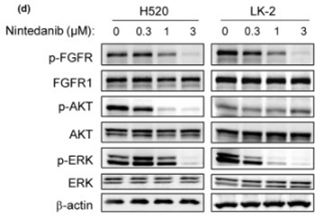
| Western blot | p-EGFR / FGFR1 / p-AKT / AKT / p-ERK / ERK Cyclin A / Cyclin D1 / Cyclin E / CDK2 / CDK4 / CDK6 p-SMAD3 / SMAD3 / p-p38 MAPK / p38 MAPK Fibronectin / Collagen 1a1 |
|
27581340 |
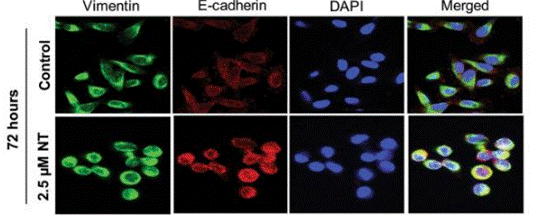
| Immunofluorescence | Vimentin / E-cadherin |
|
29934570 |
Informatie over klinische proeven
(gegevens van https://clinicaltrials.gov, bijgewerkt op 2024-05-22)
| NCT-nummer | Werving | Aandoeningen | Sponsor/medewerkers | Startdatum | Fasen |
|---|---|---|---|---|---|
| NCT06200714 | Recruiting | Idiopathic Pulmonary Fibrosis|Diarrhoea |
Boehringer Ingelheim |
April 30 2024 | -- |
| NCT05676112 | Withdrawn | Pulmonary Fibrosis |
Boehringer Ingelheim|China-Japan Friendship Hospital |
December 29 2023 | -- |
| NCT06070610 | Completed | Healthy |
Boehringer Ingelheim |
November 8 2023 | Phase 1 |
| NCT05755308 | Not yet recruiting | Idiopathic Pulmonary Fibrosis |
Fondazione Policlinico Universitario Agostino Gemelli IRCCS |
October 2023 | Not Applicable |
| NCT06071013 | Not yet recruiting | Non-small Cell Lung Cancer|EGFR Gene Mutation|EGFR-TKI Resistant Mutation |
China Medical University Hospital |
September 28 2023 | Phase 1|Phase 2 |
Technische ondersteuning
Tel: +1-832-582-8158 Ext:3
Als u nog andere vragen heeft, laat dan een bericht achter.

Producten zijn uitsluitend voor onderzoeksdoeleinden. Niet voor menselijk gebruik. Wij verkopen niet aan patiënten.
©Copyright 2013 Selleck Chemicals. Alle rechten voorbehouden.