
alleen voor onderzoeksdoeleinden
KRN 633 VEGFR Remmer
Cat.nr.: S1557
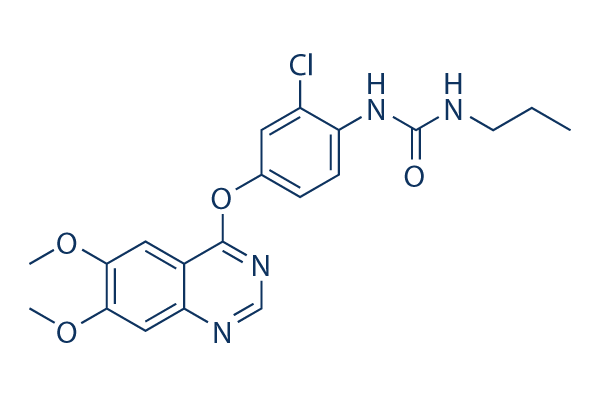
Chemische structuur
Molecuulgewicht: 416.86
Kwaliteitscontrole (Quality Control)
| Gerelateerde doelwitten | EGFR FGFR PDGFR c-Met Src MEK CSF-1R FLT3 HER2 c-Kit |
|---|---|
| Overig VEGFR Inhibitoren | SAR131675 SU 5402 Cediranib (AZD2171) Vatalanib (PTK787) 2HCl Anlotinib (AL3818) Dihydrochloride Linifanib (ABT-869) Apatinib (YN968D1) Apatinib (YN968D1) mesylate Ki8751 Semaxanib (SU5416) |
Chemische informatie, opslag en stabiliteit (Chemical Information, Storage & Stability)
| Molecuulgewicht | 416.86 | Formule | C20H21ClN4O4 |
Opslag (vanaf de datum van ontvangst) | |
|---|---|---|---|---|---|
| CAS-nr. | 286370-15-8 | SDF downloaden | Opslag van stamoplossingen |
|
|
| Synoniemen | N/A | Smiles | CCCNC(=O)NC1=C(C=C(C=C1)OC2=NC=NC3=CC(=C(C=C32)OC)OC)Cl | ||
Oplosbaarheid (Solubility)
|
In vitro |
DMSO
: 9 mg/mL
(21.58 mM)
Water : Insoluble Ethanol : Insoluble |
Molariteitscalculator
|
In vivo |
|||||
In vivo formulatiecalculator (heldere oplossing)
Stap 1: Voer onderstaande informatie in (Aanbevolen: een extra dier om rekening te houden met verlies tijdens het experiment)
Stap 2: Voer de in vivo formulering in (Dit is alleen de calculator, geen formulering. Neem eerst contact met ons op als er geen in vivo formulering is in de sectie oplosbaarheid.)
Berekeningsresultaten:
Werkconcentratie: mg/ml;
Methode voor het bereiden van DMSO-moedervloeistof: mg geneesmiddel vooropgelost in μL DMSO ( Concentratie moedervloeistof mg/mL, Neem eerst contact met ons op als de concentratie de DMSO-oplosbaarheid van de batch van het geneesmiddel overschrijdt. )
Methode voor het bereiden van in vivo formulering: Neem μL DMSO moedervloeistof, voeg daarna toeμL PEG300, mengen en verhelderen, daarna toevoegenμL Tween 80, mengen en verhelderen, daarna toevoegen μL ddH2O, mengen en verhelderen.
Methode voor het bereiden van in vivo formulering: Neem μL DMSO moedervloeistof, voeg daarna toe μL Maïsolie, mengen en verhelderen.
Opmerking: 1. Zorg ervoor dat de vloeistof helder is voordat u het volgende oplosmiddel toevoegt.
2. Zorg ervoor dat u het/de oplosmiddel(en) in de juiste volgorde toevoegt. U moet ervoor zorgen dat de verkregen oplossing, bij de vorige toevoeging, een heldere oplossing is voordat u verdergaat met het toevoegen van het volgende oplosmiddel. Fysieke methoden zoals vortexen, ultrasoon of een warmwaterbad kunnen worden gebruikt om het oplossen te bevorderen.
Werkingsmechanisme (Mechanism of Action)
| Targets/IC50/Ki |
VEGFR3
125 nM
VEGFR2
160 nM
VEGFR1
170 nM
PDGFRα
965 nM
c-Kit
4330 nM
BTK
9200 nM
PDGFRβ
9850 nM
Tie-2
9900 nM
|
|---|---|
| In vitro |
KRN 633, a novel quinazoline urea derivative, strongly inhibits VEGFR1, VEGFR2 and VEGFR3 receptors with IC50 values of 170 nM, 160 nM and 125 nM respectively. It shows lower inhibitory activity towards non-RTKs, such as PDGF receptor (PDGFRα and β, c-Kit, breast tumor kinase, and tunica interna endothelial cell kinase tyrosine kinases (IC50 = 965, 9850, 4330, 9200, and 9900 nM, respectively). This compound potently inhibits ligand VEGF induced phosphorylation of VEGFR2 in HUVECs with an IC50 of 1.16 nM. It also inhibits VEGF-dependent, but not bFGF-dependent, phosphorylation of the MAP kinases in endothelial cells, with IC50 values of 3.51 nM and 6.08 nM for ERK1 and ERK2, respectively. This chemical has also been shown to inhibit the VEGF-driven proliferation of HUVECs with an IC50 of 14.9 nM, but it only suppresses FGF-driven proliferation at 3 μM weakly. It inhibits hypoxia-induced transcriptional activation of HIF-1α in a concentration-dependent manner with an IC50 of 3.79 μM, through the inhibition of both Akt and ERK phosphorylation signaling pathways.
|
| Kinase Assay |
Celvrije Kinase Assays
|
|
Celvrije kinase-assays worden uitgevoerd om IC50-waarden te verkrijgen tegen een verscheidenheid aan recombinante VEGF-receptoren. KRN633 wordt getest in concentraties variërend van 0,3 nM tot 10 μM. Alle assays worden in viervoud uitgevoerd met 1 μM ATP.
|
|
| In vivo |
Although not cytotoxic to various cancer cells in vitro, KRN633 exhibits excellent antitumor activity in vivo due to its inhibitory effect on tumor vessel formation and vascular permeability. Once-daily administration of this compound at 100 mg/kg/d produces significant tumor growth inhibition in A549, LC-6-LCK, HT29, Ls174T, LNCap and Du145 cells while twice-daily administration of this compound at 100 mg/kg induces ~90% growth inhibition of HT29 tumors. Treatment of mid-pregnancy mice with this chemical (300 mg/kg, p.o.) reduces the blood supply to fetal tissues due to diminished vascularization in both placenta and fetal organs and consequently increases the risk of induction of intrauterine growth restriction (IUGR).
|
Referenties |
|

Producten zijn uitsluitend voor onderzoeksdoeleinden. Niet voor menselijk gebruik. Wij verkopen niet aan patiënten.
©Copyright 2013 Selleck Chemicals. Alle rechten voorbehouden.