
alleen voor onderzoeksdoeleinden
ICG-001 Wnt/β-catenine-remmer
Cat.nr.S2662
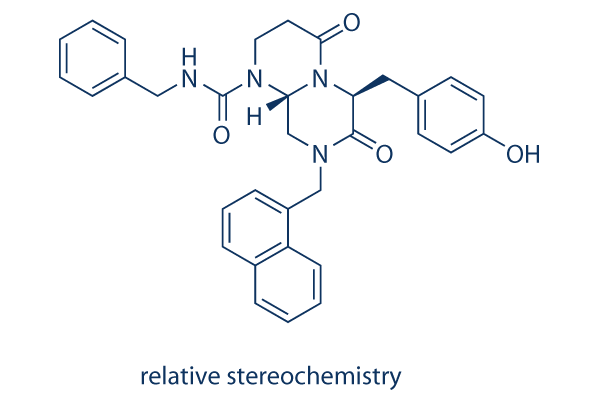
Chemische structuur
Molecuulgewicht: 548.63
Kwaliteitscontrole
Producten die vaak samen worden gebruikt met ICG-001
| Gerelateerde doelwitten | JAK TGF-beta/Smad ERK GSK-3 ROCK Hedgehog/Smoothened PKA Secretase STAT Casein Kinase |
|---|---|
| Overig Wnt/beta-catenin Inhibitoren | IWR-1-endo PRI-724 (Foscenvivint) IWP-2 Tegatrabetan (BC-2059) Isoquercitrin SKL2001 BML-284 Hydrochloride (Wnt agonist 1, AMBMP) PNU-74654 Salinomycin (Procoxacin) FH535 |
Celkweek, behandeling & werkzame concentratie
| Cellijnen | Assaytype | Concentratie | Incubatietijd | Formulering | Activiteitsbeschrijving | PMID |
|---|---|---|---|---|---|---|
| SH-SY5Y | Apoptosis Assay | 50 μm | 24 h | DMSO | blocks the protective effect of melatonin against PrP (106–126)-induced apoptotic signals | 25251028 |
| AsPC-1 | Growth Inhibition Assay | 1-20 μM | 2/4/6 d | inhibits the cell growth in a dose-dependent manner | 25082960 | |
| MiaPaCa-2 | Growth Inhibition Assay | 1-20 μM | 2/4/6 d | inhibits the cell growth in a dose-dependent manner | 25082960 | |
| PANC-1 | Growth Inhibition Assay | 1-20 μM | 2/4/6 d | inhibits the cell growth in a dose-dependent manner | 25082960 | |
| L3.6pl | Growth Inhibition Assay | 1-20 μM | 2/4/6 d | inhibits the cell growth in a dose-dependent manner | 25082960 | |
| SH-SY5Y | Apoptosis Assay | 10 μM | 24 h | inhibits the neuroprotective effects of hypoxia against PrP (106-126)-mediated neuronal cell death | 23900566 | |
| HKC-8 | Function Assay | 10 µM | 24 h | abolishes β-catenin–mediated RAS induction | 25012166 | |
| HK-2 | Function Assay | 10 µM | 3 h | reduced the expression of TGF-β1, α-SMA, and CTGF after treatment with HHE | 23690997 | |
| HepT1 | Apoptosis Assay | 0-100 μM | 24 h | IC50=34 μM | 23266718 | |
| HuH6 | Apoptosis Assay | 0-100 μM | 24 h | IC50=39 μM | 23266718 | |
| MCF7 | Function Assay | 5 μm | inhibits leptin-mediated increased expression of Snail, Slug, and Zeb2 | 22270359 | ||
| RLE-6TN | Function Assay | 2.5/5/7.5 μM | 48 h | inhibits TGF-β1-induced α-SMA induction and EMT | 22241478 | |
| HKC-8 | Function Assay | 5/10/20 μM | 48 h | blocks β-catenin-driven gene expression | 21816937 | |
| SW480 | Growth Inhibition Assay | 2-100 μM | IC50=5.8±0.68 μM | 15782138 | ||
| SW480 | Function assay | Inhibition of CBP binding to beta-casein in human SW480 cells by immunoblot analysis, IC50 = 1.3 μM. | 23232060 | |||
| A549 | Antiproliferative assay | 72 hrs | Antiproliferative activity against human A549 cells after 72 hrs by MTT assay, GI50 = 6.1 μM. | 24950489 | ||
| HepG2 | Antiproliferative assay | 72 hrs | Antiproliferative activity against human HepG2 cells after 72 hrs by MTT assay, GI50 = 12.7 μM. | 24950489 | ||
| LoVo | Antiproliferative assay | 72 hrs | Antiproliferative activity against human LoVo cells after 72 hrs by MTT assay, GI50 = 15.6 μM. | 24950489 | ||
| HT-29 | Antiproliferative assay | 72 hrs | Antiproliferative activity against human HT-29 cells after 72 hrs by MTT assay, GI50 = 17.2 μM. | 24950489 | ||
| HT29 | Function assay | 24 hrs | Inhibition of Wnt signaling in human HT29 cells assessed as inhibition of beta-catenin-mediated Tcf/Lef transcriptional activity after 24 hrs by dual luciferase reporter gene assay relative to control, IC50 = 18.7 μM. | 24950489 | ||
| TC32 | qHTS assay | qHTS of pediatric cancer cell lines to identify multiple opportunities for drug repurposing: Primary screen for TC32 cells | 29435139 | |||
| A673 | qHTS assay | qHTS of pediatric cancer cell lines to identify multiple opportunities for drug repurposing: Primary screen for A673 cells | 29435139 | |||
| DAOY | qHTS assay | qHTS of pediatric cancer cell lines to identify multiple opportunities for drug repurposing: Primary screen for DAOY cells | 29435139 | |||
| BT-37 | qHTS assay | qHTS of pediatric cancer cell lines to identify multiple opportunities for drug repurposing: Primary screen for BT-37 cells | 29435139 | |||
| RD | qHTS assay | qHTS of pediatric cancer cell lines to identify multiple opportunities for drug repurposing: Primary screen for RD cells | 29435139 | |||
| MG 63 (6-TG R) | qHTS assay | qHTS of pediatric cancer cell lines to identify multiple opportunities for drug repurposing: Primary screen for MG 63 (6-TG R) cells | 29435139 | |||
| NB1643 | qHTS assay | qHTS of pediatric cancer cell lines to identify multiple opportunities for drug repurposing: Primary screen for NB1643 cells | 29435139 | |||
| OHS-50 | qHTS assay | qHTS of pediatric cancer cell lines to identify multiple opportunities for drug repurposing: Primary screen for OHS-50 cells | 29435139 | |||
| SJ-GBM2 | qHTS assay | qHTS of pediatric cancer cell lines to identify multiple opportunities for drug repurposing: Primary screen for SJ-GBM2 cells | 29435139 | |||
| SK-N-MC | qHTS assay | qHTS of pediatric cancer cell lines to identify multiple opportunities for drug repurposing: Primary screen for SK-N-MC cells | 29435139 | |||
| NB-EBc1 | qHTS assay | qHTS of pediatric cancer cell lines to identify multiple opportunities for drug repurposing: Primary screen for NB-EBc1 cells | 29435139 | |||
| LAN-5 | qHTS assay | qHTS of pediatric cancer cell lines to identify multiple opportunities for drug repurposing: Primary screen for LAN-5 cells | 29435139 | |||
| LoVo | Cytotoxicity assay | 10 uM | 72 hrs | Cytotoxicity against Wnt/beta-catenin signalling dependent human LoVo cells assessed as cell viability at 10 uM after 72 hrs by ATPlite assay | ChEMBL | |
| NCI-H1703 | Function assay | 10 uM | 24 hrs | Inhibition of TNIK in human NCI-H1703 cells transfected with lentiviral vector 7TFP assessed as reduction of GSK3 inhibitor X activated TNIK-mediated Wnt/TCF/beta-catenin-dependent transcription at 10 uM after 24 hrs by luciferase reporter assay | ChEMBL | |
| HCT116 | Cytotoxicity assay | 10 uM | 72 hrs | Cytotoxicity against Wnt/beta-catenin signalling dependent human HCT116 cells assessed as cell viability at 10 uM after 72 hrs by ATPlite assay | ChEMBL | |
| Klik om meer experimentele gegevens over cellijnen te bekijken | ||||||
Chemische informatie, opslag en stabiliteit
| Molecuulgewicht | 548.63 | Formule | C33H32N4O4 |
Opslag (vanaf de datum van ontvangst) | |
|---|---|---|---|---|---|
| CAS-nr. | 780757-88-2 (relative stereochemistry); 847591-62-2 (absolute stereochemistry) | SDF downloaden | Opslag van stamoplossingen |
|
|
Oplosbaarheid
|
In vitro |
DMSO
: 30 mg/mL
(54.68 mM)
Water : Insoluble Ethanol : Insoluble |
Molariteitscalculator
|
In vivo |
|||||
In vivo formulatiecalculator (heldere oplossing)
Stap 1: Voer onderstaande informatie in (Aanbevolen: een extra dier om rekening te houden met verlies tijdens het experiment)
Stap 2: Voer de in vivo formulering in (Dit is alleen de calculator, geen formulering. Neem eerst contact met ons op als er geen in vivo formulering is in de sectie oplosbaarheid.)
Berekeningsresultaten:
Werkconcentratie: mg/ml;
Methode voor het bereiden van DMSO-moedervloeistof: mg geneesmiddel vooropgelost in μL DMSO ( Concentratie moedervloeistof mg/mL, Neem eerst contact met ons op als de concentratie de DMSO-oplosbaarheid van de batch van het geneesmiddel overschrijdt. )
Methode voor het bereiden van in vivo formulering: Neem μL DMSO moedervloeistof, voeg daarna toeμL PEG300, mengen en verhelderen, daarna toevoegenμL Tween 80, mengen en verhelderen, daarna toevoegen μL ddH2O, mengen en verhelderen.
Methode voor het bereiden van in vivo formulering: Neem μL DMSO moedervloeistof, voeg daarna toe μL Maïsolie, mengen en verhelderen.
Opmerking: 1. Zorg ervoor dat de vloeistof helder is voordat u het volgende oplosmiddel toevoegt.
2. Zorg ervoor dat u het/de oplosmiddel(en) in de juiste volgorde toevoegt. U moet ervoor zorgen dat de verkregen oplossing, bij de vorige toevoeging, een heldere oplossing is voordat u verdergaat met het toevoegen van het volgende oplosmiddel. Fysieke methoden zoals vortexen, ultrasoon of een warmwaterbad kunnen worden gebruikt om het oplossen te bevorderen.
Werkingsmechanisme
| Targets/IC50/Ki |
CBP
(Cell-free assay) 3 μM
|
|---|---|
| In vitro |
ICG-001 heeft geen effect op het gerelateerde reporterconstruct, FOPFLASH, dat gemuteerde TCF-sites bevat. Na behandeling met 25μM van deze verbinding gedurende 8 uur, vermindert SW480-cel de steady-state niveaus van Survivin en Cycline D1 RNA en eiwit, die beide kunnen worden opgereguleerd door β-catenine. Deze verbinding induceert selectief apoptose in getransformeerde cellen, maar niet in normale coloncellen, en vermindert de in vitro groei van coloncarcinoomcellen. Het kan fenotypisch normale zenuwgroeifactor (NGF)-geïnduceerde neuronale differentiatie en neurietuitgroei redden in de preseniline-1 mutantencellen, wat het belang benadrukt van de TCF/β-catenine signaalroute voor neurietuitgroei en neuronale differentiatie. Een recente studie toont aan dat 5μM van deze chemische stof leptine-geïnduceerde EMT, invasie en tumorsfeerformatie in MCF7-cellen remt. |
| Kinase Assay |
DUAL-Luciferase Reporter Assay
|
|
Het Dual-Luciferase Reporter (DLR) Assay System biedt een efficiënte manier om duale reporterassays uit te voeren. In de DLRTM Assay worden de activiteiten van vuurvlieg (Photinus pyralis) en Renilla (Renilla reniformis, ook bekend als zeepanne) luciferasen sequentieel gemeten uit een enkel monster. De vuurvlieg luciferase reporter wordt eerst gemeten door Luciferase Assay Reagent II (LAR II) toe te voegen om een “glow-type” luminescent signaal te genereren. Na kwantificatie van de vuurvlieg luminescentie, wordt deze reactie gedoofd en wordt de Renilla luciferase reactie geïnitieerd door gelijktijdig Stop & Glo® Reagent aan dezelfde buis toe te voegen. Het Stop & Glo® Reagent produceert ook een “glow-type” signaal van de Renilla luciferase, dat langzaam afneemt gedurende de meting. In het DLRTM Assay System leveren beide reporters lineaire assays met subattomol (<10-18) gevoeligheden en geen endogene activiteit van een van de reporters in de experimentele gastheercellen. Bovendien biedt het geïntegreerde formaat van de DLRTM Assay een snelle kwantificatie van beide reporters, hetzij in getransfecteerde cellen of in celvrije transcriptie/translatie reacties.
|
|
| In vivo |
Toediening van een wateroplosbaar analoog van ICG-001 gedurende 9 weken vermindert de vorming van colon- en dunne darmpoliepen met 42%, even effectief als het niet-steroïde ontstekingsremmende middel, dat consequent werkzaamheid heeft aangetoond in dit model. Gedurende de gehele behandelingsperiode wordt geen duidelijke toxiciteit waargenomen. In het SW620 naakte muis xenograftmodel van tumorregressie, toont 150 mg/kg, i.v. van deze verbinding een dramatische vermindering van het tumorvolume gedurende de 19-daagse behandelingsperiode, zonder mortaliteit of gewichtsverlies. Deze chemische stof (5 mg/kg per dag) remt significant de beta-catenine signalering en vermindert bleomycine-geïnduceerde longfibrose bij muizen, terwijl tegelijkertijd het epitheel behouden blijft. |
Referenties |
|
Toepassingen
| Methoden | Biomarkers | Afbeeldingen | PMID |
|---|---|---|---|
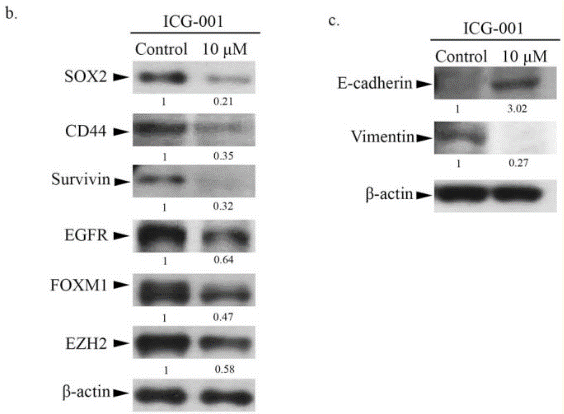
| Western blot | SOX-2 / CD44 / Survivin / EGFR / FOXM1 / EZH2 / Vimentin pβ-catenin beta-catenin / F-actin ABC / Beta-catenin / E-cadherin / N-cadherin / MMP-9 / c-MYC / Actin / Histone H3 CCNB1 / Cyclin D1 |
|
25897700 |
Technische ondersteuning
Tel: +1-832-582-8158 Ext:3
Als u nog andere vragen heeft, laat dan een bericht achter.
Veelgestelde vragen
Vraag 1:
If the compound is stored in DMSO at -80, how long would it be stable? For cell culture, how long should I change for the fresh medium with it?
Antwoord:
It in DMSO solution can be stored at 4 degree for 1 week and -20 degree for 1 month. The best storage condition is solid powder, even at -80 the solution is not stable enough for long term storage. For cell culture, you need change medium every 48h.

Producten zijn uitsluitend voor onderzoeksdoeleinden. Niet voor menselijk gebruik. Wij verkopen niet aan patiënten.
©Copyright 2013 Selleck Chemicals. Alle rechten voorbehouden.