Wnt proteins form a family of highly conserved secreted signaling molecules that regulate cell-to-cell interactions during embryogenesis. Wnt signalling pathway plays a key role in the development of CSC(Cancer stem cell) and it may be a significant step in the development of a large number of tomours. As currently understood, Wnt proteins bind to receptors of the Frizzled and LRP families on the cell surface. [show the full text]

Wnt/beta-catenin remmers/activatoren (Wnt/beta-catenin Inhibitors/Activators)
Overige Stem Cells & Wnt Inhibitoren
| Cat.nr. | Productnaam | Informatie | Citaties van productgebruik | Productvalidaties |
|---|---|---|---|---|
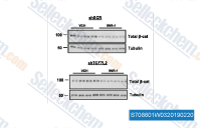
| S7086 | IWR-1-endo | IWR-1-endo (endo-IWR 1, IWR-1) is een Wnt-pathwayremmer met een IC50 van 180 nM in L-cellen die Wnt3A tot expressie brengen, induceert Axin2-eiwitniveaus en bevordert β-cateninefosforylering door Axin-gescaffolde afbraakcomplexen te stabiliseren. |
|
|
| S8968 | PRI-724 (Foscenvivint) | Foscenvivint (PRI-724) is een potente en specifieke remmer die de interactie van β-catenine en CBP verstoort. |
|
|
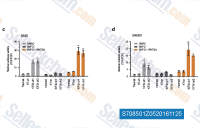
| S7085 | IWP-2 | IWP-2 is een remmer van Wnt-verwerking en -secretie met een IC50 van 27 nM in een celvrije assay, selectieve blokkering van Porcn-gemedieerde Wnt-palmitoylering, beïnvloedt Wnt/β-catenine in het algemeen niet en vertoont geen effect tegen Wnt-gestimuleerde cellulaire responsen. IWP-2 remt specifiek CK1δ. |
|
|
| S0733 | Tegatrabetan (BC-2059) | Tegatrabetan (BC-2059, Tegavivint), een antagonist van β-Catenine, verstoort de binding van β-catenine met het scaffold-eiwit transducine β-like 1 (TBL1) en de proteasomale afbraak, wat leidt tot een daling van de nucleaire niveaus van β-catenine. |
|
|
| S3842 | Isoquercitrin | Isoquercitrin (Hirsutrin, 3-Glucosylquercetin, Quercetin 3-o-glucopyranoside), een flavonoïde verbinding met antikankeractiviteit geïsoleerd uit Bidens bipinnata L, is een remmer van Wnt/ A-catenine die stroomafwaarts van de nucleaire translocatie van A-catenine werkt. |
|
|
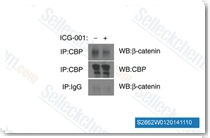
| S2662 | ICG-001 | ICG-001 antagoniseert de Wnt/β-catenine/TCF-gemedieerde transcriptie en bindt specifiek aan CREB-bindend eiwit (CBP) met een IC50 van 3 μM, maar is niet de gerelateerde transcriptionele coactivator p300. ICG-001 induceert apoptose. |
|
|
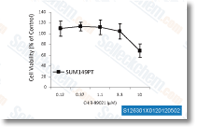
| S1263 | CHIR-99021 (Laduviglusib) | Laduviglusib (CHIR-99021, CT99021) is een GSK-3α en GSK-3β remmer met IC50-waarden van respectievelijk 10 nM en 6,7 nM. Het vertoont geen kruisreactiviteit tegen cycline-afhankelijke kinasen (CDK's) en toont een 350-voudige selectiviteit voor GSK-3β vergeleken met CDK's. Deze verbinding functioneert als een Wnt/β-catenin activator en induceert autophagy. |
|
|
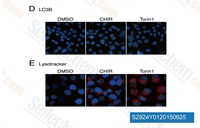
| S2924 | Laduviglusib (CHIR-99021) Hydrochloride | Laduviglusib (CHIR-99021; CT99021) HCl is het hydrochloride van CHIR-99021, een GSK-3α/β-remmer met een IC50 van 10 nM/6.7 nM; CHIR-99021 vertoont een meer dan 500-voudige selectiviteit voor GSK-3 ten opzichte van zijn nauwste homologen Cdc2 en ERK2. CHIR-99021 is een krachtige farmacologische activator van de Wnt/beta-catenin-signaalroute. CHIR-99021 redt significant licht-geïnduceerde autophagy en verhoogt GR, RORα en autofagie-gerelateerde eiwitten. |
|
|
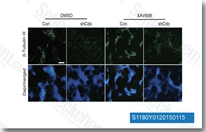
| S1180 | XAV-939 | XAV-939 (NVP-XAV939) remt selectief Wnt/β-catenine-gemedieerde transcriptie door tankyrase1/2-remming met een IC50 van 11 nM/4 nM in celvrije assays, reguleert axine-niveaus en beïnvloedt CRE, NF-κB of TGF-β niet. |
|
|
| S5992 | Heparan Sulfate | Heparan sulfate (HS, Heparitin sulfate, Alpha-idosane, HHS 5, N-Acetylheparan Sulfate, Suleparoid, Tavidan), een bestanddeel van HS-proteoglycanen (HSPG's), is een lineair polysaccharide dat aanwezig is op het celoppervlak. Heparan sulfate beïnvloedt de bindingsaffiniteit van intestinale epitheelcellen (IEC's) aan Wnt, waardoor de activering van canonische Wnt-signalering wordt bevorderd en de regeneratie van dunnedarmcrypten na epitheliale schade wordt vergemakkelijkt. |
|
|
The Wnt/β-catenin signalling pathway is an important mechanism of study for researchers of human diseases as it plays a role in oncology when overactivated, however, reduced signalling of this pathway also results in abnormal bone development and neurodegenerative illnesses. Depending on the indication of use, development of inhibitors or activators of the Wnt/β-catenin signalling pathway is an important area of focus.
Normally, regulation of the Wnt/β-catenin signalling pathway occurs by a large protein assembly called the β-catenin destruction complex that maintains low concentrations of β-catenin in the cytoplasm, and consequently in the nucleus. The β-catenin destruction complex is comprised of glycogen synthase kinase 3 (GSK3α/ GSK3β), casein kinase Iα (CKIα), Axin1/Axin2 scaffolding, and adenomatous polyposis coli (APC) – a tumor suppressor protein. Recruitment of β-catenin to the destruction complex leads to the phosphorylation of β-catenin N-terminus residues by CKIα and GSK3, following which ubiquitination and degradation events occur. Sequestering β-catenin at several N-terminal serine and threonine residues to the β-catenin destruction complex are Axin and APC. Similarly, it is believed these constituents of the β-catenin destruction complex regulate β-catenin efflux from the nucleus. The low concentration of β-catenin in the cell restricts β-catenin to the essential role of cadherin-mediated cell adhesion. An additional mechanism controlling the expression of Wnt signalling in the cell involves the inhibition of Wnt specific gene transcription by the T-cell factor (TCF) family of proteins.[1]
Activation of the Wnt/β-catenin signalling pathway is signified by the formation of a “Wnt signalosome” – a large protein complex that develops following the recognition of Wnt protein on the cell surface by a set of proteins called the seven-pass transmembrane Frizzled (Fz) family and its co-receptor, low density lipoprotein receptor related protein (LRP5/LRP6).ii The Wnt signalosome inhibits the activity of the β-catenin destruction complex by recruiting several components of the destruction complex to the membrane. As a consequence, the buildup of β-catenin’s unphosphorylated form results in the cytoplasm and subsequently in the nucleus. It is in the nucleus where rising concentrations of β-catenin combine with TCF proteins to transform this protein from an inhibitory protein to an activator of Wnt-signalling pathway by encouraging the transcription of the Wnt-responsive gene.[1]
Among cancer research, Wnt/β-catenin signalling is an area of focus since loss-of-function mutations in the APC gene results in β-catenin stabilization. Deletions within a chromosomal region containing the APC gene is understood to be associated with a hereditary disease known as familial adenomatous polyposis that yield intestinal polyps in large numbers that ultimately gives rise to tumors. Alternatively, mutations that promote gain-of-function of the APC gene inhibit the β-catenin destruction complex from limiting β-catenin concentrations in the cell. Additionally, some cancers have been correlated to a loss of Axin1 or Axin2 function. Overexpression of the Wnt/ β-catenin signalling pathway results in the constitutive activation of c-myc, and is most commonly linked to colorectal cancer.[2]
Since the Wnt/β-catenin signalling pathway plays a critical role in cancer, clinical research has yielded several new targets that may positively influence Wnt/β-catenin signalling where its absence is related to disease. Potential new drug targets include two lipid kinases that were found with the accumulation of β-catenin among HEK293T cells transfected with short inhibitory RNAs (siRNAs) targeting human kinases, these include: (1) phosphatidylinositol 4-kinase type IIα (PI4KIIα), and (2) phosphatidylinositol-4-phosphate 5-kinase type Iβ (PIP5Kiβ). Additionally, three human homologs of Drosophila PAR-1 can also provide useful drug targets as these elements activate Wnt/β-catenin signalling pathway as well.[2]
There are many enzymes involved in the Wnt/β-catenin signalling pathway and knowing whether activation or repression is best suited will determine the molecular strategy to explore for therapeutic benefit.

Producten zijn uitsluitend voor onderzoeksdoeleinden. Niet voor menselijk gebruik. Wij verkopen niet aan patiënten.
©Copyright 2013 Selleck Chemicals. Alle rechten voorbehouden.