
alleen voor onderzoeksdoeleinden
PF-573228 FAK inhibitor
Cat.nr.S2013
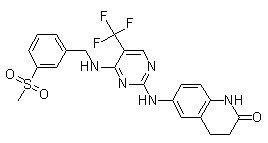
Chemische structuur
Molecuulgewicht: 491.49
Kwaliteitscontrole
| Gerelateerde doelwitten | EGFR VEGFR JAK PDGFR FGFR Src HIF FLT FLT3 HER2 |
|---|---|
| Overig FAK Inhibitoren | Defactinib (VS-6063) PF-562271 (VS-6062) VS-4718 (PND-1186) PF-562271 HCl PF-562271 Besylate TAE226 (NVP-TAE226) GSK2256098 PF-431396 Y15 Solanesol (Nonaisoprenol) |
Celkweek, behandeling & werkzame concentratie
| Cellijnen | Assaytype | Concentratie | Incubatietijd | Formulering | Activiteitsbeschrijving | PMID |
|---|---|---|---|---|---|---|
| A431 | Kinase assay | ~10 μM | DMSO | inhibits FAK phosphorylation with IC50 of 11 nM | 17395594 | |
| REF52 | Kinase assay | ~10 μM | DMSO | inhibits the phosphorylation of FAK Tyr397 with IC50 of ~100 nM | 17395594 | |
| PC3 | Kinase assay | ~10 μM | DMSO | inhibits the phosphorylation of FAK Tyr397 with IC50 of 100 nM | 17395594 | |
| SKOV-3 | Kinase assay | ~10 μM | DMSO | inhibits the phosphorylation of FAK Tyr397 with IC50 of 50 nM | 17395594 | |
| L3.6p1 | Kinase assay | ~10 μM | DMSO | inhibits the phosphorylation of FAK Tyr397 with IC50 of 300 nM | 17395594 | |
| F-G | Kinase assay | ~10 μM | DMSO | inhibits the phosphorylation of FAK Tyr397 with IC50 of 30 nM | 17395594 | |
| MDCK | Kinase assay | ~10 μM | DMSO | inhibits the phosphorylation of FAK Tyr397 with IC50 of 500 nM | 17395594 | |
| PC3 | Growth inhibitory assay | 10 μM | DMSO | significantly inhibits cell growth. | 17395594 | |
| REF52 | Growth inhibitory assay | 10 μM | DMSO | significantly inhibits cell growth. | 17395594 | |
| MDCK | Apoptosis assay | 10 μM | DMSO | induces apoptosis | 17395594 | |
| REF52 | Apoptosis assay | 10 μM | DMSO | induces apoptosis | 17395594 | |
| REF52 | Function assay | 10 μM | DMSO | blocks serum and FN-stimulated migration | 17395594 | |
| platelet | Function assay | 1 μM | DMSO | inhibits platelet aggregation and spreading | 19716803 | |
| platelet | Function assay | 1 μM | DMSO | leads to inhibition of PAK and AKT | 19716803 | |
| platelet | Function assay | 1 μM | DMSO | blocks calcium mobilization and dense granule secretion | 19716803 | |
| 4T1 | Function assay | DMSO | abolishes the interaction between β3 integrin and TβR-II | 19740433 | ||
| MCF7 | Kinase assay | ~10 μM | DMSO | inhibits the phosphorylation of FAK Tyr397 with IC50 of 430 nM | 20354780 | |
| TamR | Kinase assay | ~10 μM | DMSO | inhibits the phosphorylation of FAK Tyr397 with IC50 of 50 nM | 20354780 | |
| FasR | Kinase assay | ~10 μM | DMSO | inhibits the phosphorylation of FAK Tyr397 with IC50 of 130 nM | 20354780 | |
| TamR | Function assay | 1 μM | DMSO | inhibits cell migration | 20354780 | |
| FasR | Function assay | 1 μM | DMSO | inhibits cell migration | 20354780 | |
| endothelial cell | Kinase assay | 40 nM | DMSO | inhibits H2O2-induced phosphorylation of FAK | 21212402 | |
| endothelial cell | Function assay | 40 nM | DMSO | inhibits H2O2-induced stress fiber formation | 21212402 | |
| endothelial cell | Apoptosis assay | 40 nM | DMSO | inhibits apoptosis | 21212402 | |
| GH3 | Function assay | 3 μM | DMSO | increases IK(Ca) amplitude | 21925512 | |
| GH3 | Function assay | 3 μM | DMSO | enhances BKCa-channel activity | 21925512 | |
| HUVEC | cytotoxicity assay | ~10 μM | DMSO | impairs endothelial cell viability | 22075057 | |
| HUVEC | Kinase assay | 5 μM | DMSO | inhibits FAK kinase activity | 22075057 | |
| HUVEC | Function assay | 5 μM | DMSO | induces cell cycle arrest | 22075057 | |
| HUVEC | Apoptosis assay | 5 μM | DMSO | induces apoptosis | 22075057 | |
| HUVEC | Function assay | 5 μM | DMSO | impedes endothelial cell migration and alters the cellular actin cytoskeleton | 22075057 | |
| HUVEC | Function assay | 5 μM | DMSO | blocks HUVEC sprouting on collagen I gels | 22075057 | |
| human peripheral blood T cells | Kinase assay | ~10 μM | DMSO | inhibits site-specific phosphorylation of FAK | 23928188 | |
| human peripheral blood T cells | Function assay | ~10 μM | DMSO | impairs TCR-induced T cell morphological changes and alters activity of RhoA | 23928188 | |
| human peripheral blood T cells | Function assay | ~10 μM | DMSO | inhibits phosphorylation of ZAP-70 and LAT | 23928188 | |
| human peripheral blood T cells | Function assay | ~10 μM | DMSO | impairs Antigen-dependent T cell conjugation | 23928188 | |
| U-2 OS | qHTS assay | qHTS of pediatric cancer cell lines to identify multiple opportunities for drug repurposing: Primary screen for U-2 OS cells | 29435139 | |||
| A673 | qHTS assay | qHTS of pediatric cancer cell lines to identify multiple opportunities for drug repurposing: Primary screen for A673 cells | 29435139 | |||
| Saos-2 | qHTS assay | qHTS of pediatric cancer cell lines to identify multiple opportunities for drug repurposing: Primary screen for Saos-2 cells | 29435139 | |||
| BT-37 | qHTS assay | qHTS of pediatric cancer cell lines to identify multiple opportunities for drug repurposing: Primary screen for BT-37 cells | 29435139 | |||
| RD | qHTS assay | qHTS of pediatric cancer cell lines to identify multiple opportunities for drug repurposing: Primary screen for RD cells | 29435139 | |||
| SK-N-SH | qHTS assay | qHTS of pediatric cancer cell lines to identify multiple opportunities for drug repurposing: Primary screen for SK-N-SH cells | 29435139 | |||
| MG 63 (6-TG R) | qHTS assay | qHTS of pediatric cancer cell lines to identify multiple opportunities for drug repurposing: Primary screen for MG 63 (6-TG R) cells | 29435139 | |||
| NB1643 | qHTS assay | qHTS of pediatric cancer cell lines to identify multiple opportunities for drug repurposing: Primary screen for NB1643 cells | 29435139 | |||
| OHS-50 | qHTS assay | qHTS of pediatric cancer cell lines to identify multiple opportunities for drug repurposing: Primary screen for OHS-50 cells | 29435139 | |||
| SJ-GBM2 | qHTS assay | qHTS of pediatric cancer cell lines to identify multiple opportunities for drug repurposing: Primary screen for SJ-GBM2 cells | 29435139 | |||
| SK-N-MC | qHTS assay | qHTS of pediatric cancer cell lines to identify multiple opportunities for drug repurposing: Primary screen for SK-N-MC cells | 29435139 | |||
| NB-EBc1 | qHTS assay | qHTS of pediatric cancer cell lines to identify multiple opportunities for drug repurposing: Primary screen for NB-EBc1 cells | 29435139 | |||
| LAN-5 | qHTS assay | qHTS of pediatric cancer cell lines to identify multiple opportunities for drug repurposing: Primary screen for LAN-5 cells | 29435139 | |||
| Klik om meer experimentele gegevens over cellijnen te bekijken | ||||||
Chemische informatie, opslag en stabiliteit
| Molecuulgewicht | 491.49 | Formule | C22H20F3N5O3S |
Opslag (vanaf de datum van ontvangst) | |
|---|---|---|---|---|---|
| CAS-nr. | 869288-64-2 | SDF downloaden | Opslag van stamoplossingen |
|
|
| Synoniemen | N/A | Smiles | CS(=O)(=O)C1=CC=CC(=C1)CNC2=NC(=NC=C2C(F)(F)F)NC3=CC4=C(C=C3)NC(=O)CC4 | ||
Oplosbaarheid
|
In vitro |
DMSO
: 26 mg/mL
(52.9 mM)
Water : Insoluble Ethanol : Insoluble |
Molariteitscalculator
|
In vivo |
|||||
In vivo formulatiecalculator (heldere oplossing)
Stap 1: Voer onderstaande informatie in (Aanbevolen: een extra dier om rekening te houden met verlies tijdens het experiment)
Stap 2: Voer de in vivo formulering in (Dit is alleen de calculator, geen formulering. Neem eerst contact met ons op als er geen in vivo formulering is in de sectie oplosbaarheid.)
Berekeningsresultaten:
Werkconcentratie: mg/ml;
Methode voor het bereiden van DMSO-moedervloeistof: mg geneesmiddel vooropgelost in μL DMSO ( Concentratie moedervloeistof mg/mL, Neem eerst contact met ons op als de concentratie de DMSO-oplosbaarheid van de batch van het geneesmiddel overschrijdt. )
Methode voor het bereiden van in vivo formulering: Neem μL DMSO moedervloeistof, voeg daarna toeμL PEG300, mengen en verhelderen, daarna toevoegenμL Tween 80, mengen en verhelderen, daarna toevoegen μL ddH2O, mengen en verhelderen.
Methode voor het bereiden van in vivo formulering: Neem μL DMSO moedervloeistof, voeg daarna toe μL Maïsolie, mengen en verhelderen.
Opmerking: 1. Zorg ervoor dat de vloeistof helder is voordat u het volgende oplosmiddel toevoegt.
2. Zorg ervoor dat u het/de oplosmiddel(en) in de juiste volgorde toevoegt. U moet ervoor zorgen dat de verkregen oplossing, bij de vorige toevoeging, een heldere oplossing is voordat u verdergaat met het toevoegen van het volgende oplosmiddel. Fysieke methoden zoals vortexen, ultrasoon of een warmwaterbad kunnen worden gebruikt om het oplossen te bevorderen.
Werkingsmechanisme
| Targets/IC50/Ki |
FAK
(Cell-free assay) 4 nM
|
|---|---|
| In vitro |
PF-573228 blokkeert de fosforylering van FAK Tyr397 in REF52-cellen, PC3-cellen, SKOV-3-cellen, L3.6p1 en F-G, MDCK-cellen met een IC50 van 30-500 nM. Deze verbinding (1 μM) met 80% inhibitie van FAK-fosforylering slaagt er echter niet in de celgroei of apoptosis te remmen. Een vergelijkbare behandeling van cellen met deze chemische stof resulteerde in remming van serum- of FN-gerichte migratie en verminderde focale adhesie-omzet.
|
| Kinase Assay |
Affiniteitsbepaling
|
|
Gezuiverd geactiveerd FAK kinase-domein (aminozuren 410–689) wordt gedurende 15 min gereageerd met 50 μM ATP en 10 μg/well van een willekeurig peptidepolymeer van Glu en Tyr (molaire verhouding van 4:1), poly(Glu/Tyr) in kinasebuffer (50 mM HEPES, pH 7,5, 125 mM NaCl, 48 mM MgCl2). Fosforylering van poly(Glu/Tyr) wordt uitgedaagd met serieel verdunde verbindingen in 1/2-Log concentraties, beginnend bij een topconcentratie van 1 μM. Elke concentratie wordt in drievoud uitgevoerd. Fosforylering van poly(Glu/Tyr) wordt gedetecteerd met een algemeen anti-fosfo-tyrosine (PY20) antilichaam, gevolgd door mierikswortelperoxidase-geconjugeerd geiten-anti-muis IgG antilichaam. Het standaard mierikswortelperoxidase-substraat 3, 3
|
|
| In vivo |
Remming van FAK door PF-573,228 bij Ctrl-MT-muizen leidt tot een significante onderdrukking van mammatumorgenese en longmetastase. Daarentegen had de behandeling van MFCKO-MT-muizen met deze verbinding geen invloed op de initiatie van mammatumoren bij deze muizen, zoals verwacht zou worden door de afwezigheid van FAK in de mamma-epitheelcellen van deze muizen .
|
Referenties |
|
Toepassingen
| Methoden | Biomarkers | Afbeeldingen | PMID |
|---|---|---|---|
| Western blot | cyclin B1 p-FAK / FAK Lamin A / Lamin C |

|
30761269 |
| Immunofluorescence | FAK / F-actin Emerin |
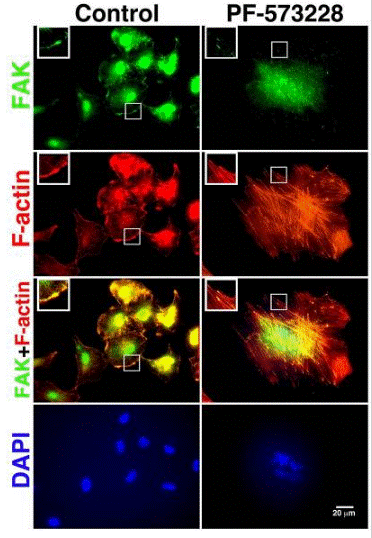
|
30761269 |
| Growth inhibition assay | Cell viability |
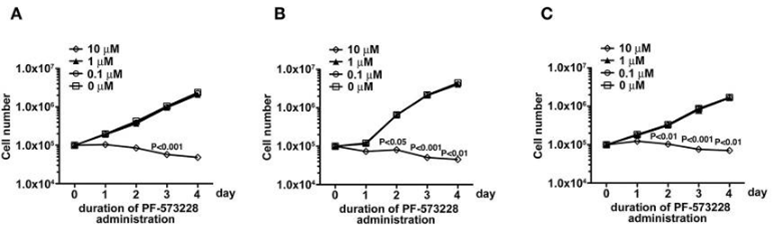
|
30761269 |
Technische ondersteuning
Tel: +1-832-582-8158 Ext:3
Als u nog andere vragen heeft, laat dan een bericht achter.
Veelgestelde vragen
Vraag 1:
Would you please let me know the detail of how to dissolve it for in vivo study (oral administration)? This compound is referred to as Catalog No.S2013.
Antwoord:
A suspension of this compound in 30% PEG400+0.5% Tween80+ 5% Propylene glycol at 30mg/ml is fine for oral gavage.

Producten zijn uitsluitend voor onderzoeksdoeleinden. Niet voor menselijk gebruik. Wij verkopen niet aan patiënten.
©Copyright 2013 Selleck Chemicals. Alle rechten voorbehouden.