
alleen voor onderzoeksdoeleinden
CUDC-101 HDAC remmer
Cat.nr.S1194
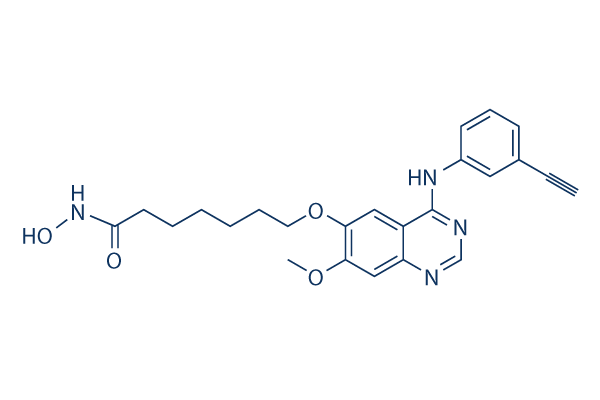
Chemische structuur
Molecuulgewicht: 434.49
Kwaliteitscontrole
Celkweek, behandeling & werkzame concentratie
| Cellijnen | Assaytype | Concentratie | Incubatietijd | Formulering | Activiteitsbeschrijving | PMID |
|---|---|---|---|---|---|---|
| human SK-BR-3 cells | Proliferation assay | Antiproliferative activity against human SK-BR-3 cells after hrs by ATP content assay, IC50=0.04 μM | ||||
| MDA-MB-231 cells | Proliferation assay | Antiproliferative activity against human MDA-MB-231 cells after hrs by ATP content assay, IC50=0.1 μM | ||||
| human HepG2 cells | Proliferation assay | Antiproliferative activity against human HepG2 cells after hrs by ATP content assay, IC50=0.13 μM | ||||
| human SKHEP1 cells | Proliferation assay | Antiproliferative activity against human SKHEP1 cells after hrs by ATP content assay, IC50=0.22 μM | ||||
| human Hep3B2 cells | Proliferation assay | Antiproliferative activity against human Hep3B2 cells after hrs by ATP content assay, IC50=0.23 μM | ||||
| human BxPC3 cells | Proliferation assay | Antiproliferative activity against human BxPC3 cells after hrs by ATP content assay, IC50=0.27 μM | ||||
| human NCI-H358 cells | Proliferation assay | Antiproliferative activity against human NCI-H358 cells after hrs by ATP content assay, IC50=0.4 μM | ||||
| human MCF7 cells | Proliferation assay | Antiproliferative activity against human MCF7 cells after hrs by ATP content assay, IC50=0.55 μM | ||||
| human HCC827 cells | Proliferation assay | Antiproliferative activity against human HCC827 cells after hrs by ATP content assay, IC50=0.6 μM | ||||
| human H460 cells | Proliferation assay | Antiproliferative activity against human H460 cells after hrs by ATP content assay, IC50=0.7 μM | ||||
| human Capan1 cells | Proliferation assay | Antiproliferative activity against human Capan1 cells after hrs by ATP content assay, IC50=0.8 μM | ||||
| Klik om meer experimentele gegevens over cellijnen te bekijken | ||||||
Chemische informatie, opslag en stabiliteit
| Molecuulgewicht | 434.49 | Formule | C24H26N4O4 |
Opslag (vanaf de datum van ontvangst) | |
|---|---|---|---|---|---|
| CAS-nr. | 1012054-59-9 | SDF downloaden | Opslag van stamoplossingen |
|
|
| Synoniemen | N/A | Smiles | COC1=C(C=C2C(=C1)N=CN=C2NC3=CC=CC(=C3)C#C)OCCCCCCC(=O)NO | ||
Oplosbaarheid
|
In vitro |
DMSO
: 43 mg/mL
(98.96 mM)
Water : Insoluble Ethanol : Insoluble |
Molariteitscalculator
|
In vivo |
|||||
In vivo formulatiecalculator (heldere oplossing)
Stap 1: Voer onderstaande informatie in (Aanbevolen: een extra dier om rekening te houden met verlies tijdens het experiment)
Stap 2: Voer de in vivo formulering in (Dit is alleen de calculator, geen formulering. Neem eerst contact met ons op als er geen in vivo formulering is in de sectie oplosbaarheid.)
Berekeningsresultaten:
Werkconcentratie: mg/ml;
Methode voor het bereiden van DMSO-moedervloeistof: mg geneesmiddel vooropgelost in μL DMSO ( Concentratie moedervloeistof mg/mL, Neem eerst contact met ons op als de concentratie de DMSO-oplosbaarheid van de batch van het geneesmiddel overschrijdt. )
Methode voor het bereiden van in vivo formulering: Neem μL DMSO moedervloeistof, voeg daarna toeμL PEG300, mengen en verhelderen, daarna toevoegenμL Tween 80, mengen en verhelderen, daarna toevoegen μL ddH2O, mengen en verhelderen.
Methode voor het bereiden van in vivo formulering: Neem μL DMSO moedervloeistof, voeg daarna toe μL Maïsolie, mengen en verhelderen.
Opmerking: 1. Zorg ervoor dat de vloeistof helder is voordat u het volgende oplosmiddel toevoegt.
2. Zorg ervoor dat u het/de oplosmiddel(en) in de juiste volgorde toevoegt. U moet ervoor zorgen dat de verkregen oplossing, bij de vorige toevoeging, een heldere oplossing is voordat u verdergaat met het toevoegen van het volgende oplosmiddel. Fysieke methoden zoals vortexen, ultrasoon of een warmwaterbad kunnen worden gebruikt om het oplossen te bevorderen.
Werkingsmechanisme
| Targets/IC50/Ki |
EGFR
(Cell-free assay) 2.4 nM
HDAC
(Cell-free assay) 4.4 nM
HDAC1
(Cell-free assay) 4.5 nM
HDAC6
(Cell-free assay) 5.1 nM
HDAC3
(Cell-free assay) 9.1 nM
HDAC5
(Cell-free assay) 11.4 nM
HDAC2
(Cell-free assay) 12.6 nM
HDAC4
(Cell-free assay) 13.2 nM
HER2
(Cell-free assay) 15.7 nM
HDAC10
(Cell-free assay) 26.1 nM
HDAC9
(Cell-free assay) 67.2 nM
HDAC8
(Cell-free assay) 79.8 nM
HDAC7
(Cell-free assay) 373 nM
|
|---|---|
| In vitro |
Specifiek voor klasse I en klasse II HDAC's remt CUDC-101 geen klasse III Sir-type HDAC's. Deze verbinding vertoont een zwakke activiteit tegen andere proteïnekinasen, waaronder KDR/VEGFR2, Lyn, Lck, Abl-1, FGFR-2, Flt-3 en Ret met IC50 van respectievelijk 0,85 μM, 0,84 μM, 5,91 μM, 2,89 μM, 3,43 μM, 1,5 μM en 3,2 μM. Het vertoont brede antiproliferatieve activiteit in vele menselijke kankerceltypen met IC50 van 0,04-0,80 μM, waarbij het in de meeste gevallen een hogere potentie en combinaties van vorinostat vertoont. Deze chemische stof remt kankercellijnen krachtig. Het remt de resistente EGFR-mutant T790M, hoewel de effecten onvolledig zijn met een Amax van ~60% van de piek-enzymactiviteit na remming. Deze verbindingbehandeling verhoogt de acetylering van histone H3 en H4, evenals de acetylering van niet-histonsubstraten van HDAC, zoals p53 en α-tubuline, op een dosisafhankelijke manier in verschillende kankercellijnen. Het onderdrukt ook HER3-expressie, Met-amplificatie en AKT-reactivering in tumorcellen. |
| Kinase Assay |
HDAC-, EGFR- en HER2-remmingsassays
|
|
De activiteiten van klasse I en II HDAC's worden beoordeeld met behulp van het Biomol Color de Lys-systeem. Kortom, HeLa-celkernextracten worden gebruikt als bron van HDAC's. Verschillende concentraties CUDC-101 worden toegevoegd aan HeLa-celkernextracten in aanwezigheid van een colorimetrisch kunstmatig substraat. Ontwikkelaar wordt toegevoegd aan het einde van de assay en de enzymactiviteit wordt gemeten in de Wallac Victor II 1420 microplaatlezer bij 405 nM. EGFR- en HER2-kinaseactiviteit worden gemeten met behulp van HTScan EGF-receptor en HER2-kinaseassaykits. Kortom, het GST-EGFR-fusie-eiwit wordt geïncubeerd met synthetisch gebiotinyleerd peptidesubstraat en verschillende concentraties van deze verbinding in aanwezigheid van 400 mM ATP. Gefosforyleerd substraat wordt gevangen met met streptavidine gecoate 96-well platen. Het niveau van fosforylering wordt gecontroleerd door anti-fosfo-tyrosine- en europium-gelabelde secundaire antilichamen. De versterkingsoplossing wordt aan het einde van de assay toegevoegd en de enzymactiviteit wordt gemeten in de Wallac Victor II 1420 microplaatlezer bij 615 nM.
|
|
| In vivo |
Toediening van CUDC-101 in een dosering van 120 mg/kg/dag induceert tumorregressie in het Hep-G2 leverkankermodel, wat effectiever is bij de maximaal getolereerde dosis (25 mg/kg/dag) en vorinostat bij een equimolaire concentratiedosis (72 mg/kg/dag). Deze verbinding remt de groei van -gevoelige H358 NSCLC-xenografts op een dosisafhankelijke manier. Het toont ook een krachtige remming van tumorgroei in het -resistente A549 NSCLC-xenograftmodel. Deze chemische stof produceert significante tumorregressie in het -resistente, HER2-negatieve, EGFR-overexpresserende MDA-MB-468 borstkankermodel en het EGFR-overexpresserende CAL-27 hoofd- en halsplaveiselcelcarcinoom (HNSCC)-model. Bovendien remt het tumorgroei in de K-ras-mutante HCT116 colorectale en EGFR/HER2 (neu)-expresserende HPAC pancreaskankermodellen. |
Referenties |
|
Informatie over klinische proeven
(gegevens van https://clinicaltrials.gov, bijgewerkt op 2024-05-22)
| NCT-nummer | Werving | Aandoeningen | Sponsor/medewerkers | Startdatum | Fasen |
|---|---|---|---|---|---|
| NCT01702285 | Terminated | Cancer |
Curis Inc. |
September 2012 | Phase 1 |
| NCT01384799 | Completed | Head and Neck Cancer |
Curis Inc. |
November 2011 | Phase 1 |
| NCT00728793 | Completed | Tumors |
Curis Inc. |
August 2008 | Phase 1 |
Technische ondersteuning
Tel: +1-832-582-8158 Ext:3
Als u nog andere vragen heeft, laat dan een bericht achter.

Producten zijn uitsluitend voor onderzoeksdoeleinden. Niet voor menselijk gebruik. Wij verkopen niet aan patiënten.
©Copyright 2013 Selleck Chemicals. Alle rechten voorbehouden.