AMPK (AMP-activated protein kinase) plays a pivotal role in the regulation of cellular energy homeostasis as the principal energy sensor in most eukaryotic cells. In response to stress, AMPK activation switches on catabolic pathways that generate ATP while simultaneously inactivating biosynthetic pathways that consume ATP. [show the full text]

AMPK activatoren/remmers (AMPK Activators/Inhibitors)
| Cat.nr. | Productnaam | Informatie | Citaties van productgebruik | Productvalidaties |
|---|---|---|---|---|
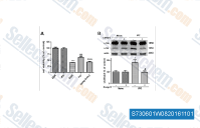
| S7306 | Dorsomorphin Dihydrochloride | Dorsomorphin 2HCl is een potente, reversibele, selectieve AMPK-remmer met een Ki van 109 nM in celvrije assays, die geen significante remming vertoont van verschillende structureel verwante kinasen, waaronder ZAPK, SYK, PKCθ, PKA en JAK3. Remt ook de activiteit van de type I BMP-receptor. Dorsomorphin induceert autophagy in kankercellijnen. |
|
|
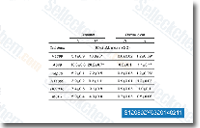
| S1208 | Doxorubicin (Adriamycin) Hydrochloride | Doxorubicin (DOX) HCl is een antibioticum dat humane DNA topoisomerase II remt met een IC50 van 2,67 μM. Doxorubicin vermindert de basale fosforylering van AMPK. Doxorubicin wordt gebruikt bij de gelijktijdige behandeling van HIV-geïnfecteerde patiënten, maar blijkt een hoog risico op HBV-reactivering met zich mee te brengen.Dit product kan neerslaan wanneer het wordt opgelost in PBS-oplossing. Het wordt aanbevolen de stamoplossing in zuiver water te bereiden en te verdunnen met zuiver water of fysiologische zoutoplossing om de werkzame oplossing te verkrijgen.Doxorubicin (Adriamycin) HCl kan worden gebruikt om diermodellen van nierziekten te induceren. |
|
|
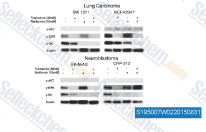
| S1950 | Metformin Hydrochloride | Metformin Hydrochloride (1,1-Dimethylbiguanide Hydrochloride) is een zeer effectief Antihyperglycemisch middel, dat voornamelijk hyperglycemie in hepatocyten vermindert door hepatische gluconeogenese (glucoseproductie door de lever) te onderdrukken. Het bevordert ook Mitophagy in mononucleaire cellen en induceert Apoptosis van longkankercellen door activering van de JNK/p38 MAPK pathway en GADD153. |
|
|
| S8161 | ON123300 | ON123300 is een potente en multi-gerichte kinaseremmer met IC50 van 3,9 nM, 5 nM, 26 nM, 26 nM, 9,2 nM en 11 nM voor respectievelijk CDK4, Ark5/NUAK1, PDGFRβ, FGFR1, RET (c-RET) en Fyn. |
|
|
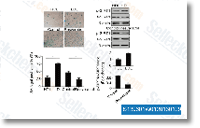
| S1396 | Resveratrol (trans-Resveratrol) | Resveratrol heeft een breed spectrum aan doelwitten, waaronder cyclo-oxygenasen (d.w.z. COX, IC50=1.1 μM), lipo-oxygenasen (LOX, IC50=2.7 μM), kinasen, sirtuïnes en andere eiwitten. Het heeft antikanker-, ontstekingsremmende, bloedsuikerverlagende en andere gunstige cardiovasculaire effecten. Resveratrol induceert mitofagie/autofagie en autofagie-afhankelijke apoptose. |
|
|
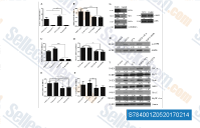
| S7840 | Dorsomorphin (Compound C) | Dorsomorphin is een potente, reversibele, selectieve AMPK-remmer met een Ki van 109 nM in celvrije assays, die geen significante remming vertoont van verschillende structureel gerelateerde kinasen, waaronder ZAPK, SYK, PKCθ, PKA en JAK3. Dorsomorphin remt selectief de BMP type I receptors ALK2, ALK3 and ALK6. Dorsomorphin wordt gebruikt bij het bevorderen van specifieke celdifferentiatie en het induceren van autofagie van kankercellijnen. Voor celtesten wordt de wateroplosbare S7306 Dorsomorphin (Compound C) 2HCl aanbevolen. |
|
|
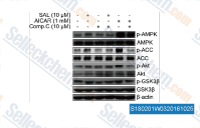
| S1802 | AICAR (Acadesine) | AICAR (Acadesine, NSC105823, AICA Riboside), een AMPK activator, resulteert in accumulatie van ZMP, wat het stimulerende effect van AMP op AMPK en AMPK kinase nabootst. Deze verbinding induceert mitophagy. Fase 3. |
|
|
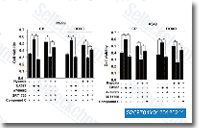
| S2697 | A-769662 | A-769662 is een potente, reversibele AMPK-activator met een EC50 van 0,8 μM in celvrije assays, met weinig effect op GPPase/FBPase-activiteit. |
|
|
| S5958 | Metformin (1,1-Dimethylbiguanide) | Metformin (1,1-Dimethylbiguanide), een veelgebruikt medicijn voor de behandeling van type 2 diabetes, activeert AMP-geactiveerd proteïne kinase (AMPK) in hepatocyten. Metformin bevordert mitophagy in mononucleaire cellen. Metformin induceert apoptose van longkankercellen door activering van de JNK/p38 MAPK route en GADD153. |
|
|
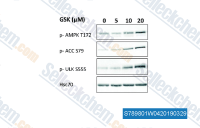
| S7898 | GSK621 | GSK621 is een specifieke en potente AMPK-activator. |
|
|
AMPK exists as a heterotrimeric protein complex composed of a catalytic α-subunit (α1 or α2) and regulatory β-subunit (β1 or β2) and γ- subunit (γ1, γ2 or γ3). The structure of the α-subunit consists of a conventional Ser/Thr kinase domain at the N-terminal, an auto-inhibitory domain (AID), an extended linker peptide and the α-subunit C-terminal domain (α-CTD). The β-subunit contains a carbohydrate-binding module (CBM), with the β-subunit C-terminal domain (β-CTD) interacting with both the α-CTD and the amino terminus of the γ-subunit, thus forming the core of the complex. The γ-subunit includes four tandem repeats of a sequence motif, termed a CBS repeat (cystathionine β-synthase, CBS1-4), that forms a flattened disk with one repeat in each quadrant to create four potential ligand binding sites in the centre (site 1-4). AMPK activity increases more than 100-fold when the conserved Thr172 residue in the activation loop of the catalytic α-subunit is phosphorylated by upstream AMPK kinases (AMPKK) such as LKB1 requiring the change in AMP or ADP levels, and CaMKKβ (CaMKK2) in response to increases in cell Ca2+. AMP binding to ligand binding site 1 of the γ subunit allosterically activates the AMPK complex by facilitating the phosphorylation of Thr172 in the catalytic α-subunit, whereas binding of AMP or ADP to site 3 modulates the phosphorylation state of Thr172. In addition to allosteric activation by AMP, the effects on phosphorylation and dephosphorylation of Thr172 can also be produced by ADP, which requires N-terminal myristylation of the β-subunit. [1][2]
AMPK is activated by various types of metabolic stress (glucose deprivation, hypoxia, ischemia, metabolic poisons, or muscle contraction), as well as drugs and xenobiotics (metformin, resveratrol, or berberine) through the classical or canonical mechanisms, which involve increases in cellular AMP, ADP or Ca2+. The metformin for the treatment of people with type 2 diabetes indirectly activates AMPK by increasing cellular AMP and ADP, usually by inhibiting mitochondrial ATP synthesis. Additionally, AMPK activated by resveratrol or metformin upregulates genes involved in oxidative metabolism and oxidative stress resistance by regulating transcription factors of the abnormal dauer formation 16 (DAF-16)/forkhead box O (FOXO) family, contributing to its effects on extending healthy lifespan. Some types of cellular stress such as reactive oxygen species (ROS) and DNA damaging agents (etoposide, doxorubicin and ionizing radiation) activate AMPK by non-canonical mechanisms that involve ATM rather than the increases in AMP, ADP or Ca2+ levels. Activation of AMPK enhances both the transcription and translocation of GLUT4, resulting in an increase in insulin-stimulated glucose uptake. In LKB1-knockout but not AMPKα1-knockout mice, the effects of both AICAR and contraction on glucose uptake are lost. In addition, AMPK also stimulates other catabolic processes such as fatty acid oxidation and glycolysis via inhibition of ACC2 and activation of PFKFB. AMPK is also involved in the regulation of mitochondrial biogenesis through the activation of PGC1α, and the turnover of mitochondria via the special form of autophagy termed mitophagy by activating ULK1, and subsequently triggering autophagy. In addition, mTOR complex-1 (TORC1) can be inhibited by AMPK mediated phosphorylation of both its upstream regulator, TSC2, and the TORC1 subunit Raptor. Consistent with its role in cellular energy homeostasis, AMPK also conserves ATP by switching off almost all anabolic pathways, including the biosynthesis of lipids, carbohydrates, proteins and ribosomal RNA. Moreover, AMPK also functions beyond metabolism through regulation of the cell cycle and modulation of membrane excitability. As LKB1 is a tumor suppressor and is frequently mutated in spontaneous cancers, AMPK-activating drugs such as metformin or A-769662 significantly protect against the development of cancer. [1][2]

Producten zijn uitsluitend voor onderzoeksdoeleinden. Niet voor menselijk gebruik. Wij verkopen niet aan patiënten.
©Copyright 2013 Selleck Chemicals. Alle rechten voorbehouden.