
alleen voor onderzoeksdoeleinden
Savolitinib (AZD6094) c-Met remmer
Cat.nr.S7674
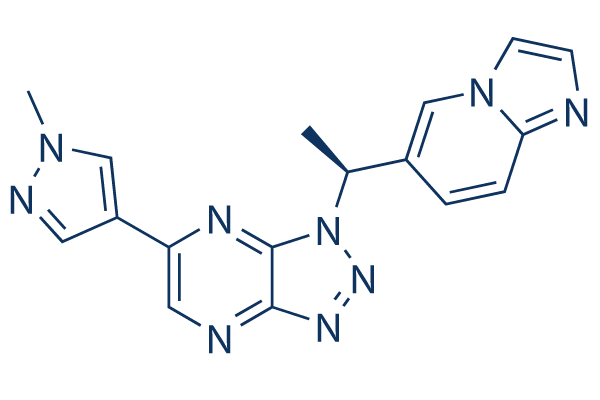
Chemische structuur
Molecuulgewicht: 345.36
Kwaliteitscontrole
| Gerelateerde doelwitten | EGFR VEGFR PDGFR FGFR Src MEK CSF-1R FLT3 HER2 c-Kit |
|---|---|
| Overig c-Met Inhibitoren | Tepotinib Dihexa SGX-523 PHA-665752 Foretinib SU11274 BMS-777607 JNJ-38877605 Tivantinib PF-04217903 |
Celkweek, behandeling & werkzame concentratie
| Cellijnen | Assaytype | Concentratie | Incubatietijd | Formulering | Activiteitsbeschrijving | PMID |
|---|---|---|---|---|---|---|
| NCI-H441 | Function assay | 1 h | Inhibition of c-Met autophosphorylation in human NCI-H441 cells for 1 hr by ELISA, IC50=0.003 μM | 25148209 | ||
| NCI-H441 | Proliferation assay | 72 h | Antiproliferative activity against human NCI-H441 cells assessed as HGF-induced proliferation after 72 hrs by MTT assay, IC50=0.006 μM | 25148209 | ||
| Klik om meer experimentele gegevens over cellijnen te bekijken | ||||||
Chemische informatie, opslag en stabiliteit
| Molecuulgewicht | 345.36 | Formule | C17H15N9 |
Opslag (vanaf de datum van ontvangst) | |
|---|---|---|---|---|---|
| CAS-nr. | 1313725-88-0 | SDF downloaden | Opslag van stamoplossingen |
|
|
| Synoniemen | HMPL-504, Volitinib | Smiles | CC(C1=CN2C=CN=C2C=C1)N3C4=NC(=CN=C4N=N3)C5=CN(N=C5)C | ||
Oplosbaarheid
|
In vitro |
DMSO
: 69 mg/mL
(199.79 mM)
Water : Insoluble Ethanol : Insoluble |
Molariteitscalculator
|
In vivo |
|||||
In vivo formulatiecalculator (heldere oplossing)
Stap 1: Voer onderstaande informatie in (Aanbevolen: een extra dier om rekening te houden met verlies tijdens het experiment)
Stap 2: Voer de in vivo formulering in (Dit is alleen de calculator, geen formulering. Neem eerst contact met ons op als er geen in vivo formulering is in de sectie oplosbaarheid.)
Berekeningsresultaten:
Werkconcentratie: mg/ml;
Methode voor het bereiden van DMSO-moedervloeistof: mg geneesmiddel vooropgelost in μL DMSO ( Concentratie moedervloeistof mg/mL, Neem eerst contact met ons op als de concentratie de DMSO-oplosbaarheid van de batch van het geneesmiddel overschrijdt. )
Methode voor het bereiden van in vivo formulering: Neem μL DMSO moedervloeistof, voeg daarna toeμL PEG300, mengen en verhelderen, daarna toevoegenμL Tween 80, mengen en verhelderen, daarna toevoegen μL ddH2O, mengen en verhelderen.
Methode voor het bereiden van in vivo formulering: Neem μL DMSO moedervloeistof, voeg daarna toe μL Maïsolie, mengen en verhelderen.
Opmerking: 1. Zorg ervoor dat de vloeistof helder is voordat u het volgende oplosmiddel toevoegt.
2. Zorg ervoor dat u het/de oplosmiddel(en) in de juiste volgorde toevoegt. U moet ervoor zorgen dat de verkregen oplossing, bij de vorige toevoeging, een heldere oplossing is voordat u verdergaat met het toevoegen van het volgende oplosmiddel. Fysieke methoden zoals vortexen, ultrasoon of een warmwaterbad kunnen worden gebruikt om het oplossen te bevorderen.
Werkingsmechanisme
| Targets/IC50/Ki |
p-Met
(Cell-free assay) 3 nM
c-Met
(Cell-free assay) 5 nM
|
|---|---|
| In vitro |
Volitinib heeft een uitstekende kinase-selectiviteit en uitstekende potentie. Volitinib vertoont een zeer selectief profiel over een panel van maagcellijnen, waarbij het de celgroei krachtig remt in alleen die lijnen met gedysreguleerde cMET (EC50-waarden 0,6 nM/L-12,5 nM/L). Volitinib heeft een hoge membraanpermeabiliteit zonder efflux-transport over Caco-2 celmonolagen en vertoont een verwaarloosbare P-gp-remming (IC50 > 17 M). Volitinib vertoont geen significante reversibele of mechanisme-gebaseerde CYP-remming in humane levermicrosomen, en geen inductie van CYP1A2 en CYP3A4 in humane hepatocyten. |
| In vivo |
In een farmacokinetische studie bij muizen (mannelijke ICR-muizen) bedraagt de klaring van de verbinding 4,28 L/(h·kg) en de halfwaardetijd 1,7 uur. Ondanks de matige orale biologische beschikbaarheid (F = 27,2%), is de algehele plasmaspiegels veel hoger. Volitinib toont dosisafhankelijke tumorgeremdheid in een U87MG subcutaan xenograftmodel. De behandeling leidt tot farmacodynamische modulatie van c-MET signalering en krachtige tumorstase in 3/3 cMET-gedysreguleerde maagkanker patiënt-afgeleide tumorxenograftmodellen, maar heeft verwaarloosbare activiteit in een maagkanker-controlemodel. Volitinib heeft een matige plasmaproteïnebindingssnelheid (60%~70% bij rat, hond en mens; 40% bij muis; 80% bij aap) en vertoont een brede distributie naar verschillende organen bij ratten, met hoge blootstellingen in lever en nieren, zeer laag in hersenen, ruggenmerg en testes vergeleken met het plasmaniveau. In PK-studies bij muizen, ratten en honden toont Volitinib een snelle orale absorptie (Tmax<2,5 uur) met hoge blootstellingen en een aanvaardbare biologische beschikbaarheid van respectievelijk 27,2%, 42,6% en 86,3%. De in vivo klaring (CL) bedraagt respectievelijk 11,0, 11,8 en 3,5 mL/min/kg bij muizen, ratten en honden, wat een lage extractieverhouding onthult. Het distributievolume in steady-state (Vss) bedraagt respectievelijk 0,4, 1,4 en 1,4 L/kg in deze soorten, wat een matig tot laag distributiepatroon aangeeft. Volitinib vertoont ook lineaire farmacokinetiek (PK) in de dosisbereiken van 1 tot 25 mg/kg bij ratten en 2 tot 10 mg/kg bij honden. Voedsel beïnvloedt nauwelijks het PK-profiel bij honden. Daarentegen toont volitinib bij apen een opmerkelijk hoge extractieverhouding (CL=17,2 mL/min/kg) consistent met het in vitro metabolisme-resultaat. Gezien de snelle absorptie van volitinib (Tmax=1,9 uur) en de matig lage distributie (Vss=0,7 L/kg), wordt de slechte orale biologische beschikbaarheid (1,9%) van volitinib bij apen beschouwd als het resultaat van overmatige first-pass extractie. Over het geheel genomen vertoont volitinib gunstige preklinische PK/ADME-eigenschappen. |
Referenties |
|
Toepassingen
| Methoden | Biomarkers | Afbeeldingen | PMID |
|---|---|---|---|
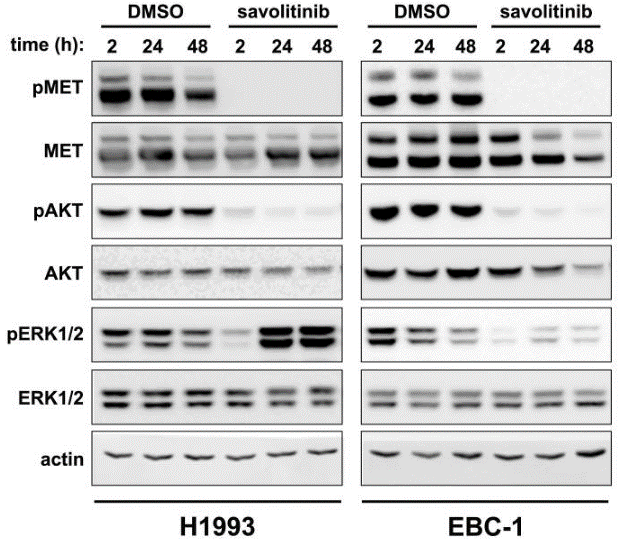
| Western blot | pMET / MET / pAKT / AKT / pERK / ERK |
|
27472392 |
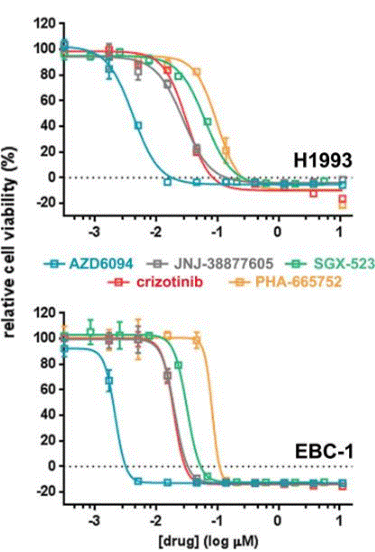
| Growth inhibition assay | Cell viability |
|
27472392 |
Informatie over klinische proeven
(gegevens van https://clinicaltrials.gov, bijgewerkt op 2024-05-22)
| NCT-nummer | Werving | Aandoeningen | Sponsor/medewerkers | Startdatum | Fasen |
|---|---|---|---|---|---|
| NCT05888207 | Completed | Healthy Male Subjects |
AstraZeneca|Parexel |
June 2 2023 | Phase 1 |
| NCT05043090 | Recruiting | Papillary Renal Cell Carcinoma |
AstraZeneca |
October 28 2021 | Phase 3 |
| NCT04606771 | Active not recruiting | Non-Small Cell Lung Cancer |
AstraZeneca |
September 28 2020 | Phase 2 |
Technische ondersteuning
Tel: +1-832-582-8158 Ext:3
Als u nog andere vragen heeft, laat dan een bericht achter.

Producten zijn uitsluitend voor onderzoeksdoeleinden. Niet voor menselijk gebruik. Wij verkopen niet aan patiënten.
©Copyright 2013 Selleck Chemicals. Alle rechten voorbehouden.