
alleen voor onderzoeksdoeleinden
AMG-458 c-Met remmer
Cat.nr.S2747
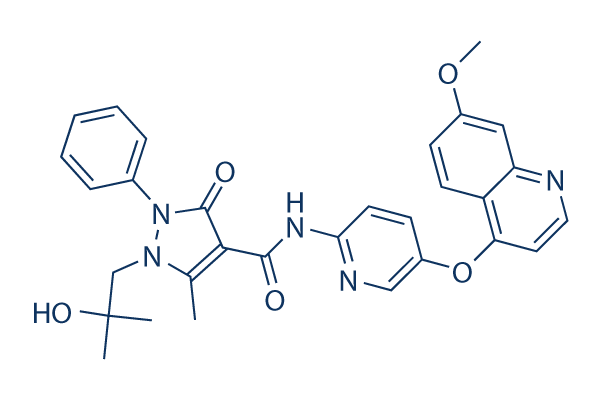
Chemische structuur
Molecuulgewicht: 539.58
Kwaliteitscontrole
| Gerelateerde doelwitten | EGFR VEGFR PDGFR FGFR Src MEK CSF-1R FLT3 HER2 c-Kit |
|---|---|
| Overig c-Met Inhibitoren | Tepotinib Dihexa SGX-523 PHA-665752 Foretinib SU11274 BMS-777607 JNJ-38877605 Tivantinib PF-04217903 |
Chemische informatie, opslag en stabiliteit
| Molecuulgewicht | 539.58 | Formule | C30H29N5O5 |
Opslag (vanaf de datum van ontvangst) | |
|---|---|---|---|---|---|
| CAS-nr. | 913376-83-7 | SDF downloaden | Opslag van stamoplossingen |
|
|
| Synoniemen | N/A | Smiles | CC1=C(C(=O)N(N1CC(C)(C)O)C2=CC=CC=C2)C(=O)NC3=NC=C(C=C3)OC4=C5C=CC(=CC5=NC=C4)OC | ||
Oplosbaarheid
|
In vitro |
DMSO
: 26 mg/mL
(48.18 mM)
Water : Insoluble Ethanol : Insoluble |
Molariteitscalculator
|
In vivo |
|||||
In vivo formulatiecalculator (heldere oplossing)
Stap 1: Voer onderstaande informatie in (Aanbevolen: een extra dier om rekening te houden met verlies tijdens het experiment)
Stap 2: Voer de in vivo formulering in (Dit is alleen de calculator, geen formulering. Neem eerst contact met ons op als er geen in vivo formulering is in de sectie oplosbaarheid.)
Berekeningsresultaten:
Werkconcentratie: mg/ml;
Methode voor het bereiden van DMSO-moedervloeistof: mg geneesmiddel vooropgelost in μL DMSO ( Concentratie moedervloeistof mg/mL, Neem eerst contact met ons op als de concentratie de DMSO-oplosbaarheid van de batch van het geneesmiddel overschrijdt. )
Methode voor het bereiden van in vivo formulering: Neem μL DMSO moedervloeistof, voeg daarna toeμL PEG300, mengen en verhelderen, daarna toevoegenμL Tween 80, mengen en verhelderen, daarna toevoegen μL ddH2O, mengen en verhelderen.
Methode voor het bereiden van in vivo formulering: Neem μL DMSO moedervloeistof, voeg daarna toe μL Maïsolie, mengen en verhelderen.
Opmerking: 1. Zorg ervoor dat de vloeistof helder is voordat u het volgende oplosmiddel toevoegt.
2. Zorg ervoor dat u het/de oplosmiddel(en) in de juiste volgorde toevoegt. U moet ervoor zorgen dat de verkregen oplossing, bij de vorige toevoeging, een heldere oplossing is voordat u verdergaat met het toevoegen van het volgende oplosmiddel. Fysieke methoden zoals vortexen, ultrasoon of een warmwaterbad kunnen worden gebruikt om het oplossen te bevorderen.
Werkingsmechanisme
| Kenmerken |
Completely bioavailable across species and the intrinsic half-life is increased in higher mammals.
|
|---|---|
| Targets/IC50/Ki |
c-Met (H1094R)
0.5 nM(Ki)
c-Met (V1092I)
1.1 nM(Ki)
c-Met (Human)
1.2 nM(Ki)
c-Met (Mouse)
2.0 nM(Ki)
c-Met (D1228H)
2.2 nM(Ki)
c-Met (M1250T)
4.1 nM(Ki)
c-Met (Y1230H)
4.5 nM(Ki)
|
| In vitro |
AMG 458 remt ook HGF-gemedieerde c-Met-fosforylering in PC3- en CT26-cellen met een IC50 van respectievelijk 60 en 120 nM. Van AMG 458 is waargenomen dat het covalent bindt aan microsomale leverproteïnen van ratten en mensen in afwezigheid van NADPH. Aangenomen wordt dat AMG 458 reageert met thiolgroepen in proteïnen, waardoor een methoxyquinoline-thioetherconjugaat ontstaat. Een recente studie toont aan dat de constitutieve fosforylering van c-Met in H441 wordt opgeheven door AMG 458. De basale en HGF-geïnduceerde fosforylering van c-Met in A549 wordt verzwakt door AMG 458. De combinatie van radiotherapie en AMG 458-behandeling blijkt synergetisch apoptose in de H441-cellijn te verhogen door vermindering van p-Akt- en p-Erk-niveaus, maar niet in A549.
|
| In vivo |
AMG 458 is metabolisch stabiel in de levermicrosomen van muis, rat, hond, aap en mens met lage intrinsieke klaringen (Clint: <5, 62, 8, 8, 18 (μL/min)/mg, respectievelijk). Bij orale toediening bereikt AMG 458 een opmerkelijk hoge biologische beschikbaarheid in alle geteste soorten. Orale dosering van AMG 458 remt HGF-gemedieerde c-Met-fosforylering met een geschatte ED90 van 30 mg/kg en een geassocieerde plasmaconcentratie van ongeveer 15 μM na 6 uur. AMG 458 remt significant de tumorgroei in de NIH3T3/TPR-Met- en U-87 MG-xenograftmodellen bij 30 en 100 mg/kg eenmaal daags en 30 mg/kg tweemaal daags zonder nadelig effect op het lichaamsgewicht. Hoge concentraties van AMG 458 in sommige organen kunnen toxiciteit veroorzaken via oxidatieve stress.
|
Referenties |
|
Technische ondersteuning
Tel: +1-832-582-8158 Ext:3
Als u nog andere vragen heeft, laat dan een bericht achter.

Producten zijn uitsluitend voor onderzoeksdoeleinden. Niet voor menselijk gebruik. Wij verkopen niet aan patiënten.
©Copyright 2013 Selleck Chemicals. Alle rechten voorbehouden.