
alleen voor onderzoeksdoeleinden
Ruxolitinib (INCB18424) JAK1/2-remmer
Cat.nr.S1378
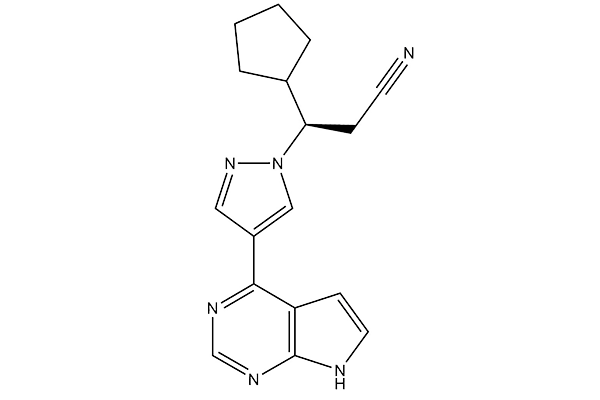
Chemische structuur
Molecuulgewicht: 306.37
Kwaliteitscontrole
Producten die vaak samen worden gebruikt met Ruxolitinib (INCB18424)
| Gerelateerde doelwitten | EGFR STAT Pim |
|---|---|
| Overig JAK Inhibitoren | BMS-986165 (Deucravacitinib) AZD1480 WP1066 Momelotinib (CYT387) Filgotinib (GLPG0634) AT9283 Gandotinib (LY2784544) Pacritinib TG101209 Cerdulatinib (PRT062070) hydrochloride |
Celkweek, behandeling & werkzame concentratie
| Cellijnen | Assaytype | Concentratie | Incubatietijd | Formulering | Activiteitsbeschrijving | PMID |
|---|---|---|---|---|---|---|
| SNU423 | Function Assay | 50 μM | 24 h | DMSO | Inhibition of STAT1 and STAT3 phosphorylation significantly | 23941832 |
| SNU182 | Function Assay | 50 μM | 24 h | DMSO | Inhibition of STAT1 and STAT3 phosphorylation significantly | 23941832 |
| HuH7 | Function Assay | 50 μM | 24 h | DMSO | Inhibition of STAT1 and STAT3 phosphorylation significantly | 23941832 |
| SNU423 | Growth Inhibition Assay | 50 μM | 48 h | DMSO | >81% reduction | 23941832 |
| SNU182 | Growth Inhibition Assay | 50 μM | 48 h | DMSO | >64% reduction | 23941832 |
| HuH7 | Growth Inhibition Assay | 50 μM | 48 h | DMSO | >82% reduction | 23941832 |
| RKO | Apoptosis Assay | 25 μM | 48 h | DMSO | Induces apoptosis by activating caspase 3 | 24050550 |
| DLD-1 | Apoptosis Assay | 25 μM | 48 h | DMSO | Induces apoptosis by activating caspase 3 | 24050550 |
| DLD-1 | Growth Inhibition Assay | 50 μM | 48 h | DMSO | IC50=15.51 μM | 24050550 |
| RKO | Growth Inhibition Assay | 50 μM | 48 h | DMSO | IC50=14.76 μM | 24050550 |
| RKO | Kinase Assay | 25 μM | 48 h | DMSO | does not inhibit JAK1 phosphorylation | 24050550 |
| DLD-1 | Kinase Assay | 25 μM | 48 h | DMSO | Inhibition of JAK2 phosphorylation | 24050550 |
| RKO | Kinase Assay | 25 μM | 48 h | DMSO | Inhibition of JAK1 phosphorylation | 24050550 |
| DLD-1 | Kinase Assay | 25 μM | 48 h | DMSO | Inhibition of JAK1 phosphorylation | 24050550 |
| BaF3 | Kinase Assay | 80 nM | 6 h | DMSO | Reduces the phosphorylation of STAT5 in JAK2V617F-mutated BAF3-EPOR cell | 24237791 |
| Huh7 | Function Assay | 1 μM | 16 h | DMSO | Impaires the capacity of IHCA-associated gp130 mutants to signal to STAT3 | 24501689 |
| HepG2 | Function Assay | 1 μM | 16 h | DMSO | Impaires the capacity of IHCA-associated gp130 mutants to signal to STAT3 | 24501689 |
| Hep3B | Function Assay | 1 μM | 16 h | DMSO | Impaires the capacity of IHCA-associated gp130 mutants to active STAT3 with IC50 of ~50 μM | 24501689 |
| NCI-H2347 | Apoptosis Assay | 30 nM | 48 h | DMSO | Induction of apoptosis | 25213670 |
| NCI-H1299 | Apoptosis Assay | 30 nM | 48 h | DMSO | Induction of apoptosis | 25213670 |
| A549/DDP | Apoptosis Assay | 30 nM | 48 h | DMSO | Induction of apoptosis | 25213670 |
| NCI-H1299 | Function Assay | 30 nM | 48 h | DMSO | Down-regulation of STAT3 phosphorylation | 25213670 |
| NCI-H2347 | Function Assay | 30 nM | 48 h | DMSO | Decrease in Bcl2 expression | 25213670 |
| A549/DDP | Function Assay | 30 nM | 48 h | DMSO | Down-regulation of STAT3 phosphorylation | 25213670 |
| NCI-H2347 | Growth Inhibition Assay | DMSO | IC50=0.17 μM | 25213670 | ||
| NCI-H1299 | Growth Inhibition Assay | DMSO | IC50=0.28 μM | 25213670 | ||
| A549/DDP | Growth Inhibition Assay | DMSO | IC50=0.22 μM | 25213670 | ||
| A549 | Growth Inhibition Assay | DMSO | IC50=0.04 μM | 25213670 | ||
| NCI-H358 | Growth Inhibition Assay | DMSO | IC50=0.1 μM | 25213670 | ||
| NCI-H460 | Growth Inhibition Assay | DMSO | IC50=0.13 μM | 25213670 | ||
| CMK | Growth Inhibition Assay | Inhibition of CMK carrying the WT JAK cell proliferation with IC50 of 0.075 μM | 25352124 | |||
| CMK | Growth Inhibition Assay | Inhibition of CMK carrying the JAK3A63D mutation cell proliferation with IC50 of 0.163 μM | 25352124 | |||
| CMK | Growth Inhibition Assay | Inhibition of CMK carrying the JAK3A572V mutation cell proliferation | 25352124 | |||
| HT93A | Growth Inhibition Assay | 320 nM | 5 d | DMSO | Inhibition of GCS-F induced granulocytic differentiation | 25805962 |
| SET-2 | Cytotoxic Assay | 5 μM | 48 h | Cytotoxic index=18.7% | 25931349 | |
| HEL | Cytotoxic Assay | 5 μM | 48 h | Cytotoxic index=12.2% | 25931349 | |
| Human monocyte | Kinase Assay | Inhibition of JAK2/1 in human monocytes expressing CD14 assessed as inhibition of IFNgamma-stimulated STAT1 phosphorylation with IC50 of 0.031μM | 23540648 | |||
| Human monocyte | Kinase Assay | Inhibition of JAK2 in human monocytes expressing CD14 assessed as inhibition of GM-CSF-stimulated STAT5a phosphorylation with IC50 of 0.026μM | 23540648 | |||
| Human T cell | Kinase Assay | Inhibition of JAK3/1 in human T cells expressing CD3 assessed as inhibition of IL2-stimulated STAT5a phosphorylation with IC50 of 0.023μM | 23540648 | |||
| TF1 | Kinase Assay | 20 min | DMSO | Inhibition of JAK1 in human TF1 cells assessed as inhibition of IL6-induced STAT3 phosphorylation with IC50 of 0.024μM | 22698084 | |
| TF1 | Kinase Assay | 20 min | DMSO | Inhibition of JAK2 in human TF1 cells assessed as inhibition of EPO-induced STAT5 phosphorylation with IC50 of 0.012μM | 22698084 | |
| Sf9 cells | JAK inhibition assay | 1 h | Ki = 0.0001 μM | 23668484 | ||
| Sf9 cells | JAK inhibition assay | 1 h | Ki = 0.0002 μM | 23668484 | ||
| Sf9 cells | JAK inhibition assay | 1 h | Ki = 0.0005 μM | 23668484 | ||
| SET2 cells | JAK inhibition assay | IC50 = 0.00184 μM | 23061660 | |||
| Sf21 cells | JAK inhibition assay | 1 h | IC50 = 0.0028 μM | 22591402 | ||
| Sf21 cells | JAK inhibition assay | 60 min | IC50 = 0.003 μM | 27137359 | ||
| Sf9 cells | JAK inhibition assay | 1 h | Ki = 0.0032 μM | 23668484 | ||
| Sf21 cells | JAK inhibition assay | 1 h | IC50 = 0.0033 μM | 22591402 | ||
| TF1 cells | JAK inhibition assay | 30 min | IC50 = 0.00685 μM | 23061660 | ||
| CD34+ cells | JAK inhibition assay | IC50 = 0.008 μM | 26927423 | |||
| TF1 cells | JAK inhibition assay | 20 min | EC50 = 0.012 μM | 22698084 | ||
| Sf21 cells | TYK2 inhibition assay | 1 h | IC50 = 0.019 μM | 22591402 | ||
| T cells | JAK inhibition assay | IC50 = 0.023 μM | 23540648 | |||
| T cells | JAK inhibition assay | IC50 = 0.023 μM | 23540648 | |||
| TF1 cells | JAK inhibition assay | 20 min | EC50 = 0.024 μM | 22698084 | ||
| T cells | JAK inhibition assay | IC50 = 0.031 μM | 23540648 | |||
| T cells | JAK inhibition assay | IC50 = 0.031 μM | 23540648 | |||
| PBMC cells | JAK inhibition assay | IC50 = 0.04 μM | 26927423 | |||
| Sf21 cells | JAK inhibition assay | 1 h | IC50 = 0.428 μM | 22591402 | ||
| PBMC cells | STAT5 inhibition assay | IC50 = 0.448 μM | 26927423 | |||
| CD34+ cells | JAK inhibition assay | 45 min | IC50 = 0.677 μM | 24417533 | ||
| Klik om meer experimentele gegevens over cellijnen te bekijken | ||||||
Chemische informatie, opslag en stabiliteit
| Molecuulgewicht | 306.37 | Formule | C17H18N6 |
Opslag (vanaf de datum van ontvangst) | 3 years-20°C(in the dark) powder |
|---|---|---|---|---|---|
| CAS-nr. | 941678-49-5 | SDF downloaden | Opslag van stamoplossingen |
|
|
| Synoniemen | INCB018424 | Smiles | C1CCC(C1)C(CC#N)N2C=C(C=N2)C3=C4C=CNC4=NC=N3 | ||
Oplosbaarheid
|
In vitro |
DMSO
: 300 mg/mL
(979.2 mM)
Ethanol : 12 mg/mL Water : Insoluble |
Molariteitscalculator
|
In vivo |
|||||
In vivo formulatiecalculator (heldere oplossing)
Stap 1: Voer onderstaande informatie in (Aanbevolen: een extra dier om rekening te houden met verlies tijdens het experiment)
Stap 2: Voer de in vivo formulering in (Dit is alleen de calculator, geen formulering. Neem eerst contact met ons op als er geen in vivo formulering is in de sectie oplosbaarheid.)
Berekeningsresultaten:
Werkconcentratie: mg/ml;
Methode voor het bereiden van DMSO-moedervloeistof: mg geneesmiddel vooropgelost in μL DMSO ( Concentratie moedervloeistof mg/mL, Neem eerst contact met ons op als de concentratie de DMSO-oplosbaarheid van de batch van het geneesmiddel overschrijdt. )
Methode voor het bereiden van in vivo formulering: Neem μL DMSO moedervloeistof, voeg daarna toeμL PEG300, mengen en verhelderen, daarna toevoegenμL Tween 80, mengen en verhelderen, daarna toevoegen μL ddH2O, mengen en verhelderen.
Methode voor het bereiden van in vivo formulering: Neem μL DMSO moedervloeistof, voeg daarna toe μL Maïsolie, mengen en verhelderen.
Opmerking: 1. Zorg ervoor dat de vloeistof helder is voordat u het volgende oplosmiddel toevoegt.
2. Zorg ervoor dat u het/de oplosmiddel(en) in de juiste volgorde toevoegt. U moet ervoor zorgen dat de verkregen oplossing, bij de vorige toevoeging, een heldere oplossing is voordat u verdergaat met het toevoegen van het volgende oplosmiddel. Fysieke methoden zoals vortexen, ultrasoon of een warmwaterbad kunnen worden gebruikt om het oplossen te bevorderen.
Werkingsmechanisme
| Targets/IC50/Ki |
JAK2
(Cell-free assay) 2.8 nM
JAK1
(Cell-free assay) 3.3 nM
|
|---|---|
| In vitro |
Ruxolitinib (INCB18424) remt krachtig en selectief JAK2V617F-gemedieerde signalering en proliferatie in Ba/F3-cellen en HEL-cellen. Deze verbinding verhoogt de apoptosis aanzienlijk op een dosisafhankelijke manier in Ba/F3-cellen. Het (64 nM) resulteert in een verdubbeling van cellen met gedepolariseerde mitochondria in Ba/F3-cellen. Deze chemische stof remt de proliferatie van erytroïde voorlopercellen van normale donoren en polycythemia vera-patiënten met een IC50 van respectievelijk 407 nM en 223 nM. Het toont een opmerkelijke potentie tegen de vorming van erytroïde kolonies met een IC50 van 67 nM.
|
| Kinase Assay |
Bindingsassay
|
|
Recombinant eiwitten worden tot expressie gebracht met behulp van Sf21-cellen en baculovirus-vectoren en gezuiverd met affiniteitschromatografie. JAK kinase-assays gebruiken een homogene, tijd-opgeloste fluorescentie-assay met het peptidesubstraat (-EQEDEPEGDYFEWLE). Elke enzymreactie wordt gedurende 1 uur uitgevoerd met Ruxolitinib (INCB18424) of controle, JAK-enzym, 500 nM peptide, adenosinetrifosfaat (ATP; 1mM) en 2% dimethylsulfoxide (DMSO). De 50% remmende concentratie (IC50) wordt berekend als de concentratie van deze verbinding die nodig is voor 50% remming van het fluorescente signaal.
|
|
| In vivo |
INCB018424 (180 mg/kg, oraal, tweemaal daags) resulteert in een overlevingspercentage van meer dan 90% op dag 22 in een JAK2V617F-gedreven muismodel. Deze verbinding (180 mg/kg, oraal, tweemaal daags) vermindert aanzienlijk splenomegalie en circulerende niveaus van inflammatoire cytokines, en elimineert bij voorkeur neoplastische cellen, wat resulteert in een significant verlengde overleving zonder myelosuppressieve of immunosuppressieve effecten in een JAK2V617F-gedreven muismodel. In de dubbelblinde studie naar myelofibrose wordt het primaire eindpunt bereikt bij 41,9% van de patiënten in de Ruxolitinib (INCB18424)-groep, vergeleken met 0,7% in de placebogroep. Dit resulteert in het behoud van de vermindering van het miltvolume en een verbetering van 50% of meer in de totale symptoomscore. In totaal had 28% van de patiënten in de groep die deze verbinding kreeg (15 mg tweemaal daags) minstens een 35% vermindering van het miltvolume in week 48 bij patiënten met myelofibrose, vergeleken met 0% in de groep die de best beschikbare therapie kreeg. De gemiddelde palpabele miltlengte was met 56% afgenomen, maar was met 4% toegenomen met de best beschikbare therapie in week 48. Patiënten in de ruxolitinib-groep hadden een verbetering in de algehele kwaliteit van leven en een vermindering van symptomen geassocieerd met myelofibrose.
|
Referenties |
|
Toepassingen
| Methoden | Biomarkers | Afbeeldingen | PMID |
|---|---|---|---|
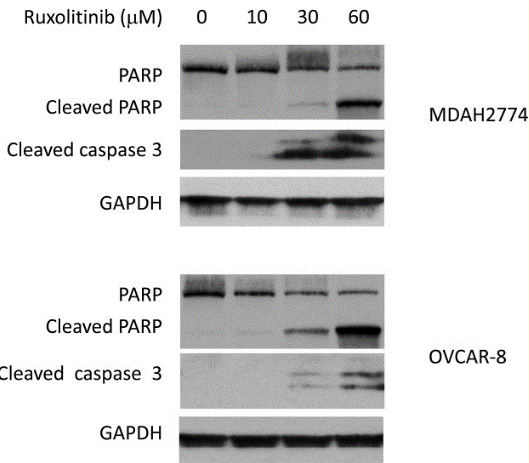
| Western blot | cleaved PARP / cleaved caspase3 p-JAK2 / p-AKT / p-MAPK / Bcl-xl / MCL-1 c-Myc / c-Jun / Cyclin B / Cyclin D / Bcl-2 / HIF-1α p-STAT3 |
|
29849942 |
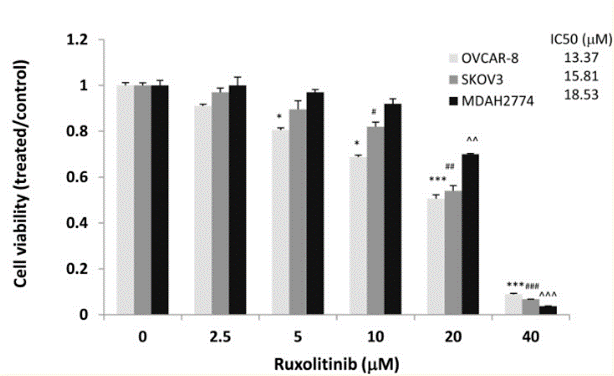
| Growth inhibition assay | Cell viability Cell apoptosis Cell proliferation |
|
29849942 |
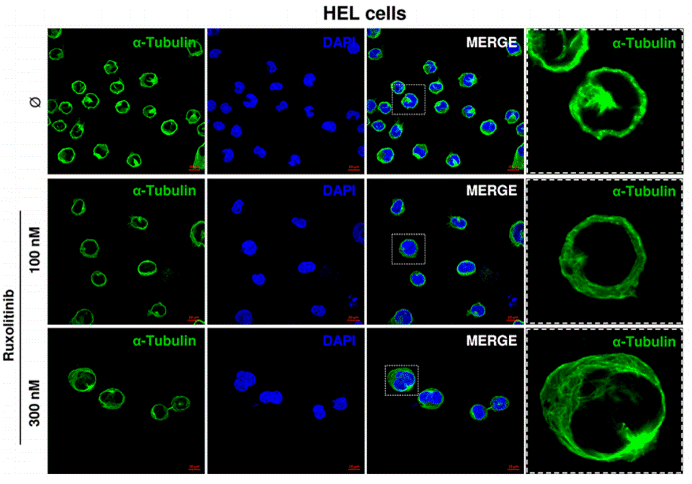
| Immunofluorescence | α-tubulin |
|
26356819 |
Informatie over klinische proeven
(gegevens van https://clinicaltrials.gov, bijgewerkt op 2024-05-22)
| NCT-nummer | Werving | Aandoeningen | Sponsor/medewerkers | Startdatum | Fasen |
|---|---|---|---|---|---|
| NCT06397313 | Not yet recruiting | Myelofibrosis |
Ryvu Therapeutics SA |
September 2024 | Phase 2 |
| NCT06388564 | Not yet recruiting | Chronic Graft-versus-host-disease |
Incyte Corporation |
July 8 2024 | Phase 2 |
| NCT06251102 | Not yet recruiting | Polycythemia Vera |
Gruppo Italiano Malattie EMatologiche dell''Adulto |
July 2024 | -- |
| NCT06343792 | Not yet recruiting | Steroid Refractory GVHD |
ReAlta Life Sciences Inc. |
May 2024 | Phase 2 |
Technische ondersteuning
Tel: +1-832-582-8158 Ext:3
Als u nog andere vragen heeft, laat dan een bericht achter.
Veelgestelde vragen
Vraag 1:
What is the difference between S2902 and S1378 which seem to have same structure formula according to the product information?
Antwoord:
These two chemicals are the two different chiral forms of this compound. S2902 S-Ruxolitinib is the S form and S1378 Ruxolitinib is the D form. One of the carbon atoms in it is asymmetric, making the two molecules mirror images of each other. The biological activities of these two molecules can be very different because of the confirmation differences.
Vraag 2:
How about the half-life of this compound? How long is the duration of its inhibitory effect on JAK-STAT signaling?
Antwoord:
According to previous study, the half-life of this compound in body is about 2~3 hours. Generally, it is longer in vitro culture medium than in vivo. It was also used for 24 hours in paper. http://www.bloodjournal.org/cgi/pmidlookup?view=long&pmid=24711661.

Producten zijn uitsluitend voor onderzoeksdoeleinden. Niet voor menselijk gebruik. Wij verkopen niet aan patiënten.
©Copyright 2013 Selleck Chemicals. Alle rechten voorbehouden.