
alleen voor onderzoeksdoeleinden
Fludarabine STAT1-remmer
Cat.nr.S1491
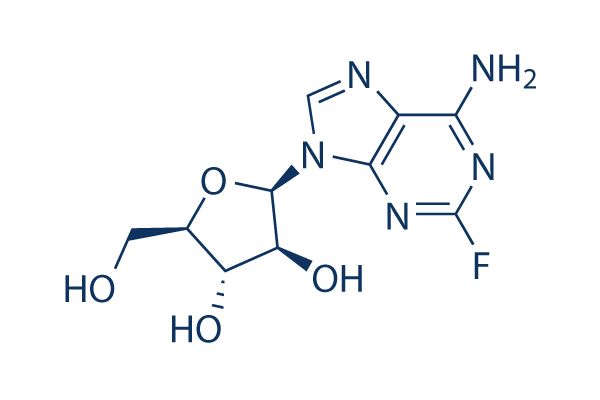
Chemische structuur
Molecuulgewicht: 285.23
Kwaliteitscontrole
| Gerelateerde doelwitten | EGFR JAK Pim |
|---|---|
| Overig STAT Inhibitoren | Napabucasin (BBI608) Stattic NSC 74859 (S3I-201) Cryptotanshinone (Tanshinone C) C188-9 (TTI-101) SH-4-54 BP-1-102 AS1517499 Nifuroxazide HO-3867 |
Celkweek, behandeling & werkzame concentratie
| Cellijnen | Assaytype | Concentratie | Incubatietijd | Formulering | Activiteitsbeschrijving | PMID |
|---|---|---|---|---|---|---|
| Jeko-1 | Function Assay | 20 μM | 24 h | inhibits expression of IDO | 25940712 | |
| MV-4-11 | Apoptosis Assay | 2.5 μM | 48 h | induces apoptosis slightly | 25111583 | |
| THP-1 | Apoptosis Assay | 2.5 μM | 48 h | induces apoptosis slightly | 25111583 | |
| MOLM 13 | Apoptosis Assay | 2.5 μM | 48 h | induces apoptosis slightly | 25111583 | |
| KBM3/Bu2506 | Apoptosis Assay | 2.5 μM | 48 h | induces apoptosis slightly | 25111583 | |
| Nalm-6 | Growth Inhibition Assay | IC50=18 μM | 25061101 | |||
| Reh | Growth Inhibition Assay | IC50=30 μM | 25061101 | |||
| U2937 | Growth Inhibition Assay | IC50=16 μM | 25061101 | |||
| Mec-1 | Growth Inhibition Assay | IC50>500 μM | 25061101 | |||
| RPMI-8226 | Growth Inhibition Assay | IC50=500 μM | 25061101 | |||
| Molt-4 | Growth Inhibition Assay | IC50=180 μM | 25061101 | |||
| Nalm-6-FluR | Growth Inhibition Assay | IC50=250 μM | 25061101 | |||
| Raji | Function Assay | 3 μM | 24/48/72 h | induces accumulations of p53, p63 and p73 | 24940695 | |
| PBMC | Function Assay | 50/100 μM | 24 h | DMSO | inhibits STAT1 phosphorylation | 24911872 |
| MDA-231 | Function Assay | 100 μM | 24 h | DMSO | decreases IDO expression | 24911872 |
| 624.38mel | Function Assay | 50 μM | 24 h | DMSO | decreases IDO expression | 24911872 |
| MDA-231 | Function Assay | 50-200 μM | 24 h | DMSO | inhibits IDO activity independently of mRNA levels | 24911872 |
| 624.38mel | Function Assay | 50-200 μM | 24 h | DMSO | inhibits IDO activity independently of mRNA levels | 24911872 |
| HMECs | Function Assay | 100 μM | 36 h | inhibits IFNγ and LPS induced STAT1 phosphorylation and IRF1 expression | 24211327 | |
| HMECs | Function Assay | 100 μM | 36 h | inhibits IFNα mediated phosphorylation of STAT1 and STAT3, but not of STAT2 | 24211327 | |
| BJAB | Apoptosis Assay | 5 μM | 24 h | induces cell apoptosis | 24057147 | |
| I-83 | Apoptosis Assay | 5 μM | 24 h | induces cell apoptosis | 24057147 | |
| NALM6 | Apoptosis Assay | 5 μM | 24 h | induces cell apoptosis | 24057147 | |
| DU-145 | Growth Inhibition Assay | 0-10 μg/ml | 48 h | inhibits cell growth in a dose-dependent manner | 23734815 | |
| Nalm-6 | Function Assay | 10 μM | 1/2/4 h | induces autophagy | 23681223 | |
| Reh | Function Assay | 10 μM | 1/2/4 h | induces autophagy | 23681223 | |
| Nalm-6 | Growth Inhibition Assay | IC50 ∼10 μM | 23681223 | |||
| Reh | Growth Inhibition Assay | IC50 ∼10 μM | 23681223 | |||
| HEC1A | Growth Inhibition Assay | 100-500 μM | 24 h | inhibits cell growth in a dose-dependent manner | 23595697 | |
| AN3CA | Growth Inhibition Assay | 100-500 μM | 24 h | inhibits cell growth in a dose-dependent manner | 23595697 | |
| HEC50B | Growth Inhibition Assay | 100-500 μM | 24 h | inhibits cell growth slightly | 23595697 | |
| HEC1A | Apoptosis Assay | 20/100 μM | 24 h | induces apoptosis in a dose-dependent manner | 23595697 | |
| AN3CA | Apoptosis Assay | 20/100 μM | 24 h | induces apoptosis in a dose-dependent manner | 23595697 | |
| HEC50B | Apoptosis Assay | 20/100 μM | 24 h | induces apoptosis slightly | 23595697 | |
| EHEB | Apoptosis Assay | 40 μM | 24 h | induces apoptosis | 23497075 | |
| A549 | Growth Inhibition Assay | IC50=15.7±2.8 µM | 23377192 | |||
| A549 GAPDH-deficient | Growth Inhibition Assay | IC50=18.5±2.3 µM | 23377192 | |||
| CLL | Apoptosis Assay | 10 μM | 24-96 h | induces apoptotic cell death | 22207686 | |
| MEC1 | Apoptosis Assay | 100 μM | 72 h | induces apoptosis significantly | 22132973 | |
| U937 | Apoptosis Assay | 0.8 μM | 4-48 h | induces apoptosis slightly | 22074700 | |
| U937 | Apoptosis Assay | 1 μM | 96 h | induces apoptosis slightly | 22023523 | |
| Daudi | Apoptosis Assay | 20 μM | 96 h | induces apoptosis slightly | 22023523 | |
| J45.01 | Apoptosis Assay | 1 μM | 96 h | induces apoptosis slightly | 22023523 | |
| RPMI 8226 | Growth Inhibition Assay | IC50=25.9 ± 3.7 μM | 21948264 | |||
| CEM | Growth Inhibition Assay | IC50=2.4 ± 0.4 μM | 21948264 | |||
| Raji | Growth Inhibition Assay | IC50=0.47 ± 0.04 μM | 21948264 | |||
| U937 | Growth Inhibition Assay | IC50=0.24 ± 0.04 μM | 21948264 | |||
| K562 | Growth Inhibition Assay | IC50=0.44 ± 0.05 μM | 21948264 | |||
| NALM-6 | Apoptosis Assay | 10 μM | 24 h | induces cell apoptosis slightly | 21699383 | |
| JMV-3 | Apoptosis Assay | 10 μM | 24 h | induces cell apoptosis slightly | 21699383 | |
| EHEB | Function Assay | 5-50 μM | 24 h | decreases p21 expression significantly | 21168391 | |
| JVM-2 | Function Assay | 30 μM | 24 h | decreases p21 expression | 21168391 | |
| KBM3/Bu2506 | Growth Inhibition Assay | IC20=0.67 µM | 20933509 | |||
| KBM3/Bu2506 | Growth Inhibition Assay | 0.6 μM | 24 h | increases the cell fraction in S-phase | 20933509 | |
| MDA-MB-231 | Growth Inhibition Assay | IC50=4.0 μM | 20447390 | |||
| MCF-7 | Growth Inhibition Assay | IC50=15.0 μM | 20447390 | |||
| HLE-B3 | Function Assay | 25 μM | 48 h | blocks IFN-γ–induced STAT1 phosphorylation and IDO expression | 20435158 | |
| K562 | Growth Inhibition Assay | 72 h | IC50=3.3 nM | 20307198 | ||
| BW-225 | Growth Inhibition Assay | IC20=1.37 ×10⁻⁸ μM | 18661380 | |||
| OH-65 | Growth Inhibition Assay | IC20=1.37 ×10⁻⁸ μM | 18661380 | |||
| GR-145 | Growth Inhibition Assay | IC20=2.74 × 10⁻⁸ μM | 18661380 | |||
| A549 | Growth Inhibition Assay | IC20=5.48 × 10⁻⁸ μM | 18661380 | |||
| CaSki | Growth Inhibition Assay | IC20=1.37 × 10⁻⁷ μM | 18661380 | |||
| ZMK-1 | Growth Inhibition Assay | IC20=1.37 × 10⁻⁶ μM | 18661380 | |||
| SKW6.4 | Apoptosis Assay | 0.01-10 μM | 24/48 h | induces cell death in both time- and dose- dependent manner | 18092340 | |
| RPMI 8226 | Growth Inhibition Assay | 24 h | IC50=1.54 μM | 17976186 | ||
| MM.1S | Growth Inhibition Assay | 48 h | IC50=13.48 μM | 17976186 | ||
| MM.1R | Growth Inhibition Assay | 48 h | IC50=33.79 μM | 17976186 | ||
| U937 | Growth Inhibition Assay | IC50=3,200 ± 560 nM | 15930361 | |||
| CLL5 | Antitumor assay | 48 hrs | Antitumor activity against CLL5 cells isolated from CLL patient assessed as cell viability after 48 hrs by FACS analysis, EC50 = 0.16 μM. | 24673739 | ||
| K562 | Cytotoxicity assay | 72 hrs | Cytotoxicity against human paclitaxel-resistant K562 cells after 72 hrs by MTT assay, IC50 = 0.26 μM. | 20605656 | ||
| CLL3 | Antitumor assay | 48 hrs | Antitumor activity against CLL3 cells isolated from CLL patient assessed as cell viability after 48 hrs by FACS analysis, EC50 = 0.35 μM. | 24673739 | ||
| CLL4 | Antitumor assay | 48 hrs | Antitumor activity against CLL4 cells isolated from CLL patient assessed as cell viability after 48 hrs by FACS analysis, EC50 = 0.64 μM. | 24673739 | ||
| CEM-DNR-B | Cytotoxicity assay | 72 hrs | Cytotoxicity against human CEM-DNR-B cells after 72 hrs by MTT assay, IC50 = 1.01 μM. | 20605656 | ||
| primary CLL | Cytotoxicity assay | Cytotoxicity against human primary CLL cells, LD50 = 1.1 μM. | 25148392 | |||
| CLL6 | Antitumor assay | 48 hrs | Antitumor activity against CLL6 cells isolated from CLL patient assessed as cell viability after 48 hrs by FACS analysis, EC50 = 1.6 μM. | 24673739 | ||
| CLL2 | Antitumor assay | 48 hrs | Antitumor activity against CLL2 cells isolated from CLL patient assessed as cell viability after 48 hrs by FACS analysis, EC50 = 2.66 μM. | 24673739 | ||
| HCT116 | Cytotoxicity assay | 72 hrs | Cytotoxicity against human HCT116 cells after 72 hrs by SRB assay, IC50 = 6.6 μM. | 25462277 | ||
| PBMC | Cytotoxicity assay | 48 hrs | Cytotoxicity against patient PBMC after 48 hrs by CellTitre-Blue assay in presenc of mouse M210B4 cells, IC50 = 10 μM. | 25562417 | ||
| CHO | Function assay | Binding affinity determined by displacement of specific binding of [125I]N-(4-amino-3-iodophenethyl)-adenosine in membranes of CHO cells stably transfected with the rat adenosine A3 receptor, Ki = 10.4 μM. | 7707320 | |||
| JVM2 | Antitumor assay | Antitumor activity against human JVM2 cells assessed as cell viability after 48 hrs by FACS analysis, EC50 = 10.4 μM. | 24673739 | |||
| HeLa | Antitumor assay | Antitumor activity against human HeLa cells assessed as cell viability by MTT assay, EC50 = 16 μM. | 24673739 | |||
| CLL1 | Antitumor assay | 48 hrs | Antitumor activity against CLL1 cells isolated from CLL patient assessed as cell viability after 48 hrs by FACS analysis, EC50 = 17.1 μM. | 24673739 | ||
| CEM | Cytotoxicity assay | 72 hrs | Cytotoxicity against human CEM cells after 72 hrs by MTT assay, IC50 = 19.49 μM. | 20605656 | ||
| T47D | Cytotoxicity assay | 72 hrs | Cytotoxicity against human T47D cells after 72 hrs by SRB assay, IC50 = 46.2 μM. | 25462277 | ||
| A549 | Cytotoxicity assay | 72 hrs | Cytotoxicity against human A549 cells after 72 hrs by MTT assay, IC50 = 47.44 μM. | 20605656 | ||
| CCRF-CEM | Function assay | 10 uM | 1 to 60 mins | Drug transport in human CCRF-CEM cells assessed as ENT1-mediated uptake at 10 uM after 1 to 60 mins by liquid scintillation counting analysis | 23388705 | |
| TC32 | qHTS assay | qHTS of pediatric cancer cell lines to identify multiple opportunities for drug repurposing: Primary screen for TC32 cells | 29435139 | |||
| U-2 OS | qHTS assay | qHTS of pediatric cancer cell lines to identify multiple opportunities for drug repurposing: Primary screen for U-2 OS cells | 29435139 | |||
| A673 | qHTS assay | qHTS of pediatric cancer cell lines to identify multiple opportunities for drug repurposing: Primary screen for A673 cells | 29435139 | |||
| DAOY | qHTS assay | qHTS of pediatric cancer cell lines to identify multiple opportunities for drug repurposing: Primary screen for DAOY cells | 29435139 | |||
| Saos-2 | qHTS assay | qHTS of pediatric cancer cell lines to identify multiple opportunities for drug repurposing: Primary screen for Saos-2 cells | 29435139 | |||
| BT-37 | qHTS assay | qHTS of pediatric cancer cell lines to identify multiple opportunities for drug repurposing: Primary screen for BT-37 cells | 29435139 | |||
| RD | qHTS assay | qHTS of pediatric cancer cell lines to identify multiple opportunities for drug repurposing: Primary screen for RD cells | 29435139 | |||
| SK-N-SH | qHTS assay | qHTS of pediatric cancer cell lines to identify multiple opportunities for drug repurposing: Primary screen for SK-N-SH cells | 29435139 | |||
| MG 63 (6-TG R) | qHTS assay | qHTS of pediatric cancer cell lines to identify multiple opportunities for drug repurposing: Primary screen for MG 63 (6-TG R) cells | 29435139 | |||
| BT-12 | qHTS assay | qHTS of pediatric cancer cell lines to identify multiple opportunities for drug repurposing: Primary screen for BT-12 cells | 29435139 | |||
| NB1643 | qHTS assay | qHTS of pediatric cancer cell lines to identify multiple opportunities for drug repurposing: Primary screen for NB1643 cells | 29435139 | |||
| OHS-50 | qHTS assay | qHTS of pediatric cancer cell lines to identify multiple opportunities for drug repurposing: Primary screen for OHS-50 cells | 29435139 | |||
| BT-12 | qHTS assay | qHTS of pediatric cancer cell lines to identify multiple opportunities for drug repurposing: Confirmatory screen for BT-12 cells | 29435139 | |||
| LAN-5 | qHTS assay | qHTS of pediatric cancer cell lines to identify multiple opportunities for drug repurposing: Confirmatory screen for LAN-5 cells | 29435139 | |||
| NB-EBc1 | qHTS assay | qHTS of pediatric cancer cell lines to identify multiple opportunities for drug repurposing: Confirmatory screen for NB-EBc1 cells | 29435139 | |||
| SK-N-SH | qHTS assay | qHTS of pediatric cancer cell lines to identify multiple opportunities for drug repurposing: Confirmatory screen for SK-N-SH cells | 29435139 | |||
| Rh41 | qHTS assay | qHTS of pediatric cancer cell lines to identify multiple opportunities for drug repurposing: Primary screen for Rh41 cells | 29435139 | |||
| A673 | qHTS assay | qHTS of pediatric cancer cell lines to identify multiple opportunities for drug repurposing: Confirmatory screen for A673 cells) | 29435139 | |||
| BT-37 | qHTS assay | qHTS of pediatric cancer cell lines to identify multiple opportunities for drug repurposing: Confirmatory screen for BT-37 cells | 29435139 | |||
| MG 63 (6-TG R) | qHTS assay | qHTS of pediatric cancer cell lines to identify multiple opportunities for drug repurposing: Confirmatory screen for MG 63 (6-TG R) cells | 29435139 | |||
| Rh30 | qHTS assay | qHTS of pediatric cancer cell lines to identify multiple opportunities for drug repurposing: Confirmatory screen for Rh30 cells | 29435139 | |||
| U-2 OS | qHTS assay | qHTS of pediatric cancer cell lines to identify multiple opportunities for drug repurposing: Confirmatory screen for U-2 OS cells | 29435139 | |||
| OHS-50 | qHTS assay | qHTS of pediatric cancer cell lines to identify multiple opportunities for drug repurposing: Confirmatory screen for OHS-50 cells | 29435139 | |||
| SK-N-SH | qHTS assay | qHTS of pediatric cancer cell lines to identify multiple opportunities for drug repurposing: Orthogonal 3D viability screen for SK-N-SH cells | 29435139 | |||
| RD | qHTS assay | qHTS of pediatric cancer cell lines to identify multiple opportunities for drug repurposing: Confirmatory screen for RD cells | 29435139 | |||
| Daoy | qHTS assay | qHTS of pediatric cancer cell lines to identify multiple opportunities for drug repurposing: Orthogonal 3D viability screen for Daoy cells | 29435139 | |||
| TC32 | qHTS assay | qHTS of pediatric cancer cell lines to identify multiple opportunities for drug repurposing: Orthogonal 3D caspase screen for TC32 cells | 29435139 | |||
| TC32 | qHTS assay | qHTS of pediatric cancer cell lines to identify multiple opportunities for drug repurposing: Orthogonal 3D viability screen for TC32 cells | 29435139 | |||
| MG 63 (6-TG R) | qHTS assay | qHTS of pediatric cancer cell lines to identify multiple opportunities for drug repurposing: Orthogonal 3D viability screen for MG 63 (6-TG R) cells | 29435139 | |||
| SJ-GBM2 | qHTS assay | qHTS of pediatric cancer cell lines to identify multiple opportunities for drug repurposing: Primary screen for SJ-GBM2 cells | 29435139 | |||
| SK-N-MC | qHTS assay | qHTS of pediatric cancer cell lines to identify multiple opportunities for drug repurposing: Primary screen for SK-N-MC cells | 29435139 | |||
| NB-EBc1 | qHTS assay | qHTS of pediatric cancer cell lines to identify multiple opportunities for drug repurposing: Primary screen for NB-EBc1 cells | 29435139 | |||
| LAN-5 | qHTS assay | qHTS of pediatric cancer cell lines to identify multiple opportunities for drug repurposing: Primary screen for LAN-5 cells | 29435139 | |||
| Rh18 | qHTS assay | qHTS of pediatric cancer cell lines to identify multiple opportunities for drug repurposing: Primary screen for Rh18 cells | 29435139 | |||
| NB1643 | qHTS assay | qHTS of pediatric cancer cell lines to identify multiple opportunities for drug repurposing: Confirmatory screen for NB1643 cells | 29435139 | |||
| SK-N-MC | qHTS assay | qHTS of pediatric cancer cell lines to identify multiple opportunities for drug repurposing: Confirmatory screen for SK-N-MC cells | 29435139 | |||
| SJ-GBM2 | qHTS assay | qHTS of pediatric cancer cell lines to identify multiple opportunities for drug repurposing: Confirmatory screen for SJ-GBM2 cells | 29435139 | |||
| TC32 | qHTS assay | qHTS of pediatric cancer cell lines to identify multiple opportunities for drug repurposing: Confirmatory screen for TC32 cells | 29435139 | |||
| Rh18 | qHTS assay | qHTS of pediatric cancer cell lines to identify multiple opportunities for drug repurposing: Confirmatory screen for Rh18 cells | 29435139 | |||
| Saos-2 | qHTS assay | qHTS of pediatric cancer cell lines to identify multiple opportunities for drug repurposing: Confirmatory screen for Saos-2 cells | 29435139 | |||
| SJ-GBM2 | qHTS assay | qHTS of pediatric cancer cell lines to identify multiple opportunities for drug repurposing: Orthogonal 3D viability screen for SJ-GBM2 cells | 29435139 | |||
| RD | qHTS assay | qHTS of pediatric cancer cell lines to identify multiple opportunities for drug repurposing: Orthogonal 3D viability screen for RD cells | 29435139 | |||
| Klik om meer experimentele gegevens over cellijnen te bekijken | ||||||
Chemische informatie, opslag en stabiliteit
| Molecuulgewicht | 285.23 | Formule | C10H12FN5O4 |
Opslag (vanaf de datum van ontvangst) | |
|---|---|---|---|---|---|
| CAS-nr. | 21679-14-1 | SDF downloaden | Opslag van stamoplossingen |
|
|
| Synoniemen | FaraA, Fludarabinum, NSC 118218 | Smiles | C1=NC2=C(N=C(N=C2N1C3C(C(C(O3)CO)O)O)F)N | ||
Oplosbaarheid
|
In vitro |
DMSO
: 57 mg/mL
(199.83 mM)
Water : Insoluble Ethanol : Insoluble |
Molariteitscalculator
|
In vivo |
|||||
In vivo formulatiecalculator (heldere oplossing)
Stap 1: Voer onderstaande informatie in (Aanbevolen: een extra dier om rekening te houden met verlies tijdens het experiment)
Stap 2: Voer de in vivo formulering in (Dit is alleen de calculator, geen formulering. Neem eerst contact met ons op als er geen in vivo formulering is in de sectie oplosbaarheid.)
Berekeningsresultaten:
Werkconcentratie: mg/ml;
Methode voor het bereiden van DMSO-moedervloeistof: mg geneesmiddel vooropgelost in μL DMSO ( Concentratie moedervloeistof mg/mL, Neem eerst contact met ons op als de concentratie de DMSO-oplosbaarheid van de batch van het geneesmiddel overschrijdt. )
Methode voor het bereiden van in vivo formulering: Neem μL DMSO moedervloeistof, voeg daarna toeμL PEG300, mengen en verhelderen, daarna toevoegenμL Tween 80, mengen en verhelderen, daarna toevoegen μL ddH2O, mengen en verhelderen.
Methode voor het bereiden van in vivo formulering: Neem μL DMSO moedervloeistof, voeg daarna toe μL Maïsolie, mengen en verhelderen.
Opmerking: 1. Zorg ervoor dat de vloeistof helder is voordat u het volgende oplosmiddel toevoegt.
2. Zorg ervoor dat u het/de oplosmiddel(en) in de juiste volgorde toevoegt. U moet ervoor zorgen dat de verkregen oplossing, bij de vorige toevoeging, een heldere oplossing is voordat u verdergaat met het toevoegen van het volgende oplosmiddel. Fysieke methoden zoals vortexen, ultrasoon of een warmwaterbad kunnen worden gebruikt om het oplossen te bevorderen.
Werkingsmechanisme
| Targets/IC50/Ki |
STAT1
(Vascular smooth muscle cells) |
|---|---|
| In vitro |
Fludarabine remt efficiënt de proliferatie van RPMI 8226 cellen met een IC50 van 1,54 μg/mL. De IC50 van deze verbinding tegen MM.1S en MM.1R cellen is respectievelijk 13,48 μg/mL en 33,79 μg/mL. Daarentegen zijn U266 cellen resistent tegen deze chemische stof met een IC50 van 222,2 μg/mL. Deze verbinding leidt tot een verhoogd aantal cellen in de G1-fase van de celcyclus, vergezeld van een gelijktijdige reductie van cellen in de S-fase van de celcyclus op een tijdsafhankelijke manier. Het induceert een celcyclusblokkade en triggert apoptose in MM-cellen. Het triggert tijdsafhankelijke splitsing van caspase-8, -9 en -3, -7, gevolgd door PARP-splitsing. Het verhoogt de expressie van Bax op een tijdsafhankelijke manier, terwijl de expressie van Bak niet verandert. Na blootstelling aan deze chemische stof gedurende 12 uur vertonen RPMI 8226 cellen een verlies van membraanpotentiaal, waarbij 61,05% van de cellen lage fluorescentie van rhodamine 123 vertoont, vergeleken met 8,62% van de cellen in de onbehandelde controle. Om de oplosbaarheid te verbeteren, wordt het geformuleerd als het monofosfaat (F-ara-AMP, fudarabine), dat onmiddellijk en kwantitatief gedefosforyleerd wordt tot het moedernucleoside bij intraveneuze infusie. Binnen de cellen vindt herfosforylatie plaats, wat leidt tot fuoroadenine arabinoside trifosfaat (F-ara-ATP), de belangrijkste cytotoxische metaboliet van F-ara-A. Het kan ook pro-inflammatoire stimulatie van monocytaire cellen induceren, zoals geëvalueerd door verhoogde expressie van ICAM-1 en IL-8 afgifte. Deze verbinding beïnvloedt de groei van eierstokkankercellijnen niet, terwijl het een duidelijke en dosisafhankelijke remming van proliferatie in melanoomcellijnen induceert. Het is een remmer van STAT1 die STAT1 specifiek vermindert zonder andere STAT-familieleden te beïnvloeden. Naast cytoplasmatische accumulatie induceert herhaaldelijk laaggedoseerd cisplatine (RLDC) HMGB1-expressie, die sterk wordt onderdrukt door STAT1-knockdown. Consistent onderdrukt deze chemische stof HMGB1-expressie tijdens RLDC-behandeling dosisafhankelijk in RLDC-behandelde nierbuiscellen. |
| In vivo |
Tumoren behandeld met PBS groeien snel tot ongeveer 10 keer hun oorspronkelijke volume in 25 dagen, terwijl de tumoren in de Fludarabine bij 40 mg/kg minder dan 5 keer toenemen. Een significant antitumor effect van 40 mg/kg van deze verbinding op RPMI8226 tumorgroei wordt aangetoond. RPMI8226 tumoren behandeld met 40 mg/kg van deze chemische stof op dag 10 vertonen een toename van apoptotische kernen. Deze verbinding is effectief in het onderdrukken van RPMI8226 myeloom xenografts in SCID muizen. |
Referenties |
|
Toepassingen
| Methoden | Biomarkers | Afbeeldingen | PMID |
|---|---|---|---|
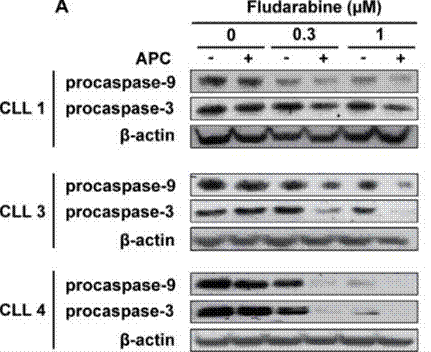
| Western blot | procaspase-9 / procaspase-3 p-p53 / p53 STAT1 |
|
27223263 |
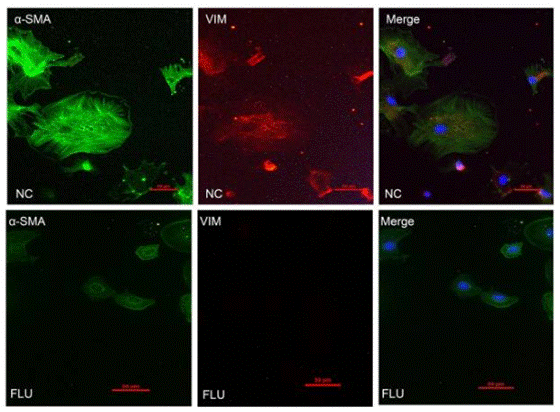
| Immunofluorescence | α-SMA / Vimentin |
|
28322315 |
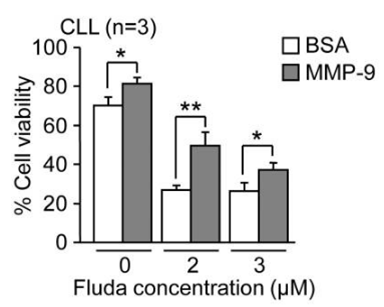
| Growth inhibition assay | Cell viability |
|
24956101 |
Informatie over klinische proeven
(gegevens van https://clinicaltrials.gov, bijgewerkt op 2024-05-22)
| NCT-nummer | Werving | Aandoeningen | Sponsor/medewerkers | Startdatum | Fasen |
|---|---|---|---|---|---|
| NCT05390814 | Recruiting | Primary Central Nervous System Lymphoma |
Assistance Publique - Hôpitaux de Paris |
December 18 2023 | Phase 1 |
| NCT05201183 | Withdrawn | Acute Myeloid Leukemia|Chronic Myeloid Leukemia|Acute Lymphocytic Leukemia|Myelodysplastic Syndromes |
Naoyuki G. Saito M.D. Ph.D.|Indiana University |
October 2023 | Phase 1|Phase 2 |
| NCT05917405 | Recruiting | Acute Myeloid Leukemia in Remission |
Nantes University Hospital |
September 14 2023 | Phase 2 |
Technische ondersteuning
Tel: +1-832-582-8158 Ext:3
Als u nog andere vragen heeft, laat dan een bericht achter.
Veelgestelde vragen
Vraag 1:
how to re-suspend and deliver it for in vivo experiments?
Antwoord:
For S1491, we tested a vehicle: 30% Propylene glycol, 5% Tween 80, 65% D5W that you can resuspend this compound in at up to 30mg/ml. It is a suspension and can only be given via oral gavage.

Producten zijn uitsluitend voor onderzoeksdoeleinden. Niet voor menselijk gebruik. Wij verkopen niet aan patiënten.
©Copyright 2013 Selleck Chemicals. Alle rechten voorbehouden.