
alleen voor onderzoeksdoeleinden
GSK429286A ROCK remmer
Cat.nr.S1474
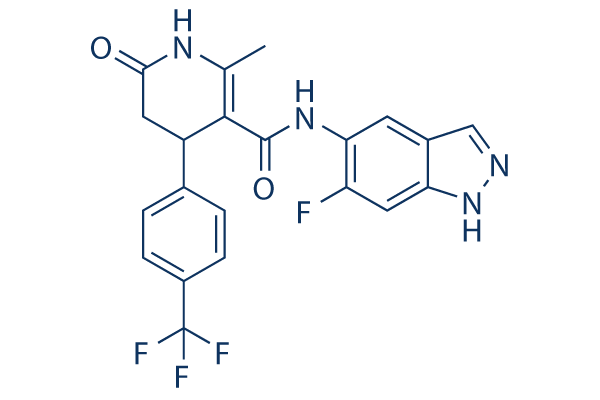
Chemische structuur
Molecuulgewicht: 432.37
Kwaliteitscontrole
Celkweek, behandeling & werkzame concentratie
| Cellijnen | Assaytype | Concentratie | Incubatietijd | Formulering | Activiteitsbeschrijving | PMID |
|---|---|---|---|---|---|---|
| Sf9 cells | Function assay | Inhibition of human recombinant ROCK1 expressed in Sf9 cells at 10 mM, IC50=0.014 μM | 17201405 | |||
| Klik om meer experimentele gegevens over cellijnen te bekijken | ||||||
Chemische informatie, opslag en stabiliteit
| Molecuulgewicht | 432.37 | Formule | C21H16F4N4O2 |
Opslag (vanaf de datum van ontvangst) | |
|---|---|---|---|---|---|
| CAS-nr. | 864082-47-3 | SDF downloaden | Opslag van stamoplossingen |
|
|
| Synoniemen | RHO-15 | Smiles | CC1=C(C(CC(=O)N1)C2=CC=C(C=C2)C(F)(F)F)C(=O)NC3=C(C=C4C(=C3)C=NN4)F | ||
Oplosbaarheid
|
In vitro |
DMSO
: 86 mg/mL
(198.9 mM)
Ethanol : 5 mg/mL Water : Insoluble |
Molariteitscalculator
|
In vivo |
|||||
In vivo formulatiecalculator (heldere oplossing)
Stap 1: Voer onderstaande informatie in (Aanbevolen: een extra dier om rekening te houden met verlies tijdens het experiment)
Stap 2: Voer de in vivo formulering in (Dit is alleen de calculator, geen formulering. Neem eerst contact met ons op als er geen in vivo formulering is in de sectie oplosbaarheid.)
Berekeningsresultaten:
Werkconcentratie: mg/ml;
Methode voor het bereiden van DMSO-moedervloeistof: mg geneesmiddel vooropgelost in μL DMSO ( Concentratie moedervloeistof mg/mL, Neem eerst contact met ons op als de concentratie de DMSO-oplosbaarheid van de batch van het geneesmiddel overschrijdt. )
Methode voor het bereiden van in vivo formulering: Neem μL DMSO moedervloeistof, voeg daarna toeμL PEG300, mengen en verhelderen, daarna toevoegenμL Tween 80, mengen en verhelderen, daarna toevoegen μL ddH2O, mengen en verhelderen.
Methode voor het bereiden van in vivo formulering: Neem μL DMSO moedervloeistof, voeg daarna toe μL Maïsolie, mengen en verhelderen.
Opmerking: 1. Zorg ervoor dat de vloeistof helder is voordat u het volgende oplosmiddel toevoegt.
2. Zorg ervoor dat u het/de oplosmiddel(en) in de juiste volgorde toevoegt. U moet ervoor zorgen dat de verkregen oplossing, bij de vorige toevoeging, een heldere oplossing is voordat u verdergaat met het toevoegen van het volgende oplosmiddel. Fysieke methoden zoals vortexen, ultrasoon of een warmwaterbad kunnen worden gebruikt om het oplossen te bevorderen.
Werkingsmechanisme
| Kenmerken |
Greater selectivity than Y-27632.
|
|---|---|
| Targets/IC50/Ki |
ROCK1
(Cell-free assay) 14 nM
ROCK2
(Cell-free assay) 63 nM
|
| In vitro |
GSK429286A remt RSK en p70S6K licht met een IC50 van respectievelijk 0,78 μM en 1,94 μM. Deze verbinding remt de dilatatie van de ratten aorta ring significant met een IC50 van 190 nM. Deze chemische stof bij 1 μM vermindert de ROCK2-activiteit met meer dan 20 keer, onder omstandigheden waarin de enige andere geteste kinase die significant wordt geremd, MSK1 is, waarvan de activiteit met ~5 keer wordt verminderd. Het is een selectievere ROCK2-remmer dan de veelgebruikte ROCK-remmer Y-27632, zoals beoordeeld op een kinase-specificiteitspaneel, en remt LRRK2 niet significant, zelfs niet bij doses zo hoog als 30 μM (500 keer hoger dan de IC50 van ROCK2-remming). Net als GSK269962A, maar niet sunitinib, aboleert deze verbindingbehandeling bij 10 μM de basale of G14V-Rho-mutant-geïnduceerde fosforylering van MYPT bij Thr850 in HEK-293-cellen in een vergelijkbare mate als H-1152 en Y-27632, wat consistent is met ROCK dat deze fosforylering medieert, terwijl het de ERM-eiwitfosforylering niet remt, noch in aanwezigheid noch in afwezigheid van G14V-Rho.
|
| In vivo |
GSK429286A heeft een orale biologische beschikbaarheid van 61% bij mannelijke Sprague-Dawley-ratten. Orale toediening van deze verbinding in enkelvoudige doses van 3-30 mg/kg vermindert de gemiddelde arteriële druk bij spontaan hypertensieve ratten (SHR's) dramatisch op een dosisafhankelijke manier, met een maximale daling van 50 mmHg na ongeveer 2 uur behandeling bij een dosis van 30 mg/kg.
|
Referenties |
|
Technische ondersteuning
Tel: +1-832-582-8158 Ext:3
Als u nog andere vragen heeft, laat dan een bericht achter.
Veelgestelde vragen
Vraag 1:
The product sold by Selleckchem has an “A” at the end. I am wondering if it is the same compound as GSK429286?
Antwoord:
For the compound GSK429286 and this compound, they are the same and have an identical CAS# (864082-47-3). Attached please find the reference about it, which was published by GSK, and the link is followed: http://www.ncbi.nlm.nih.gov/pubmed/19740074.

Producten zijn uitsluitend voor onderzoeksdoeleinden. Niet voor menselijk gebruik. Wij verkopen niet aan patiënten.
©Copyright 2013 Selleck Chemicals. Alle rechten voorbehouden.