
alleen voor onderzoeksdoeleinden
Bupivacaine HCl Sodium Channel remmer
Cat.nr.S2454
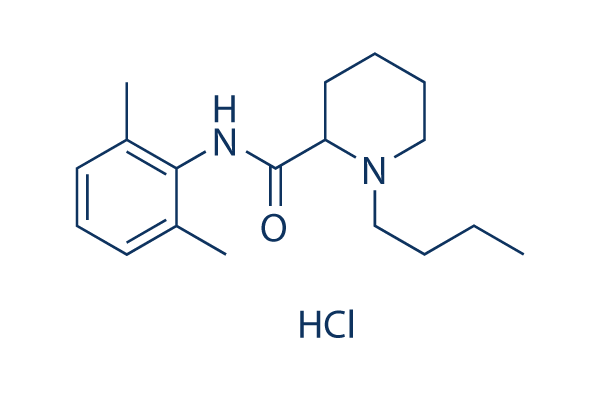
Chemische structuur
Molecuulgewicht: 324.89
Kwaliteitscontrole
| Gerelateerde doelwitten | CFTR CRM1 CD markers AChR Calcium Channel Potassium Channel GABA Receptor TRP Channel ATPase GluR |
|---|---|
| Overig Sodium Channel Inhibitoren | Camostat Mesilate A-803467 cariporide Tolperisone HCl Vinpocetine Veratramine Bulleyaconi cine A Ambroxol HCl Benzocaine Nefopam HCl |
Chemische informatie, opslag en stabiliteit
| Molecuulgewicht | 324.89 | Formule | C18H28N2O.HCl |
Opslag (vanaf de datum van ontvangst) | |
|---|---|---|---|---|---|
| CAS-nr. | 18010-40-7 | SDF downloaden | Opslag van stamoplossingen |
|
|
| Synoniemen | N/A | Smiles | CCCCN1CCCCC1C(=O)NC2=C(C=CC=C2C)C.Cl | ||
Oplosbaarheid
|
In vitro |
DMSO
: 65 mg/mL
(200.06 mM)
Water : 65 mg/mL Ethanol : 65 mg/mL |
Molariteitscalculator
|
In vivo |
|||||
In vivo formulatiecalculator (heldere oplossing)
Stap 1: Voer onderstaande informatie in (Aanbevolen: een extra dier om rekening te houden met verlies tijdens het experiment)
Stap 2: Voer de in vivo formulering in (Dit is alleen de calculator, geen formulering. Neem eerst contact met ons op als er geen in vivo formulering is in de sectie oplosbaarheid.)
Berekeningsresultaten:
Werkconcentratie: mg/ml;
Methode voor het bereiden van DMSO-moedervloeistof: mg geneesmiddel vooropgelost in μL DMSO ( Concentratie moedervloeistof mg/mL, Neem eerst contact met ons op als de concentratie de DMSO-oplosbaarheid van de batch van het geneesmiddel overschrijdt. )
Methode voor het bereiden van in vivo formulering: Neem μL DMSO moedervloeistof, voeg daarna toeμL PEG300, mengen en verhelderen, daarna toevoegenμL Tween 80, mengen en verhelderen, daarna toevoegen μL ddH2O, mengen en verhelderen.
Methode voor het bereiden van in vivo formulering: Neem μL DMSO moedervloeistof, voeg daarna toe μL Maïsolie, mengen en verhelderen.
Opmerking: 1. Zorg ervoor dat de vloeistof helder is voordat u het volgende oplosmiddel toevoegt.
2. Zorg ervoor dat u het/de oplosmiddel(en) in de juiste volgorde toevoegt. U moet ervoor zorgen dat de verkregen oplossing, bij de vorige toevoeging, een heldere oplossing is voordat u verdergaat met het toevoegen van het volgende oplosmiddel. Fysieke methoden zoals vortexen, ultrasoon of een warmwaterbad kunnen worden gebruikt om het oplossen te bevorderen.
Werkingsmechanisme
| Targets/IC50/Ki |
Sodium channel
|
|---|---|
| In vitro |
Bupivacaine-oplossing is in vitro cytotoxisch voor rundercellen en gewrichtskraakbeen na slechts 15 tot 30 minuten blootstelling. Bupivacaine werkt in geïsoleerde mitochondriën als ontkoppelaar tussen zuurstofverbruik en fosforylering van adenosinedifosfaat. Bupivacaine veroorzaakt een concentratieafhankelijke mitochondriale depolarisatie en pyridine nucleotide oxidatie in geïsoleerde mitochondriën, die gepaard gaan met een verhoogd zuurstofverbruik bij bupivacaine-concentraties van 1,5 mm of minder bij pH 7,4, terwijl de ademhaling bij hogere concentraties wordt geremd. Bupivacaine veroorzaakt de opening van de permeabiliteitsovergangsporie (PTP), een cyclosporine A-gevoelig binnenmembraankanaal dat een sleutelrol speelt bij vele vormen van celdood. Bupivacaine veroorzaakt mitochondriale depolarisatie en pyridine nucleotide oxidatie die gepaard gaan met verhoogde concentraties cytosolisch vrij Ca(2+), afgifte van cytochroom c en uiteindelijk hypercontractie in intacte flexor digitorum brevis-vezels. Bupivacaine remt GIRK-kanalen binnen enkele seconden na toediening, ongeacht of de kanalen worden geactiveerd via de muscarine receptor of direct via co-uitgedrukte G-eiwit G(beta)gamma-subeenheden. Bupivacaine remt ook alcohol-geïnduceerde GIRK-stromen in afwezigheid van functionele pertussis toxine-gevoelige G-eiwitten. Bupivacaine HCl remt ook potent de cAMP-productie met een IC50 van 2,3 μM.
|
| In vivo |
Bupivacaine induceert niet alleen Ca2+-afgifte uit het sarcoplasmatisch reticulum (SR) bij ratten, maar remt ook de Ca2+-opname door het SR, wat voornamelijk wordt gereguleerd door de SR Ca2+-adenosinetrifosfatase-activiteit.
|
Referenties |
|
Informatie over klinische proeven
(gegevens van https://clinicaltrials.gov, bijgewerkt op 2024-05-22)
| NCT-nummer | Werving | Aandoeningen | Sponsor/medewerkers | Startdatum | Fasen |
|---|---|---|---|---|---|
| NCT05038956 | Not yet recruiting | Video-assisted Thoracic Surgery (VATS) |
University of Utah |
May 1 2024 | -- |
| NCT06252662 | Not yet recruiting | Breast Cancer |
United States Naval Medical Center Portsmouth |
April 2024 | Phase 4 |
| NCT06350981 | Not yet recruiting | Back Pain|Surgery-Complications|Narcotic Use|Physical Stress|Post Operative Pain |
Foundation for Orthopaedic Research and Education|Pacira Pharmaceuticals Inc |
April 1 2024 | Phase 2|Phase 3 |
| NCT04003506 | Not yet recruiting | Pain Postoperative |
The University of Hong Kong |
March 1 2024 | Phase 4 |
| NCT06293404 | Not yet recruiting | Hip Fractures|Spinal Anesthesia |
Ankara City Hospital Bilkent |
March 1 2024 | Not Applicable |
Technische ondersteuning
Tel: +1-832-582-8158 Ext:3
Als u nog andere vragen heeft, laat dan een bericht achter.

Producten zijn uitsluitend voor onderzoeksdoeleinden. Niet voor menselijk gebruik. Wij verkopen niet aan patiënten.
©Copyright 2013 Selleck Chemicals. Alle rechten voorbehouden.