
alleen voor onderzoeksdoeleinden
MK-8245 SCD remmer
Cat.nr.S1158
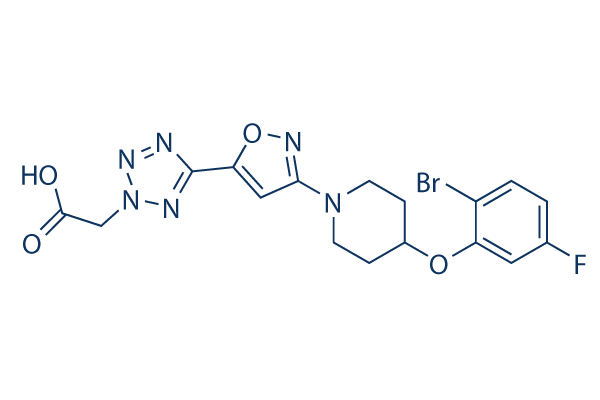
Chemische structuur
Molecuulgewicht: 467.25
Kwaliteitscontrole
| Gerelateerde doelwitten | Dehydrogenase HSP Transferase P450 (e.g. CYP17) PDE phosphatase PPAR Vitamin Carbohydrate Metabolism Mitochondrial Metabolism |
|---|---|
| Overig SCD Inhibitoren | PluriSIn #1 (NSC 14613) A939572 MF-438 CVT-11127 Aramchol CAY10566 |
Chemische informatie, opslag en stabiliteit
| Molecuulgewicht | 467.25 | Formule | C17H16BrFN6O4 |
Opslag (vanaf de datum van ontvangst) | |
|---|---|---|---|---|---|
| CAS-nr. | 1030612-90-8 | SDF downloaden | Opslag van stamoplossingen |
|
|
| Synoniemen | N/A | Smiles | C1CN(CCC1OC2=C(C=CC(=C2)F)Br)C3=NOC(=C3)C4=NN(N=N4)CC(=O)O | ||
Oplosbaarheid
|
In vitro |
DMSO
: 93 mg/mL
(199.03 mM)
Water : Insoluble Ethanol : Insoluble |
Molariteitscalculator
|
In vivo |
|||||
In vivo formulatiecalculator (heldere oplossing)
Stap 1: Voer onderstaande informatie in (Aanbevolen: een extra dier om rekening te houden met verlies tijdens het experiment)
Stap 2: Voer de in vivo formulering in (Dit is alleen de calculator, geen formulering. Neem eerst contact met ons op als er geen in vivo formulering is in de sectie oplosbaarheid.)
Berekeningsresultaten:
Werkconcentratie: mg/ml;
Methode voor het bereiden van DMSO-moedervloeistof: mg geneesmiddel vooropgelost in μL DMSO ( Concentratie moedervloeistof mg/mL, Neem eerst contact met ons op als de concentratie de DMSO-oplosbaarheid van de batch van het geneesmiddel overschrijdt. )
Methode voor het bereiden van in vivo formulering: Neem μL DMSO moedervloeistof, voeg daarna toeμL PEG300, mengen en verhelderen, daarna toevoegenμL Tween 80, mengen en verhelderen, daarna toevoegen μL ddH2O, mengen en verhelderen.
Methode voor het bereiden van in vivo formulering: Neem μL DMSO moedervloeistof, voeg daarna toe μL Maïsolie, mengen en verhelderen.
Opmerking: 1. Zorg ervoor dat de vloeistof helder is voordat u het volgende oplosmiddel toevoegt.
2. Zorg ervoor dat u het/de oplosmiddel(en) in de juiste volgorde toevoegt. U moet ervoor zorgen dat de verkregen oplossing, bij de vorige toevoeging, een heldere oplossing is voordat u verdergaat met het toevoegen van het volgende oplosmiddel. Fysieke methoden zoals vortexen, ultrasoon of een warmwaterbad kunnen worden gebruikt om het oplossen te bevorderen.
Werkingsmechanisme
| Kenmerken |
A potent hepatic SCD inhibitor, and does not affect SCD enzyme in skin and eye tissues like other systemically distributed SCD inhibitors.
|
|---|---|
| Targets/IC50/Ki |
SCD1 (human)
1 nM
SCD1 (rat)
3 nM
SCD1 (mouse)
3 nM
|
| In vitro |
MK-8245, een fenoxypiperidine-isoxazool derivaat, is geïdentificeerd als een potente en leverspecifieke SCD-remmer. Het bevat een tetrazoolazijnzuurmotief, dat het sleutelmolecuul is voor OATP-herkenning en levertargeting. Deze verbinding vertoont vergelijkbare potenties tegen humaan, rat- en muis-SCD1 met IC50-waarden van 1 nM voor humaan SCD1 en 3 nM voor zowel rat-SCD1 als muis-SCD1. Het vertoont een significante SCD-inhibitie in de rattenhepatocytenassay die functionele, actieve OATP's bevat met een IC50 van 68 nM, terwijl het slechts zwak actief is in de HepG2-celassay die verstoken is van actieve OATP's met een IC50 van ~1 μM. Het vertoont een zeer selectieve activiteit voor de Δ-5 en Δ-6 desaturases (d.w.z. >100000 μM versus rat en humaan Δ5D en Δ6D zoals beoordeeld in de HepG-assay).
|
| In vivo |
Toediening van MK-8245 in een dosis van 10 mg/kg bij muizen vertoont een weefseldistributieprofiel dat geconcentreerd is in de lever. Het vertoont een lever-tot-klier van Harder-verhouding van 21, wat een hoge mate van levertargeting suggereert in vergelijking met een systemisch gedistribueerde verbinding met een lever-tot-klier van Harder-verhouding van 1,5. Orale toediening van deze verbinding bij muizen, ratten, honden en resusapen toont aan dat het voornamelijk naar de lever wordt gedistribueerd, met lage blootstelling in weefsels die geassocieerd zijn met potentiële nadelige gebeurtenissen. De lever-tot-huidverhoudingen zijn in alle vier de soorten >30:1. Toediening van deze chemische stof aan eDIO-muizen vóór de glucosetest verbetert de glucoseklaring op een dosisafhankelijke manier met een ED50 van 7 mg/kg.
|
Referenties |
Technische ondersteuning
Tel: +1-832-582-8158 Ext:3
Als u nog andere vragen heeft, laat dan een bericht achter.

Producten zijn uitsluitend voor onderzoeksdoeleinden. Niet voor menselijk gebruik. Wij verkopen niet aan patiënten.
©Copyright 2013 Selleck Chemicals. Alle rechten voorbehouden.