
alleen voor onderzoeksdoeleinden
Lycorine hydrochloride ADC Cytotoxin Remmer
Cat.nr.: S3800
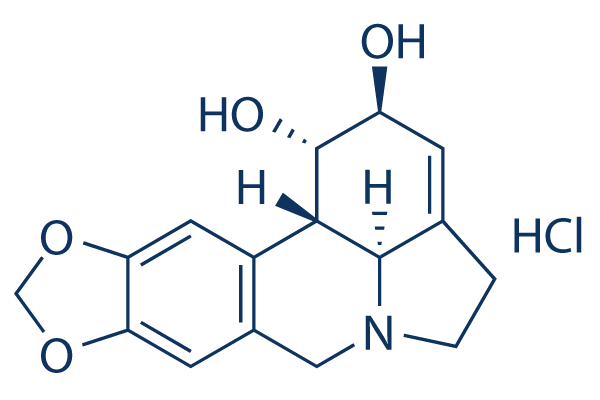
Chemische structuur
Molecuulgewicht: 323.77
Kwaliteitscontrole (Quality Control)
| Gerelateerde doelwitten | HDAC Caspase Proteasome Secretase MMP HCV Protease Cysteine Protease Tyrosinase HIV Protease DPP |
|---|---|
| Overig ADC Cytotoxin Inhibitoren | Triptolide SN-38 Luteolin (+)-Bicuculline Rutin Artemisinin BHQ Pinocembrin Luteoloside Lappaconite HBr |
Chemische informatie, opslag en stabiliteit (Chemical Information, Storage & Stability)
| Molecuulgewicht | 323.77 | Formule | C16H17NO4.HCl |
Opslag (vanaf de datum van ontvangst) | |
|---|---|---|---|---|---|
| CAS-nr. | 2188-68-3 | SDF downloaden | Opslag van stamoplossingen |
|
|
| Synoniemen | Galanthidine hydrochloride, Amarylline hydrochloride, Narcissine hydrochloride, Licorine hydrochloride | Smiles | C1CN2CC3=CC4=C(C=C3C5C2C1=CC(C5O)O)OCO4.Cl | ||
Oplosbaarheid (Solubility)
|
In vitro |
DMSO
: 65 mg/mL
(200.75 mM)
Water : Insoluble Ethanol : Insoluble |
Molariteitscalculator
|
In vivo |
|||||
In vivo formulatiecalculator (heldere oplossing)
Stap 1: Voer onderstaande informatie in (Aanbevolen: een extra dier om rekening te houden met verlies tijdens het experiment)
Stap 2: Voer de in vivo formulering in (Dit is alleen de calculator, geen formulering. Neem eerst contact met ons op als er geen in vivo formulering is in de sectie oplosbaarheid.)
Berekeningsresultaten:
Werkconcentratie: mg/ml;
Methode voor het bereiden van DMSO-moedervloeistof: mg geneesmiddel vooropgelost in μL DMSO ( Concentratie moedervloeistof mg/mL, Neem eerst contact met ons op als de concentratie de DMSO-oplosbaarheid van de batch van het geneesmiddel overschrijdt. )
Methode voor het bereiden van in vivo formulering: Neem μL DMSO moedervloeistof, voeg daarna toeμL PEG300, mengen en verhelderen, daarna toevoegenμL Tween 80, mengen en verhelderen, daarna toevoegen μL ddH2O, mengen en verhelderen.
Methode voor het bereiden van in vivo formulering: Neem μL DMSO moedervloeistof, voeg daarna toe μL Maïsolie, mengen en verhelderen.
Opmerking: 1. Zorg ervoor dat de vloeistof helder is voordat u het volgende oplosmiddel toevoegt.
2. Zorg ervoor dat u het/de oplosmiddel(en) in de juiste volgorde toevoegt. U moet ervoor zorgen dat de verkregen oplossing, bij de vorige toevoeging, een heldere oplossing is voordat u verdergaat met het toevoegen van het volgende oplosmiddel. Fysieke methoden zoals vortexen, ultrasoon of een warmwaterbad kunnen worden gebruikt om het oplossen te bevorderen.
Werkingsmechanisme (Mechanism of Action)
| In vitro |
Lycorine not only possesses strong pharmacological effects on many diseases, including anti-leukemia, anti-tumor, anti-angiogenesis, anti-virus, anti-bacteria, anti-inflammation, and anti-malaria, but also exerts many other biological functions, such as inhibition of acetylcholinesterase and topoisomerase, suppression of ascorbic acid biosynthesis, and control of circadian period length. Lycorine inhibits cell proliferation and induces cell apoptosis in acute myeloid leukemia (AML) cell line HL-60, monocyte leukemia cell line U937, and T-cell leukemia cell line Jurkat. Lycorine also blocks multiple myeloma KM3 cell cycle, induces K562 cell-cycle arrest at the G0/G1 phase and suppresses tumorigenesis and the growth of various tumor cells, including melanoma C8161, ovarian cancer Hey1B, lung cancer A549, glioblatatoma U373, and esophageal cancer OE21. Lycorine can inhibit protein synthesis in eukaryotic cells, and acetylcholinesterase activity.
|
|---|---|
| In vivo |
Lycorine exhibits its numerous pharmacological effects on various diseases with very low toxicity and mild side effects. In vivo studies, lycorine effectively inhibits tumor growth in several mouse xenograft models. It effectively inhibits tumor neovascularization. Lycorine has trivial toxicity to normal cells and normal bodies. The animal toxicological experiments show that the 50% lethal death rate (LD50) of lycorine in mice is 112.2±0.024 mg/kg via intraperitoneal injection. The LD50 of lycorine in mice is 344 mg/kg via gastric lavage injection, suggesting that lycorine is very low toxicity in gastrointestinal administration. In vivo studies show that lycorine has linear plasma kinetics with a mean elimination half-life of 0.67 and 0.3 h after single s.c. and i.v. administration, respectively. The mean oral bioavailability is calculated to be about 40%. Biochemical and hematological parameters of safety studies indicate no pathological signs.
|
Referenties |
|

Producten zijn uitsluitend voor onderzoeksdoeleinden. Niet voor menselijk gebruik. Wij verkopen niet aan patiënten.
©Copyright 2013 Selleck Chemicals. Alle rechten voorbehouden.