
alleen voor onderzoeksdoeleinden
Omipalisib (GSK2126458) PI3K Remmer
Cat.nr.: S2658
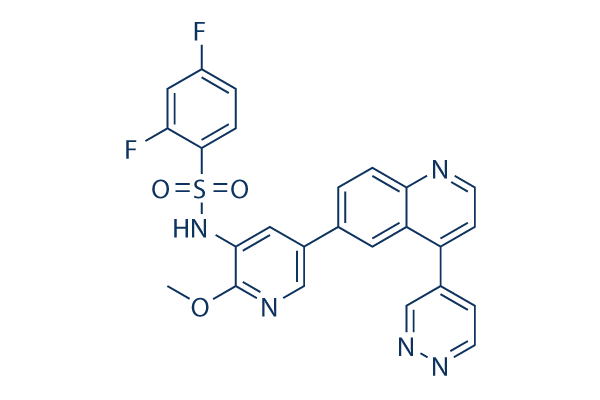
Chemische structuur
Molecuulgewicht: 505.5
Kwaliteitscontrole (Quality Control)
| Gerelateerde doelwitten | Akt mTOR GSK-3 ATM/ATR DNA-PK AMPK PDPK1 PTEN PI4K PP2A |
|---|---|
| Overig PI3K Inhibitoren | GDC-0077 (Inavolisib) SAR405 Quercetin (Sophoretin) LY294002 XL147 analogue Tersolisib (STX-478) Buparlisib (BKM120) 740 Y-P (PDGFR 740Y-P) GO-203 TFA Eganelisib (IPI-549) |
Celkweek, behandeling & werkzame concentratie
(Cell Culture, Treatment & Working Concentration)
| Cellijnen | Assaytype | Concentratie | Incubatietijd | Formulering | Activiteitsbeschrijving | PMID |
|---|---|---|---|---|---|---|
| HCT116 | Cytotoxicity assay | 72 hrs | Cytotoxicity against human HCT116 cells after 72 hrs by MTT assay, IC50 = 0.01 μM. | 26819001 | ||
| Bel7404 | Cytotoxicity assay | 72 hrs | Cytotoxicity against human Bel7404 cells after 72 hrs by MTT assay, IC50 = 0.01 μM. | 26819001 | ||
| MDA-MB-231 | Cytotoxicity assay | 72 hrs | Cytotoxicity against human MDA-MB-231 cells after 72 hrs by MTT assay, IC50 = 0.13 μM. | 26819001 | ||
| A549 | Cytotoxicity assay | 72 hrs | Cytotoxicity against human A549 cells after 72 hrs by MTT assay, IC50 = 0.14 μM. | 27448924 | ||
| HCT116 | Cytotoxicity assay | 72 hrs | Cytotoxicity against human HCT116 cells after 72 hrs by MTT assay, IC50 = 0.154 μM. | 27448924 | ||
| U87MG | Cytotoxicity assay | 72 hrs | Cytotoxicity against human U87MG cells after 72 hrs by MTT assay, IC50 = 0.537 μM. | 27448924 | ||
| A549 | Cytotoxicity assay | 72 hrs | Cytotoxicity against human A549 cells after 72 hrs by MTT assay, IC50 = 0.6 μM. | 26819001 | ||
| TC32 | qHTS assay | qHTS of pediatric cancer cell lines to identify multiple opportunities for drug repurposing: Primary screen for TC32 cells | 29435139 | |||
| U-2 OS | qHTS assay | qHTS of pediatric cancer cell lines to identify multiple opportunities for drug repurposing: Primary screen for U-2 OS cells | 29435139 | |||
| A673 | qHTS assay | qHTS of pediatric cancer cell lines to identify multiple opportunities for drug repurposing: Primary screen for A673 cells | 29435139 | |||
| DAOY | qHTS assay | qHTS of pediatric cancer cell lines to identify multiple opportunities for drug repurposing: Primary screen for DAOY cells | 29435139 | |||
| BT-37 | qHTS assay | qHTS of pediatric cancer cell lines to identify multiple opportunities for drug repurposing: Primary screen for BT-37 cells | 29435139 | |||
| RD | qHTS assay | qHTS of pediatric cancer cell lines to identify multiple opportunities for drug repurposing: Primary screen for RD cells | 29435139 | |||
| SK-N-SH | qHTS assay | qHTS of pediatric cancer cell lines to identify multiple opportunities for drug repurposing: Primary screen for SK-N-SH cells | 29435139 | |||
| NB1643 | qHTS assay | qHTS of pediatric cancer cell lines to identify multiple opportunities for drug repurposing: Primary screen for NB1643 cells | 29435139 | |||
| OHS-50 | qHTS assay | qHTS of pediatric cancer cell lines to identify multiple opportunities for drug repurposing: Primary screen for OHS-50 cells | 29435139 | |||
| LAN-5 | qHTS assay | qHTS of pediatric cancer cell lines to identify multiple opportunities for drug repurposing: Confirmatory screen for LAN-5 cells | 29435139 | |||
| NB-EBc1 | qHTS assay | qHTS of pediatric cancer cell lines to identify multiple opportunities for drug repurposing: Confirmatory screen for NB-EBc1 cells | 29435139 | |||
| SK-N-SH | qHTS assay | qHTS of pediatric cancer cell lines to identify multiple opportunities for drug repurposing: Confirmatory screen for SK-N-SH cells | 29435139 | |||
| Rh41 | qHTS assay | qHTS of pediatric cancer cell lines to identify multiple opportunities for drug repurposing: Primary screen for Rh41 cells | 29435139 | |||
| A673 | qHTS assay | qHTS of pediatric cancer cell lines to identify multiple opportunities for drug repurposing: Confirmatory screen for A673 cells) | 29435139 | |||
| BT-37 | qHTS assay | qHTS of pediatric cancer cell lines to identify multiple opportunities for drug repurposing: Confirmatory screen for BT-37 cells | 29435139 | |||
| MG 63 (6-TG R) | qHTS assay | qHTS of pediatric cancer cell lines to identify multiple opportunities for drug repurposing: Confirmatory screen for MG 63 (6-TG R) cells | 29435139 | |||
| Rh30 | qHTS assay | qHTS of pediatric cancer cell lines to identify multiple opportunities for drug repurposing: Primary screen for Rh30 cells | 29435139 | |||
| Rh30 | qHTS assay | qHTS of pediatric cancer cell lines to identify multiple opportunities for drug repurposing: Confirmatory screen for Rh30 cells | 29435139 | |||
| OHS-50 | qHTS assay | qHTS of pediatric cancer cell lines to identify multiple opportunities for drug repurposing: Confirmatory screen for OHS-50 cells | 29435139 | |||
| Rh41 | qHTS assay | qHTS of pediatric cancer cell lines to identify multiple opportunities for drug repurposing: Confirmatory screen for Rh41 cells | 29435139 | |||
| SJ-GBM2 | qHTS assay | qHTS of pediatric cancer cell lines to identify multiple opportunities for drug repurposing: Primary screen for SJ-GBM2 cells | 29435139 | |||
| SK-N-MC | qHTS assay | qHTS of pediatric cancer cell lines to identify multiple opportunities for drug repurposing: Primary screen for SK-N-MC cells | 29435139 | |||
| NB-EBc1 | qHTS assay | qHTS of pediatric cancer cell lines to identify multiple opportunities for drug repurposing: Primary screen for NB-EBc1 cells | 29435139 | |||
| LAN-5 | qHTS assay | qHTS of pediatric cancer cell lines to identify multiple opportunities for drug repurposing: Primary screen for LAN-5 cells | 29435139 | |||
| Rh18 | qHTS assay | qHTS of pediatric cancer cell lines to identify multiple opportunities for drug repurposing: Primary screen for Rh18 cells | 29435139 | |||
| NB1643 | qHTS assay | qHTS of pediatric cancer cell lines to identify multiple opportunities for drug repurposing: Confirmatory screen for NB1643 cells | 29435139 | |||
| SK-N-MC | qHTS assay | qHTS of pediatric cancer cell lines to identify multiple opportunities for drug repurposing: Confirmatory screen for SK-N-MC cells | 29435139 | |||
| TC32 | qHTS assay | qHTS of pediatric cancer cell lines to identify multiple opportunities for drug repurposing: Confirmatory screen for TC32 cells | 29435139 | |||
| Rh18 | qHTS assay | qHTS of pediatric cancer cell lines to identify multiple opportunities for drug repurposing: Confirmatory screen for Rh18 cells | 29435139 | |||
| Saos-2 | qHTS assay | qHTS of pediatric cancer cell lines to identify multiple opportunities for drug repurposing: Confirmatory screen for Saos-2 cells | 29435139 | |||
| Klik om meer experimentele gegevens over cellijnen te bekijken | ||||||
Chemische informatie, opslag en stabiliteit (Chemical Information, Storage & Stability)
| Molecuulgewicht | 505.5 | Formule | C25H17F2N5O3S |
Opslag (vanaf de datum van ontvangst) | |
|---|---|---|---|---|---|
| CAS-nr. | 1086062-66-9 | SDF downloaden | Opslag van stamoplossingen |
|
|
| Synoniemen | GSK458 | Smiles | COC1=C(C=C(C=N1)C2=CC3=C(C=CN=C3C=C2)C4=CN=NC=C4)NS(=O)(=O)C5=C(C=C(C=C5)F)F | ||
Oplosbaarheid (Solubility)
|
In vitro |
DMSO
: 101 mg/mL
(199.8 mM)
Water : Insoluble Ethanol : Insoluble |
Molariteitscalculator
|
In vivo |
|||||
In vivo formulatiecalculator (heldere oplossing)
Stap 1: Voer onderstaande informatie in (Aanbevolen: een extra dier om rekening te houden met verlies tijdens het experiment)
Stap 2: Voer de in vivo formulering in (Dit is alleen de calculator, geen formulering. Neem eerst contact met ons op als er geen in vivo formulering is in de sectie oplosbaarheid.)
Berekeningsresultaten:
Werkconcentratie: mg/ml;
Methode voor het bereiden van DMSO-moedervloeistof: mg geneesmiddel vooropgelost in μL DMSO ( Concentratie moedervloeistof mg/mL, Neem eerst contact met ons op als de concentratie de DMSO-oplosbaarheid van de batch van het geneesmiddel overschrijdt. )
Methode voor het bereiden van in vivo formulering: Neem μL DMSO moedervloeistof, voeg daarna toeμL PEG300, mengen en verhelderen, daarna toevoegenμL Tween 80, mengen en verhelderen, daarna toevoegen μL ddH2O, mengen en verhelderen.
Methode voor het bereiden van in vivo formulering: Neem μL DMSO moedervloeistof, voeg daarna toe μL Maïsolie, mengen en verhelderen.
Opmerking: 1. Zorg ervoor dat de vloeistof helder is voordat u het volgende oplosmiddel toevoegt.
2. Zorg ervoor dat u het/de oplosmiddel(en) in de juiste volgorde toevoegt. U moet ervoor zorgen dat de verkregen oplossing, bij de vorige toevoeging, een heldere oplossing is voordat u verdergaat met het toevoegen van het volgende oplosmiddel. Fysieke methoden zoals vortexen, ultrasoon of een warmwaterbad kunnen worden gebruikt om het oplossen te bevorderen.
Werkingsmechanisme (Mechanism of Action)
| Targets/IC50/Ki |
p110α
(Cell-free assay) 0.019 nM(Ki)
p110δ
(Cell-free assay) 0.024 nM(Ki)
p110γ
(Cell-free assay) 0.06 nM(Ki)
p110β
(Cell-free assay) 0.13 nM(Ki)
mTORC1
(Cell-free assay) 0.18 nM(Ki)
mTORC2
(Cell-free assay) 0.3 nM(Ki)
|
|---|---|
| In vitro |
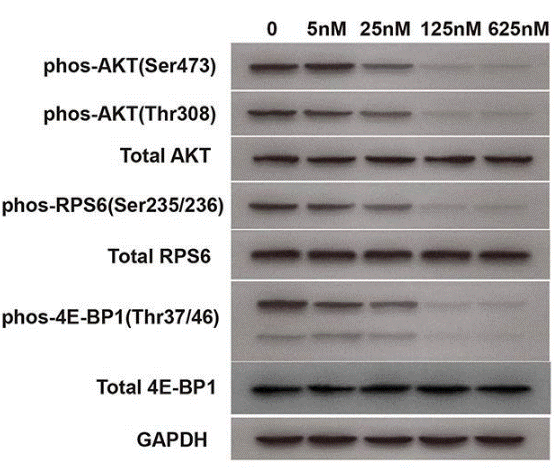
Omipalisib (GSK2126458) potently inhibits the activity of common activating mutants of p110α (E542K, E545K, and H1047R) found in human cancer with Ki of 8 pM, 8 pM and 9 pM, respectively. This compound causes a significant reduction in the levels of pAkt-S473 with remarkable potency in T47D and BT474 cells with IC50 of 0.41 nM and 0.18 nM, respectively. Furthermore, it leads to a G1 cell cycle arrest and produces the inhibitory effect on cell proliferation in a large panel of cell lines, including T47D and BT474 breast cancer lines with IC50 of 3 nM and 2.4 nM, respectively.
|
| Kinase Assay |
HTRF In vitro Profileringsassays voor PI3K-remming
|
|
Verbindingen worden serieel verdund (3-voudig in 100% DMSO) over een 384-wells polypropyleen moederplaat van kolom 1 tot kolom 12 en kolom 13 tot kolom 24, om 11 concentraties voor Omipalisib (GSK2126458) te verkrijgen. Kolommen 6 en 18 bevatten alleen DMSO. Zodra de titraties zijn gemaakt, wordt 0,05 μL overgebracht naar een 384-wells low-volume assayplaat. Deze assayplaat bevat drie farmacologische controles (bekende PI3K-remmers) en 3 assaycontroles: (1) Enzym zonder remmer; (2) Buffer minus enzym, en (3) Buffer minus enzym plus natief PIP3. DMSO wordt gestempeld in alle putjes van kolommen 6 en 18. PIP3 wordt toegevoegd bij 40 μM in 1X reactiebuffer (1μL van 200 μM PIP3) aan afwisselende rijen van kolom 18 (putjes 18 B, D, F, H, J, L, N, P). De geen-enzym-controle-reacties worden uitgevoerd in putjes 18 A, C, E, G, I, K, M, O (0,1μL van 100% DMSO). De PI3-Kinase-profileringsassay is geoptimaliseerd met behulp van de HTRF-kit. De assaykit bevat zeven reagentia: 1) 4X Reactiebuffer; 2) natief PIP2 (substraat); 3) Stop A (EDTA); 4) Stop B (Biotine-PIP3); 5) Detectiemix A (Streptavidine-APC); 6) Detectiemix B (Eu-gelabeld Anti-GST plus GST-getagd PHdomein); 7) Detectiemix C (KF). PI3Kinase Reactiebuffer wordt bereid door de stock 1:4 te verdunnen met gedeïoniseerd water. Vers bereid DTT wordt op de dag van gebruik toegevoegd in een eindconcentratie van 5 mM. Enzymadditie en compound pre-incubatie worden geïnitieerd door de toevoeging van 2,5μL PI3K (met tweemaal zijn eindconcentratie) in 1X reactiebuffer aan alle putjes met behulp van een Multidrop Combi. Platen worden gedurende 15 minuten bij kamertemperatuur geïncubeerd. Reacties worden geïnitieerd door toevoeging van 2,5μL 2X substraatoplossing (PIP2 en ATP in 1X reactiebuffer) met behulp van een Multidrop Combi. Platen worden gedurende één uur bij kamertemperatuur geïncubeerd. Reacties worden gestopt door toevoeging van 2,5μL stopoplossing (Stop A en Stop B voorgemengd in een verhouding van respectievelijk 5:1) aan alle putjes met behulp van de Multidrop Combi. De gestopte reacties worden vervolgens verwerkt om productvorming te detecteren door 2,5μL detectieoplossing toe te voegen aan alle putjes met behulp van de Multidrop Combi (Detectiemix C, Detectiemix A en Detectiemix B samen gecombineerd in een 18:1:1-verhouding, d.w.z.: voor een totaal volume van 6000 μL, meng 5400 μL Detectiemix C, 300μL Detectiemix A en 300 μL Detectiemix B. Opmerking: deze oplossing moet 2 uur voor gebruik worden bereid). Na een incubatie van één uur in het donker wordt het HTRF-signaal gemeten op de Envision plaatlezer ingesteld voor 330nm excitatie en dubbele emissiedetectie bij 620nm (Eu) en 665nm (APC).
|
|
| In vivo |
In a BT474 human tumor xenograft model, Omipalisib (GSK2126458) treatment results in a dose-dependent reduction in pAkt-S473 levels, and exhibited dose-dependent tumor growth inhibition at a low dose of 300 μg/kg. Besides, it shows low blood clearance and good oral bioavailability in four preclinical species (mouse, rat, dog, and monkey).
|
Referenties |
|
Toepassingen (Applications)
| Methoden | Biomarkers | Afbeeldingen | PMID |
|---|---|---|---|
| Western blot | p-AKT / AKT / p-RPS6 / RPS6 / p-4E-BP1 / 4E-BP1 |
|
31069214 |
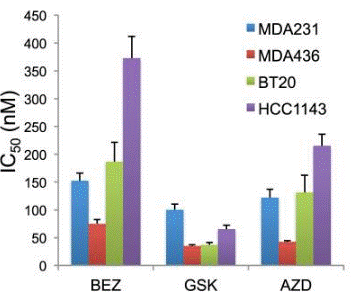
| Growth inhibition assay | IC50 |
|
26148118 |
Informatie over klinische proeven (Clinical Trial Information)
(gegevens van https://clinicaltrials.gov, bijgewerkt op 2019-11-21)
| NCT-nummer | Werving | Aandoeningen | Sponsor/medewerkers | Startdatum | Fasen |
|---|---|---|---|---|---|
| NCT01725139 | COMPLETED | Idiopathic Pulmonary Fibrosis |
GlaxoSmithKline |
2013-03-08 | PHASE1 |
| NCT01248858 | TERMINATED | Cancer |
GlaxoSmithKline |
2010-12-03 | PHASE1 |
| NCT01725139 | Completed | Idiopathic Pulmonary Fibrosis |
GlaxoSmithKline |
2013-03-08 | Phase 1 |
| NCT00972686 | COMPLETED | Solid Tumours |
GlaxoSmithKline |
2009-08-31 | PHASE1 |
| NCT01248858 | Terminated | Cancer |
GlaxoSmithKline |
2010-12-03 | Phase 1 |
| NCT00972686 | Completed | Solid Tumours |
GlaxoSmithKline |
2009-08-31 | Phase 1 |

Producten zijn uitsluitend voor onderzoeksdoeleinden. Niet voor menselijk gebruik. Wij verkopen niet aan patiënten.
©Copyright 2013 Selleck Chemicals. Alle rechten voorbehouden.