
alleen voor onderzoeksdoeleinden
Benzbromarone P450 (e.g. CYP17) remmer
Cat.nr.S4221
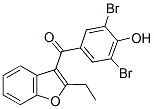
Chemische structuur
Molecuulgewicht: 424.08
Kwaliteitscontrole
| Gerelateerde doelwitten | Dehydrogenase HSP Transferase PDE phosphatase PPAR Vitamin Carbohydrate Metabolism Mitochondrial Metabolism Drug Metabolite |
|---|---|
| Overig P450 (e.g. CYP17) Inhibitoren | Apigenin Baicalein Avasimibe Naringenin Diosmetin Alizarin Orteronel Sodium Danshensu Naringin Piperine |
Chemische informatie, opslag en stabiliteit
| Molecuulgewicht | 424.08 | Formule | C17H12Br2O3 |
Opslag (vanaf de datum van ontvangst) | |
|---|---|---|---|---|---|
| CAS-nr. | 3562-84-3 | SDF downloaden | Opslag van stamoplossingen |
|
|
| Synoniemen | Desuric | Smiles | CCC1=C(C2=CC=CC=C2O1)C(=O)C3=CC(=C(C(=C3)Br)O)Br | ||
Oplosbaarheid
|
In vitro |
DMSO
: 85 mg/mL
(200.43 mM)
Ethanol : 15 mg/mL Water : Insoluble |
Molariteitscalculator
|
In vivo |
|||||
In vivo formulatiecalculator (heldere oplossing)
Stap 1: Voer onderstaande informatie in (Aanbevolen: een extra dier om rekening te houden met verlies tijdens het experiment)
Stap 2: Voer de in vivo formulering in (Dit is alleen de calculator, geen formulering. Neem eerst contact met ons op als er geen in vivo formulering is in de sectie oplosbaarheid.)
Berekeningsresultaten:
Werkconcentratie: mg/ml;
Methode voor het bereiden van DMSO-moedervloeistof: mg geneesmiddel vooropgelost in μL DMSO ( Concentratie moedervloeistof mg/mL, Neem eerst contact met ons op als de concentratie de DMSO-oplosbaarheid van de batch van het geneesmiddel overschrijdt. )
Methode voor het bereiden van in vivo formulering: Neem μL DMSO moedervloeistof, voeg daarna toeμL PEG300, mengen en verhelderen, daarna toevoegenμL Tween 80, mengen en verhelderen, daarna toevoegen μL ddH2O, mengen en verhelderen.
Methode voor het bereiden van in vivo formulering: Neem μL DMSO moedervloeistof, voeg daarna toe μL Maïsolie, mengen en verhelderen.
Opmerking: 1. Zorg ervoor dat de vloeistof helder is voordat u het volgende oplosmiddel toevoegt.
2. Zorg ervoor dat u het/de oplosmiddel(en) in de juiste volgorde toevoegt. U moet ervoor zorgen dat de verkregen oplossing, bij de vorige toevoeging, een heldere oplossing is voordat u verdergaat met het toevoegen van het volgende oplosmiddel. Fysieke methoden zoals vortexen, ultrasoon of een warmwaterbad kunnen worden gebruikt om het oplossen te bevorderen.
Werkingsmechanisme
| Targets/IC50/Ki |
CYP2C9
19.3 nM(Ki)
|
|---|---|
| In vitro |
Benzbromaron (20 μM) vermindert het mitochondriale membraanpotentiaal met 81% in geïsoleerde rattenhepatocyten. Deze verbinding vermindert de staat 3-oxidatie en respiratoire controle ratio's voor L-glutamaat met een IC50 < 1 μM in geïsoleerde rattenlevermitochondriën. Het (50 μM) ontkoppelt oxidatieve fosforylering en verhoogt de zuurstofconsumptie door hepatocyten vanaf 10 μM in geïsoleerde rattenhepatocyten. Deze chemische stof remt ook de vorming van zuuroplosbare β-oxidatieproducten op een dosisafhankelijke manier met een IC50 van 2 μM. Het (100 μM) remt de elektronen transportketen en is een ontkoppelaar van oxidatieve fosforylering in geïsoleerde rattenlevermitochondriën. Deze verbinding (1 μM) leidt tot een concentratie-afhankelijke toename van ROS-productie in HepG2-cellen. Het (100 μM) leidt tot een significante toename van de mitochondriale grootte van geïsoleerde rattenlevermitochondriën. Deze chemische stof wordt geassocieerd met lekkage van cytochroom c naar het cytoplasma van HepG2-cellen. Het (100 μM) resulteert in een proportie apoptotische cellen van 11% in rattenhepatocyten. Deze verbinding vermindert de oxypurinolopname significant bij een concentratie van slechts 10 nM en blokkeert deze volledig bij 1 μM. Het (1 μM) neemt het typische substraat van OCTN1 (tetraethylammonium) en OCTN2 (carnitine) in de HEK293-cellen die humaan OCTN1 expresseren op met respectievelijk 96,7% en 111% van de controle. Deze chemische stof remt de uraatopname volledig bij 50 μM in URAT1-expresserende oöcyten, met een IC50 van minder dan 0,1 μM. Het activeert via sequentiële hydroxylering van de benzofuraanring tot een catechol, dat vervolgens verder kan worden geoxideerd tot een reactief chinonintermediair dat in staat is tot adduceren van eiwit. |
Referenties |
|
Technische ondersteuning
Tel: +1-832-582-8158 Ext:3
Als u nog andere vragen heeft, laat dan een bericht achter.

Producten zijn uitsluitend voor onderzoeksdoeleinden. Niet voor menselijk gebruik. Wij verkopen niet aan patiënten.
©Copyright 2013 Selleck Chemicals. Alle rechten voorbehouden.