
alleen voor onderzoeksdoeleinden
Amiodarone HCl Potassium Channel remmer
Cat.nr.S1979
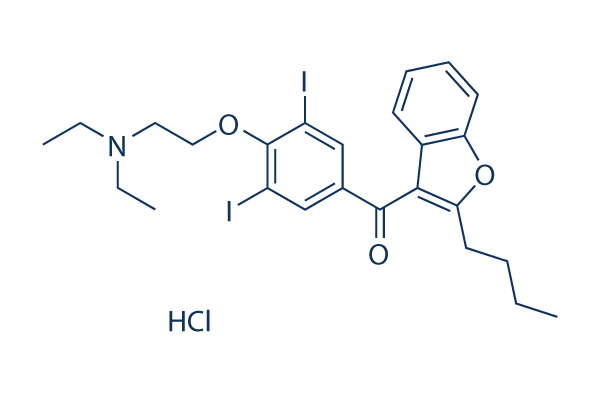
Chemische structuur
Molecuulgewicht: 681.77
Kwaliteitscontrole
| Gerelateerde doelwitten | CFTR CRM1 CD markers AChR Calcium Channel Sodium Channel GABA Receptor TRP Channel ATPase GluR |
|---|---|
| Overig Potassium Channel Inhibitoren | TRAM-34 Nicorandil ML133 HCl Sophocarpine Hydralazine HCl Nigericin Gliquidone E-4031 dihydrochloride PAP-1 Ajmaline |
Chemische informatie, opslag en stabiliteit
| Molecuulgewicht | 681.77 | Formule | C25H29I2NO3.HCl |
Opslag (vanaf de datum van ontvangst) | |
|---|---|---|---|---|---|
| CAS-nr. | 19774-82-4 | SDF downloaden | Opslag van stamoplossingen |
|
|
| Synoniemen | NSC 85442 | Smiles | CCCCC1=C(C2=CC=CC=C2O1)C(=O)C3=CC(=C(C(=C3)I)OCCN(CC)CC)I.Cl | ||
Oplosbaarheid
|
In vitro |
DMSO
: 100 mg/mL
(146.67 mM)
Ethanol : 20 mg/mL Water : Insoluble |
Molariteitscalculator
|
In vivo |
|||||
In vivo formulatiecalculator (heldere oplossing)
Stap 1: Voer onderstaande informatie in (Aanbevolen: een extra dier om rekening te houden met verlies tijdens het experiment)
Stap 2: Voer de in vivo formulering in (Dit is alleen de calculator, geen formulering. Neem eerst contact met ons op als er geen in vivo formulering is in de sectie oplosbaarheid.)
Berekeningsresultaten:
Werkconcentratie: mg/ml;
Methode voor het bereiden van DMSO-moedervloeistof: mg geneesmiddel vooropgelost in μL DMSO ( Concentratie moedervloeistof mg/mL, Neem eerst contact met ons op als de concentratie de DMSO-oplosbaarheid van de batch van het geneesmiddel overschrijdt. )
Methode voor het bereiden van in vivo formulering: Neem μL DMSO moedervloeistof, voeg daarna toeμL PEG300, mengen en verhelderen, daarna toevoegenμL Tween 80, mengen en verhelderen, daarna toevoegen μL ddH2O, mengen en verhelderen.
Methode voor het bereiden van in vivo formulering: Neem μL DMSO moedervloeistof, voeg daarna toe μL Maïsolie, mengen en verhelderen.
Opmerking: 1. Zorg ervoor dat de vloeistof helder is voordat u het volgende oplosmiddel toevoegt.
2. Zorg ervoor dat u het/de oplosmiddel(en) in de juiste volgorde toevoegt. U moet ervoor zorgen dat de verkregen oplossing, bij de vorige toevoeging, een heldere oplossing is voordat u verdergaat met het toevoegen van het volgende oplosmiddel. Fysieke methoden zoals vortexen, ultrasoon of een warmwaterbad kunnen worden gebruikt om het oplossen te bevorderen.
Werkingsmechanisme
| Targets/IC50/Ki |
Potassium channel
|
|---|---|
| In vitro |
Amiodarone heeft een remmend effect op zowel het snelle natriumkanaal als het langzame calciumkanaal. Amiodarone heeft ook niet-competitieve antisympathische effecten en moduleert de schildklierfunctie en het fosfolipidenmetabolisme. Amiodarone dringt diep door in de lipidematrix van het membraan en komt bij uitwassen zeer langzaam vrij uit hartweefsels. Amiodarone (44–88 μM) onderdrukt de Vmax van cavia papillairspier zonder het rustmembraanpotentiaal te beïnvloeden, en deze Vmax-inhibitie wordt versterkt op een frequentie- of gebruiksafhankelijke manier, net als Klasse I antiaritmica. Amiodarone (50–88 μM) blijkt ook de depolarisatie-geïnduceerde spontane actiepotentialen (abnormale automaticiteit) in ventriculaire spieren en in Purkinje-vezels te onderdrukken. |
| In vivo |
Amiodarone (1,25–25 mg/kg) resulteert in een afname van de sinussnelheid, een verlenging van de effectieve en functionele refractaire perioden van de atrioventriculaire knoop, en een frequentie-afhankelijke geleidingsvertraging in de atrioventriculaire knoop en in het ventrikel van verdoofde honden. Amiodarone (50 mg/kg/dag, i.p. gedurende 3–4 weken) resulteert in significante dalingen in de stroomdichtheid van iK en ito in ventriculaire cellen zonder de iCa- en iK1-dichtheden bij konijnen te beïnvloeden. Amiodarone (AM) remt de intracellulaire omzetting van thyroxine (T4) naar triiodothyronine (T3) via 5'-deiodinatie (5'DI) zonder de intracellulaire omzetting van T4 naar reverse T3 (rT3) te beïnvloeden. |
Referenties |
Informatie over klinische proeven
(gegevens van https://clinicaltrials.gov, bijgewerkt op 2024-05-22)
| NCT-nummer | Werving | Aandoeningen | Sponsor/medewerkers | Startdatum | Fasen |
|---|---|---|---|---|---|
| NCT06067438 | Not yet recruiting | Atrial Fibrillation|Esophageal Carcinoma |
OHSU Knight Cancer Institute |
May 1 2024 | Phase 2 |
| NCT05841056 | Not yet recruiting | Atrial Fibrillation New Onset |
Population Health Research Institute |
May 31 2024 | Phase 3 |
| NCT05852704 | Recruiting | Chronic Coronary Syndrome|Atrial Fibrillation |
Region Örebro County|Odense University Hospital|Aarhus University Hospital|Örebro University Sweden|Sahlgrenska University Hospital Sweden|Göteborg University|University of Leeds|Skane University Hospital|London School of Hygiene and Tropical Medicine|St. Anne''s University Hospital Brno Czech Republic|Mount Sinai Hospital New York|University Hospital Linkoeping|Icahn School of Medicine at Mount Sinai |
April 4 2024 | Phase 3 |
| NCT05543278 | Not yet recruiting | Surgery Cardiac|Atrial Fibrillation |
Massachusetts General Hospital |
February 1 2024 | Phase 4 |
Technische ondersteuning
Tel: +1-832-582-8158 Ext:3
Als u nog andere vragen heeft, laat dan een bericht achter.

Producten zijn uitsluitend voor onderzoeksdoeleinden. Niet voor menselijk gebruik. Wij verkopen niet aan patiënten.
©Copyright 2013 Selleck Chemicals. Alle rechten voorbehouden.