
alleen voor onderzoeksdoeleinden
RAF265 (CHIR-265) Raf remmer
Cat.nr.S2161
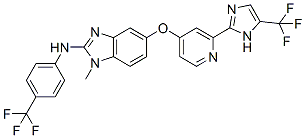
Chemische structuur
Molecuulgewicht: 518.41
Kwaliteitscontrole
| Gerelateerde doelwitten | ERK p38 MAPK JNK MEK Ras KRas S6 Kinase MAP4K TAK1 Mixed Lineage Kinase |
|---|---|
| Overig Raf Inhibitoren | LY3009120 Exarafenib (KIN-2787) GDC-0879 Avutometinib (Ro5126766, CH5126766) PLX-4720 AZ 628 SB590885 TAK-632 GW5074 PLX8394 (Plixorafenib, FORE8394) |
Celkweek, behandeling & werkzame concentratie
| Cellijnen | Assaytype | Concentratie | Incubatietijd | Formulering | Activiteitsbeschrijving | PMID |
|---|---|---|---|---|---|---|
| SK-MEL-28 | Growth inhibition assay | Growth inhibition of SK-MEL-28 cells, IC50=0.14μM. | 21576023 | |||
| MALME-3M | Growth inhibition assay | Growth inhibition of MALME-3M cells, IC50=0.14μM. | 21576023 | |||
| A375M | Growth inhibition assay | Growth inhibition of A375M cells, IC50=0.14μM. | 21576023 | |||
| A375 | Function assay | Inhibition of B-RAF V600E mutant in human A375 cells assessed as phosphorylation of ERK, IC50=0.04μM. | 26396681 | |||
| Malme-3M | Function assay | Inhibition of B-RAF V600E mutant in human Malme-3M cells assessed as phosphorylation of ERK, IC50=0.04μM. | 26396681 | |||
| WM-1799 | Function assay | Inhibition of B-RAF V600E mutant in human WM-1799 cells assessed as phosphorylation of ERK, IC50=0.04μM. | 26396681 | |||
| MALME-3M | Antiproliferative assay | Antiproliferative activity against human MALME-3M cells harboring B-RAF V600E mutant, IC50=0.04μM. | 26396681 | |||
| A375 | Antiproliferative assay | Antiproliferative activity against human A375 cells harboring B-RAF V600E mutant, IC50=0.04μM. | 26396681 | |||
| WM1799 | Antiproliferative assay | Antiproliferative activity against human WM1799 cells harboring B-RAF V600E mutant, IC50=0.04μM. | 26396681 | |||
| SK-MEL-28 | Function assay | Inhibition of B-RAF V600E mutant in human SK-MEL-28 cells assessed as phosphorylation of ERK, IC50=0.14μM. | 26396681 | |||
| SK-MEL-28 | Antiproliferative assay | Antiproliferative activity against human SK-MEL-28 cells harboring B-RAF V600E mutant, IC50=0.16μM. | 26396681 | |||
| A375M | Function assay | 100 mg/kg | fCmin in mouse xenografted with human A375M cells at 100 mg/kg, po q2d, fCmin=0.5μM. | 26396681 | ||
| A375M | Function assay | 100 mg/kg | 48 hrs | Inhibition of B-RAF V600E mutant in mouse xenografted with human A375M cells assessed as reduction of phospho-MEK level in tumor at 100 mg/kg, po q24 after 48 hrs by Western blot analysis | 26396681 | |
| A375M | Function assay | 100 mg/kg | 48 hrs | Inhibition of B-RAF V600E mutant in mouse xenografted with human A375M cells assessed as reduction of phospho-MEK level in tumor at 100 mg/kg, po q2d after 48 hrs by Western blot analysis | 26396681 | |
| A375M | Function assay | 30 to 100 mg/kg | 4 hrs | Inhibition of B-RAF V600E mutant in mouse xenografted with human A375M cells assessed as reduction of phospho-MEK level in tumor at 30 to 100 mg/kg, po q2d measured after 4 hrs post-third dose by Western blot analysis | 26396681 | |
| A375M | Antitumor assay | 10 to 100 mg/kg | 30 days | Antitumor activity against human A375M cells xenografted in mouse assessed as tumor regression at 10 to 100 mg/kg, po q2d measured up to 30 days | 26396681 | |
| TC32 | qHTS assay | qHTS of pediatric cancer cell lines to identify multiple opportunities for drug repurposing: Primary screen for TC32 cells | 29435139 | |||
| DAOY | qHTS assay | qHTS of pediatric cancer cell lines to identify multiple opportunities for drug repurposing: Primary screen for DAOY cells | 29435139 | |||
| SJ-GBM2 | qHTS assay | qHTS of pediatric cancer cell lines to identify multiple opportunities for drug repurposing: Primary screen for SJ-GBM2 cells | 29435139 | |||
| A673 | qHTS assay | qHTS of pediatric cancer cell lines to identify multiple opportunities for drug repurposing: Primary screen for A673 cells | 29435139 | |||
| SK-N-MC | qHTS assay | qHTS of pediatric cancer cell lines to identify multiple opportunities for drug repurposing: Primary screen for SK-N-MC cells | 29435139 | |||
| BT-37 | qHTS assay | qHTS of pediatric cancer cell lines to identify multiple opportunities for drug repurposing: Primary screen for BT-37 cells | 29435139 | |||
| NB-EBc1 | qHTS assay | qHTS of pediatric cancer cell lines to identify multiple opportunities for drug repurposing: Primary screen for NB-EBc1 cells | 29435139 | |||
| U-2 OS | qHTS assay | qHTS of pediatric cancer cell lines to identify multiple opportunities for drug repurposing: Primary screen for U-2 OS cells | 29435139 | |||
| Saos-2 | qHTS assay | qHTS of pediatric cancer cell lines to identify multiple opportunities for drug repurposing: Primary screen for Saos-2 cells | 29435139 | |||
| SK-N-SH | qHTS assay | qHTS of pediatric cancer cell lines to identify multiple opportunities for drug repurposing: Primary screen for SK-N-SH cells | 29435139 | |||
| NB1643 | qHTS assay | qHTS of pediatric cancer cell lines to identify multiple opportunities for drug repurposing: Primary screen for NB1643 cells | 29435139 | |||
| LAN-5 | qHTS assay | qHTS of pediatric cancer cell lines to identify multiple opportunities for drug repurposing: Primary screen for LAN-5 cells | 29435139 | |||
| BT-12 | qHTS assay | qHTS of pediatric cancer cell lines to identify multiple opportunities for drug repurposing: Primary screen for BT-12 cells | 29435139 | |||
| RD | qHTS assay | qHTS of pediatric cancer cell lines to identify multiple opportunities for drug repurposing: Primary screen for RD cells | 29435139 | |||
| NB1643 | qHTS assay | qHTS of pediatric cancer cell lines to identify multiple opportunities for drug repurposing: Confirmatory screen for NB1643 cells | 29435139 | |||
| SK-N-MC | qHTS assay | qHTS of pediatric cancer cell lines to identify multiple opportunities for drug repurposing: Confirmatory screen for SK-N-MC cells | 29435139 | |||
| LAN-5 | qHTS assay | qHTS of pediatric cancer cell lines to identify multiple opportunities for drug repurposing: Confirmatory screen for LAN-5 cells | 29435139 | |||
| NB-EBc1 | qHTS assay | qHTS of pediatric cancer cell lines to identify multiple opportunities for drug repurposing: Confirmatory screen for NB-EBc1 cells | 29435139 | |||
| BT-37 | qHTS assay | qHTS of pediatric cancer cell lines to identify multiple opportunities for drug repurposing: Confirmatory screen for BT-37 cells | 29435139 | |||
| TC32 | qHTS assay | qHTS of pediatric cancer cell lines to identify multiple opportunities for drug repurposing: Confirmatory screen for TC32 cells | 29435139 | |||
| MG 63 (6-TG R) | qHTS assay | qHTS of pediatric cancer cell lines to identify multiple opportunities for drug repurposing: Confirmatory screen for MG 63 (6-TG R) cells | 29435139 | |||
| VERO-E6 | Function assay | 48 hrs | Toxicity CC50 against VERO-E6 cells determined at 48 hours by high content imaging (same conditions as 2_LEY without exposure to 0.01 MOI SARS CoV-2 virus), CC50=9.19μM. | ChEMBL | ||
| VERO-E6 | Function assay | 48 hrs | Determination of IC50 values for inhibition of SARS-CoV-2 induced cytotoxicity of VERO-E6 cells after 48 hours exposure to 0.01 MOI SARS CoV-2 virus by high content imaging, IC50=14.64μM. | ChEMBL | ||
| Klik om meer experimentele gegevens over cellijnen te bekijken | ||||||
Chemische informatie, opslag en stabiliteit
| Molecuulgewicht | 518.41 | Formule | C24H16F6N6O |
Opslag (vanaf de datum van ontvangst) | |
|---|---|---|---|---|---|
| CAS-nr. | 927880-90-8 | SDF downloaden | Opslag van stamoplossingen |
|
|
| Synoniemen | N/A | Smiles | CN1C2=C(C=C(C=C2)OC3=CC(=NC=C3)C4=NC=C(N4)C(F)(F)F)N=C1NC5=CC=C(C=C5)C(F)(F)F | ||
Oplosbaarheid
|
In vitro |
DMSO
: 100 mg/mL
(192.89 mM)
Ethanol : 33 mg/mL Water : Insoluble |
Molariteitscalculator
|
In vivo |
|||||
In vivo formulatiecalculator (heldere oplossing)
Stap 1: Voer onderstaande informatie in (Aanbevolen: een extra dier om rekening te houden met verlies tijdens het experiment)
Stap 2: Voer de in vivo formulering in (Dit is alleen de calculator, geen formulering. Neem eerst contact met ons op als er geen in vivo formulering is in de sectie oplosbaarheid.)
Berekeningsresultaten:
Werkconcentratie: mg/ml;
Methode voor het bereiden van DMSO-moedervloeistof: mg geneesmiddel vooropgelost in μL DMSO ( Concentratie moedervloeistof mg/mL, Neem eerst contact met ons op als de concentratie de DMSO-oplosbaarheid van de batch van het geneesmiddel overschrijdt. )
Methode voor het bereiden van in vivo formulering: Neem μL DMSO moedervloeistof, voeg daarna toeμL PEG300, mengen en verhelderen, daarna toevoegenμL Tween 80, mengen en verhelderen, daarna toevoegen μL ddH2O, mengen en verhelderen.
Methode voor het bereiden van in vivo formulering: Neem μL DMSO moedervloeistof, voeg daarna toe μL Maïsolie, mengen en verhelderen.
Opmerking: 1. Zorg ervoor dat de vloeistof helder is voordat u het volgende oplosmiddel toevoegt.
2. Zorg ervoor dat u het/de oplosmiddel(en) in de juiste volgorde toevoegt. U moet ervoor zorgen dat de verkregen oplossing, bij de vorige toevoeging, een heldere oplossing is voordat u verdergaat met het toevoegen van het volgende oplosmiddel. Fysieke methoden zoals vortexen, ultrasoon of een warmwaterbad kunnen worden gebruikt om het oplossen te bevorderen.
Werkingsmechanisme
| Targets/IC50/Ki |
VEGFR2
(Cell-free assay) 30 nM(EC50)
B-Raf
(Cell-free assay) 3 nM-60 nM
|
|---|---|
| In vitro |
RAF265 (CHIR-265) remt C-Raf, wildtype B-Raf en mutant (V600E) B-Raf. Deze verbinding blokkeert effectief de fosforylering van Raf's downstream substraten MEK en ERK in cellen en doodt ook melanoom- en colorectale kankercellijnen die B-Raf-mutaties bevatten, onafhankelijk van de PTEN-mutatiestatus. Raf kinase-remming door dit middel in mutante B-Raf melanoom-cellijnen veroorzaakt celcyclusarrest en induceert apoptosis, wat het effect van Raf RNAi in deze cellen nabootst. Het remt ook potent de fosforylering van VEGFR2 en de proliferatie van VEGF-gestimuleerde hMVEC. In HT29- en MDAMB231-cellen vertoont deze chemische stof remmende activiteit met een IC20 van respectievelijk 1 tot 3 μM en een IC50 van 5 tot 10 μM. Hoewel het leidt tot een significante afname van de clonogene overleving in alle geteste cellijnen, wat betekent dat deze verbinding een dominant effect induceert op de clonogene overleving. Toevoeging van dit middel aan RAD001 in HCT116-cellen zou kunnen leiden tot een matig verminderde AKT-, S6-eiwit- en 4EBP1-fosforylering. Het vermindert de eiwitspiegel van Bcl-2 aanzienlijk en is sterk remmend in CM- en NCI-H727-cellen, terwijl het geen effect heeft op de TRAIL-gevoeligheid van BON1- en GOT1-cellen. Proteïnekinase D3 (PRKD3) dat bij knock-down de celdoding door deze verbinding in A2058-melanoomcellen zou kunnen verbeteren, wat de reactivering van MAPK-signalering voorkomt, PARP-splitsing induceert, caspase-activiteit verhoogt, de celcyclusprogressie onderbreekt en de kolonieformatie remt.
|
| Kinase Assay |
Testprotocol
|
|
Raf en Mek worden gecombineerd in 2 × eindconcentraties in assaybuffer (50 mM Tris, pH 7,5, 15 mM MgCl2, 0,1 mM EDTA en 1 mM DTT) en gedoseerd met 15 μL per putje in polypropyleen assayplaten. Achtergrondniveaus worden bepaald in putjes die Mek en DMSO bevatten zonder Raf. Aan de Raf/Mek-bevattende putjes wordt 3 μL van 10 × van deze verbinding, verdund in 100% DMSO, toegevoegd. De RAF kinase-activiteitsreactie wordt gestart door de toevoeging van 12 μL per putje van 2,5 × 33P-ATP verdund in assaybuffer. Na 45-60 minuten worden de reacties gestopt met de toevoeging van 70 μL stopreagens (30 mM EDTA). Filtratieplaten worden 5 minuten voorbevochtigd met 70% ethanol en vervolgens gespoeld door filtratie met wasbuffer. Monsters (90 μL) uit de reactieputjes worden vervolgens overgebracht naar de filtratieplaten. De filtratieplaten worden 6 × gewassen met wasbuffer met behulp van een Millipore filtratieapparaat. De platen worden gedroogd en 100 μL per putje scintillatievloeistof wordt toegevoegd. De CPM wordt vervolgens bepaald met behulp van een Wallac Microbeta 1450-lezer.
|
|
| In vivo |
RAF265 (CHIR-265) vertoont 71% tot 72% TVI% (tumorvolume-inhibitiepercentage) in HCT116-xenografts bij 12 mg/kg. De combinatie van deze verbinding en RAD001 vertoont een verbeterde antitumoractiviteit met een verhoogde T10 (tijd om een relatief tumorvolume van 10 keer het initi
jele tumorvolume te bereiken) en tumorgroeivertraging. De combinatie van RAD001 en deze chemische stof verbetert ook significant de activering van caspase-3 in HCT116 en MDAMB231, maar niet in A549-xenografts. Deze verbinding remt de FDG (2-deoxy-2-[18F]fluoro-d-glucose)-accumulatie en verlaagt de tumorvolumes in A375M-xenografts bij een orale dosis van 100 mg/kg.
|
Referenties |
|
Informatie over klinische proeven
(gegevens van https://clinicaltrials.gov, bijgewerkt op 2024-05-22)
| NCT-nummer | Werving | Aandoeningen | Sponsor/medewerkers | Startdatum | Fasen |
|---|---|---|---|---|---|
| NCT01352273 | Completed | Advanced Solid Tumors |
Array Biopharma now a wholly owned subsidiary of Pfizer|Array BioPharma |
June 2011 | Phase 1 |
Technische ondersteuning
Tel: +1-832-582-8158 Ext:3
Als u nog andere vragen heeft, laat dan een bericht achter.

Producten zijn uitsluitend voor onderzoeksdoeleinden. Niet voor menselijk gebruik. Wij verkopen niet aan patiënten.
©Copyright 2013 Selleck Chemicals. Alle rechten voorbehouden.