
alleen voor onderzoeksdoeleinden
Cilnidipine Calcium Channel remmer
Cat.nr.S1293
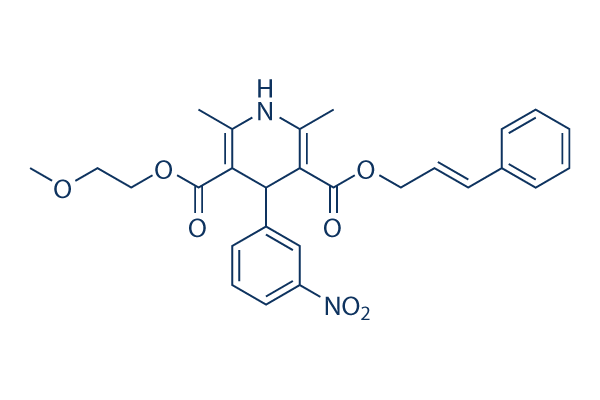
Chemische structuur
Molecuulgewicht: 492.52
Kwaliteitscontrole
| Gerelateerde doelwitten | CFTR CRM1 CD markers AChR Sodium Channel Potassium Channel GABA Receptor TRP Channel ATPase GluR |
|---|---|
| Overig Calcium Channel Inhibitoren | Bay K 8644 Tetrandrine Nilvadipine Flunarizine 2HCl YM-58483 (BTP2) Ionomycin Imperatorin Manidipine 2HCl Astragaloside A Benidipine HCl |
Chemische informatie, opslag en stabiliteit
| Molecuulgewicht | 492.52 | Formule | C27H28N2O7 |
Opslag (vanaf de datum van ontvangst) | |
|---|---|---|---|---|---|
| CAS-nr. | 132203-70-4 | SDF downloaden | Opslag van stamoplossingen |
|
|
| Synoniemen | FRC-8653 | Smiles | CC1=C(C(C(=C(N1)C)C(=O)OCC=CC2=CC=CC=C2)C3=CC(=CC=C3)[N+](=O)[O-])C(=O)OCCOC | ||
Oplosbaarheid
|
In vitro |
DMSO
: 99 mg/mL
(201.0 mM)
Ethanol : 15 mg/mL Water : Insoluble |
Molariteitscalculator
|
In vivo |
|||||
In vivo formulatiecalculator (heldere oplossing)
Stap 1: Voer onderstaande informatie in (Aanbevolen: een extra dier om rekening te houden met verlies tijdens het experiment)
Stap 2: Voer de in vivo formulering in (Dit is alleen de calculator, geen formulering. Neem eerst contact met ons op als er geen in vivo formulering is in de sectie oplosbaarheid.)
Berekeningsresultaten:
Werkconcentratie: mg/ml;
Methode voor het bereiden van DMSO-moedervloeistof: mg geneesmiddel vooropgelost in μL DMSO ( Concentratie moedervloeistof mg/mL, Neem eerst contact met ons op als de concentratie de DMSO-oplosbaarheid van de batch van het geneesmiddel overschrijdt. )
Methode voor het bereiden van in vivo formulering: Neem μL DMSO moedervloeistof, voeg daarna toeμL PEG300, mengen en verhelderen, daarna toevoegenμL Tween 80, mengen en verhelderen, daarna toevoegen μL ddH2O, mengen en verhelderen.
Methode voor het bereiden van in vivo formulering: Neem μL DMSO moedervloeistof, voeg daarna toe μL Maïsolie, mengen en verhelderen.
Opmerking: 1. Zorg ervoor dat de vloeistof helder is voordat u het volgende oplosmiddel toevoegt.
2. Zorg ervoor dat u het/de oplosmiddel(en) in de juiste volgorde toevoegt. U moet ervoor zorgen dat de verkregen oplossing, bij de vorige toevoeging, een heldere oplossing is voordat u verdergaat met het toevoegen van het volgende oplosmiddel. Fysieke methoden zoals vortexen, ultrasoon of een warmwaterbad kunnen worden gebruikt om het oplossen te bevorderen.
Werkingsmechanisme
| Targets/IC50/Ki |
Calcium channel
|
|---|---|
| In vitro |
Cilnidipine (10 mM) onderdrukt de verhoging van de verhouding geïnduceerd door 40 mM KCl, en deze onderdrukking wordt effectief geremd na behandeling met omega-conotoxine GVIA.
|
| In vivo |
Cilnidipine vermindert de Ca(2+) instroom via N-type Ca(2+) kanalen na activering van NMDA-receptoren en beschermt vervolgens neuronen tegen ischemie-reperfusieschade in de retina van ratten in vivo. Deze verbinding voorkomt significant de toename van desminekleuring en herstelt de glomerulaire podocin- en nefrine-expressie vergeleken met amlodipine bij spontaan hypertensieve ratten/ND mcr-cp (SHR/ND). Het voorkomt ook de toename van renale angiotensine II-inhoud, de expressie en membraantranslocatie van NADPH oxidase-subeenheden en dihydroethidiumkleuring in SHR/ND. Deze chemische behandeling (30 mg/kg/d als voedseltoevoeging) onderdrukt de toename van de systolische bloeddruk bij zoutgevoelige Dahl-ratten. Het remt de toename van bloedureumstikstof en de afname van de creatinineklaring, evenals de progressie van glomerulaire sclerose. De verbinding vermindert het plasmanorepinefrineniveau en de plasmarenenneactiviteit vergeleken met met voertuig behandelde Dahl S-ratten. Het onderdrukt de pressorrespons geïnduceerd door sympathische zenuwstimulatie en angiotensine II bij gedecerebreerde ratten. Deze verbinding of omega-conotoxine MVIIA verlaagt de gemiddelde bloeddruk, maar verhoogt de hartslag enigszins bij geanestheseerde ratten. Het kan sympathische N-type Ca(2+) kanalen beïnvloeden naast vasculaire L-type Ca(2+) kanalen in antihypertensieve doses bij de rat in vivo.
|
Referenties |
|
Technische ondersteuning
Tel: +1-832-582-8158 Ext:3
Als u nog andere vragen heeft, laat dan een bericht achter.

Producten zijn uitsluitend voor onderzoeksdoeleinden. Niet voor menselijk gebruik. Wij verkopen niet aan patiënten.
©Copyright 2013 Selleck Chemicals. Alle rechten voorbehouden.