
alleen voor onderzoeksdoeleinden
Sapitinib (AZD8931) HER2 remmer
Cat.nr.S2192
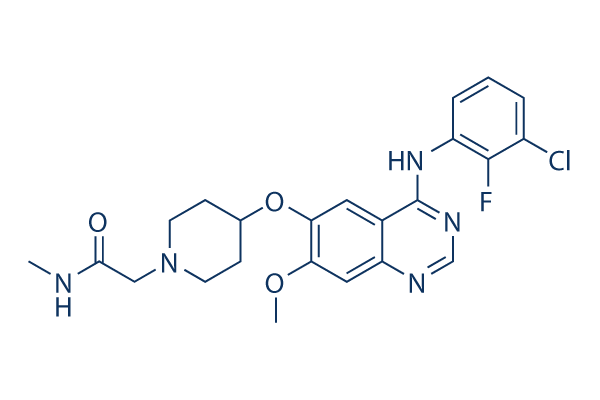
Chemische structuur
Molecuulgewicht: 473.93
Kwaliteitscontrole
| Gerelateerde doelwitten | EGFR VEGFR PDGFR FGFR c-Met Src MEK CSF-1R FLT3 c-Kit |
|---|---|
| Overig HER2 Inhibitoren | CP-724714 Mubritinib (TAK 165) AC480 (BMS-599626) Tyrphostin AG 879 HER2-Inhibitor-1 TAS0728 Zongertinib |
Celkweek, behandeling & werkzame concentratie
| Cellijnen | Assaytype | Concentratie | Incubatietijd | Formulering | Activiteitsbeschrijving | PMID |
|---|---|---|---|---|---|---|
| MCF7 | Function assay | Inhibition of heregulin-stimulated HER2 phosphorylation in human MCF7 cells, IC50 = 0.003 μM. | 24900741 | |||
| MCF7 | Function assay | Inhibition of heregulin-stimulated HER3 phosphorylation in human MCF7 cells, IC50 = 0.004 μM. | 24900741 | |||
| KB | Function assay | Inhibition of EGF-stimulated EGFR phosphorylation in human KB cells, IC50 = 0.004 μM. | 24900741 | |||
| MCF-7 | Function assay | 4 hrs | Inhibition of full-length HER2 phosphorylation transfected in in human MCF-7 cl.24 cells after 4 hrs by laser scanning fluorescence microplate cytometry, IC50 = 0.06 μM. | 24900741 | ||
| TC32 | qHTS assay | qHTS of pediatric cancer cell lines to identify multiple opportunities for drug repurposing: Primary screen for TC32 cells | 29435139 | |||
| DAOY | qHTS assay | qHTS of pediatric cancer cell lines to identify multiple opportunities for drug repurposing: Primary screen for DAOY cells | 29435139 | |||
| SJ-GBM2 | qHTS assay | qHTS of pediatric cancer cell lines to identify multiple opportunities for drug repurposing: Primary screen for SJ-GBM2 cells | 29435139 | |||
| SK-N-MC | qHTS assay | qHTS of pediatric cancer cell lines to identify multiple opportunities for drug repurposing: Primary screen for SK-N-MC cells | 29435139 | |||
| BT-37 | qHTS assay | qHTS of pediatric cancer cell lines to identify multiple opportunities for drug repurposing: Primary screen for BT-37 cells | 29435139 | |||
| NB-EBc1 | qHTS assay | qHTS of pediatric cancer cell lines to identify multiple opportunities for drug repurposing: Primary screen for NB-EBc1 cells | 29435139 | |||
| Saos-2 | qHTS assay | qHTS of pediatric cancer cell lines to identify multiple opportunities for drug repurposing: Primary screen for Saos-2 cells | 29435139 | |||
| SK-N-SH | qHTS assay | qHTS of pediatric cancer cell lines to identify multiple opportunities for drug repurposing: Primary screen for SK-N-SH cells | 29435139 | |||
| LAN-5 | qHTS assay | qHTS of pediatric cancer cell lines to identify multiple opportunities for drug repurposing: Primary screen for LAN-5 cells | 29435139 | |||
| BT-12 | qHTS assay | qHTS of pediatric cancer cell lines to identify multiple opportunities for drug repurposing: Primary screen for BT-12 cells | 29435139 | |||
| OHS-50 | qHTS assay | qHTS of pediatric cancer cell lines to identify multiple opportunities for drug repurposing: Primary screen for OHS-50 cells | 29435139 | |||
| RD | qHTS assay | qHTS of pediatric cancer cell lines to identify multiple opportunities for drug repurposing: Primary screen for RD cells | 29435139 | |||
| Rh41 | qHTS assay | qHTS of pediatric cancer cell lines to identify multiple opportunities for drug repurposing: Primary screen for Rh41 cells | 29435139 | |||
| NB1643 | qHTS assay | qHTS of pediatric cancer cell lines to identify multiple opportunities for drug repurposing: Confirmatory screen for NB1643 cells | 29435139 | |||
| SK-N-MC | qHTS assay | qHTS of pediatric cancer cell lines to identify multiple opportunities for drug repurposing: Confirmatory screen for SK-N-MC cells | 29435139 | |||
| LAN-5 | qHTS assay | qHTS of pediatric cancer cell lines to identify multiple opportunities for drug repurposing: Confirmatory screen for LAN-5 cells | 29435139 | |||
| NB-EBc1 | qHTS assay | qHTS of pediatric cancer cell lines to identify multiple opportunities for drug repurposing: Confirmatory screen for NB-EBc1 cells | 29435139 | |||
| BT-37 | qHTS assay | qHTS of pediatric cancer cell lines to identify multiple opportunities for drug repurposing: Confirmatory screen for BT-37 cells | 29435139 | |||
| TC32 | qHTS assay | qHTS of pediatric cancer cell lines to identify multiple opportunities for drug repurposing: Confirmatory screen for TC32 cells | 29435139 | |||
| Rh18 | qHTS assay | qHTS of pediatric cancer cell lines to identify multiple opportunities for drug repurposing: Confirmatory screen for Rh18 cells | 29435139 | |||
| Rh30 | qHTS assay | qHTS of pediatric cancer cell lines to identify multiple opportunities for drug repurposing: Confirmatory screen for Rh30 cells | 29435139 | |||
| Klik om meer experimentele gegevens over cellijnen te bekijken | ||||||
Chemische informatie, opslag en stabiliteit
| Molecuulgewicht | 473.93 | Formule | C23H25ClFN5O3 |
Opslag (vanaf de datum van ontvangst) | |
|---|---|---|---|---|---|
| CAS-nr. | 848942-61-0 | SDF downloaden | Opslag van stamoplossingen |
|
|
| Synoniemen | N/A | Smiles | CNC(=O)CN1CCC(CC1)OC2=C(C=C3C(=C2)C(=NC=N3)NC4=C(C(=CC=C4)Cl)F)OC | ||
Oplosbaarheid
|
In vitro |
DMSO
: 40 mg/mL
(84.4 mM)
Water : Insoluble Ethanol : Insoluble |
Molariteitscalculator
|
In vivo |
|||||
In vivo formulatiecalculator (heldere oplossing)
Stap 1: Voer onderstaande informatie in (Aanbevolen: een extra dier om rekening te houden met verlies tijdens het experiment)
Stap 2: Voer de in vivo formulering in (Dit is alleen de calculator, geen formulering. Neem eerst contact met ons op als er geen in vivo formulering is in de sectie oplosbaarheid.)
Berekeningsresultaten:
Werkconcentratie: mg/ml;
Methode voor het bereiden van DMSO-moedervloeistof: mg geneesmiddel vooropgelost in μL DMSO ( Concentratie moedervloeistof mg/mL, Neem eerst contact met ons op als de concentratie de DMSO-oplosbaarheid van de batch van het geneesmiddel overschrijdt. )
Methode voor het bereiden van in vivo formulering: Neem μL DMSO moedervloeistof, voeg daarna toeμL PEG300, mengen en verhelderen, daarna toevoegenμL Tween 80, mengen en verhelderen, daarna toevoegen μL ddH2O, mengen en verhelderen.
Methode voor het bereiden van in vivo formulering: Neem μL DMSO moedervloeistof, voeg daarna toe μL Maïsolie, mengen en verhelderen.
Opmerking: 1. Zorg ervoor dat de vloeistof helder is voordat u het volgende oplosmiddel toevoegt.
2. Zorg ervoor dat u het/de oplosmiddel(en) in de juiste volgorde toevoegt. U moet ervoor zorgen dat de verkregen oplossing, bij de vorige toevoeging, een heldere oplossing is voordat u verdergaat met het toevoegen van het volgende oplosmiddel. Fysieke methoden zoals vortexen, ultrasoon of een warmwaterbad kunnen worden gebruikt om het oplossen te bevorderen.
Werkingsmechanisme
| Targets/IC50/Ki |
ErbB2
(Cell-free assay) 3 nM
EGFR
(Cell-free assay) 4 nM
ErbB3
(Cell-free assay) 4 nM
|
|---|---|
| In vitro |
Sapitinib (AZD8931) vertoont een verschillende potentie voor NSCLC- en SCCHN-cellijnen, met een hoge gevoeligheid voor PC-9-cellen (EGFR-activerende mutatie) met een GI50 van 0,1 nM en lage activiteit voor NCI-1437-cellen met een GI50 boven 10 μM. Deze verbinding vertoont meer potentie tegen fosfo-EGFR, fosfo-erbB2 en fosfo-erbB3 in PE/CA-PJ41-, PE/CA-PJ49-, DOK- en FaDu-cellen. |
| Kinase Assay |
Geïsoleerde kinase-assays
|
|
De intracellulaire kinasedomeinen van humane EGFR en erbB2 worden gekloond en tot expressie gebracht in het baculovirus/Sf21-systeem. Met behulp van de ELISA-methode wordt de remmende activiteit van Sapitinib (AZD8931) bepaald met ATP bij Km-concentraties (0,4 mM voor erbB2 en 2 mM voor EGFR).
|
|
| In vivo |
Sapitinib (AZD8931) vertoont antitumoractiviteit in BT474c, Calu-3, LoVo, FaDu en PC-9 xenografts. Het kan p-Akt, Ki67-expressie en p-ERK verminderen in BT474c xenografts na acute behandeling. Deze verbinding veroorzaakt ook inductie van de M30 apoptosemarker. Bovendien vertoont het een groter pro-apoptotisch effect in LoVo xenografts. |
Referenties |
Toepassingen
| Methoden | Biomarkers | Afbeeldingen | PMID |
|---|---|---|---|
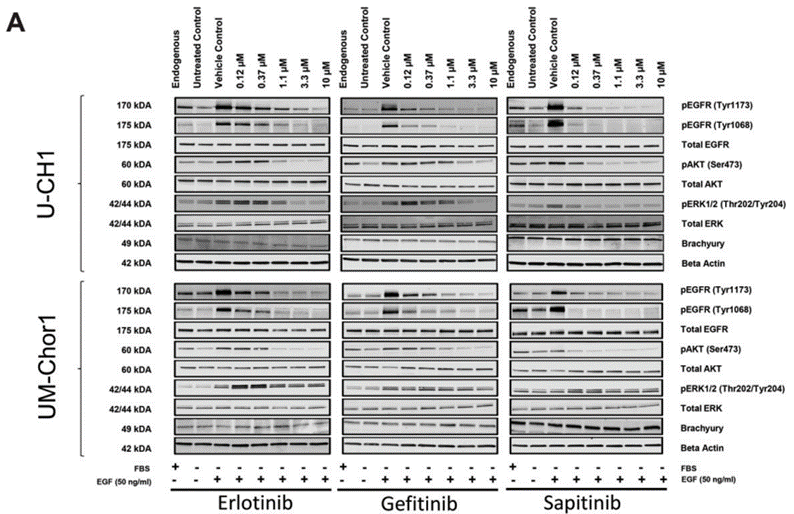
| Western blot | pEGFR / EGFR / pAKT / AKT / pERK / ERK HER3 / p-HER3 / HER2 / p-HER2 / p-PRAS40 / p-S6 / p-4EBP1 / p-FOXO / PARP / cleaved PARP |
|
27102572 |
| Growth inhibition assay | Cell viability |
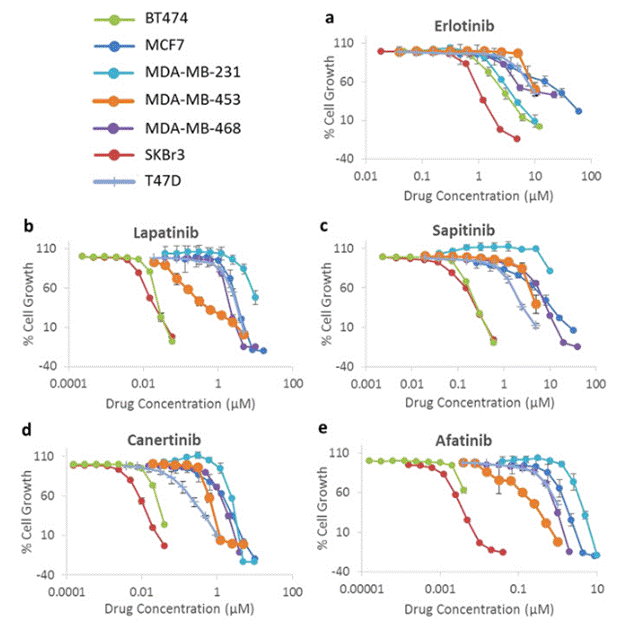
|
28638122 |
Informatie over klinische proeven
(gegevens van https://clinicaltrials.gov, bijgewerkt op 2024-05-22)
| NCT-nummer | Werving | Aandoeningen | Sponsor/medewerkers | Startdatum | Fasen |
|---|---|---|---|---|---|
| NCT01596530 | Terminated | Breast Neoplasm |
AstraZeneca |
June 2012 | Phase 1 |
| NCT01579578 | Terminated | Metastatic Gastric or Gastro-oesophageal Junction Cancer |
AstraZeneca |
April 2012 | Phase 2 |
| NCT01330758 | Completed | Healthy |
AstraZeneca |
April 2011 | Phase 1 |
| NCT01284595 | Completed | Healthy |
AstraZeneca |
March 2011 | Phase 1 |
| NCT01151215 | Terminated | Neoplasms|Breast Neoplasms|Breast Cancer |
AstraZeneca |
June 2010 | Phase 2 |
Technische ondersteuning
Tel: +1-832-582-8158 Ext:3
Als u nog andere vragen heeft, laat dan een bericht achter.

Producten zijn uitsluitend voor onderzoeksdoeleinden. Niet voor menselijk gebruik. Wij verkopen niet aan patiënten.
©Copyright 2013 Selleck Chemicals. Alle rechten voorbehouden.