
alleen voor onderzoeksdoeleinden
Paxalisib (GDC-0084) PI3K/mTOR-remmer
Cat.nr.: S8163
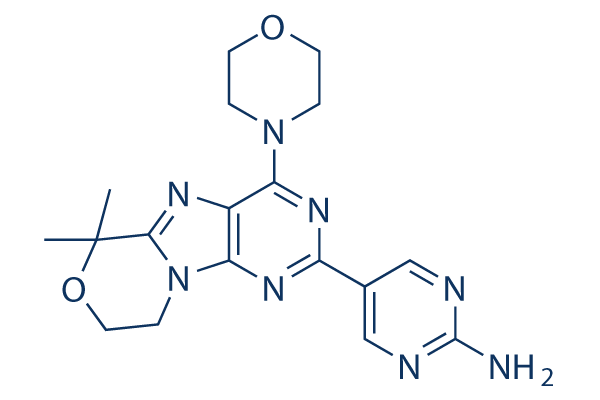
Chemische structuur
Molecuulgewicht: 382.42
Kwaliteitscontrole (Quality Control)
| Gerelateerde doelwitten | Akt mTOR GSK-3 ATM/ATR DNA-PK AMPK PDPK1 PTEN PI4K PP2A |
|---|---|
| Overig PI3K Inhibitoren | GDC-0077 (Inavolisib) SAR405 Quercetin (Sophoretin) LY294002 XL147 analogue Tersolisib (STX-478) Buparlisib (BKM120) 740 Y-P (PDGFR 740Y-P) GO-203 TFA Eganelisib (IPI-549) |
Chemische informatie, opslag en stabiliteit (Chemical Information, Storage & Stability)
| Molecuulgewicht | 382.42 | Formule | C18H22N8O2 |
Opslag (vanaf de datum van ontvangst) | |
|---|---|---|---|---|---|
| CAS-nr. | 1382979-44-3 | SDF downloaden | Opslag van stamoplossingen |
|
|
| Synoniemen | RG7666 | Smiles | CC1(C2=NC3=C(N2CCO1)N=C(N=C3N4CCOCC4)C5=CN=C(N=C5)N)C | ||
Oplosbaarheid (Solubility)
|
In vitro |
DMSO
: 5 mg/mL
(13.07 mM)
Water : Insoluble Ethanol : Insoluble |
Molariteitscalculator
|
In vivo |
|||||
In vivo formulatiecalculator (heldere oplossing)
Stap 1: Voer onderstaande informatie in (Aanbevolen: een extra dier om rekening te houden met verlies tijdens het experiment)
Stap 2: Voer de in vivo formulering in (Dit is alleen de calculator, geen formulering. Neem eerst contact met ons op als er geen in vivo formulering is in de sectie oplosbaarheid.)
Berekeningsresultaten:
Werkconcentratie: mg/ml;
Methode voor het bereiden van DMSO-moedervloeistof: mg geneesmiddel vooropgelost in μL DMSO ( Concentratie moedervloeistof mg/mL, Neem eerst contact met ons op als de concentratie de DMSO-oplosbaarheid van de batch van het geneesmiddel overschrijdt. )
Methode voor het bereiden van in vivo formulering: Neem μL DMSO moedervloeistof, voeg daarna toeμL PEG300, mengen en verhelderen, daarna toevoegenμL Tween 80, mengen en verhelderen, daarna toevoegen μL ddH2O, mengen en verhelderen.
Methode voor het bereiden van in vivo formulering: Neem μL DMSO moedervloeistof, voeg daarna toe μL Maïsolie, mengen en verhelderen.
Opmerking: 1. Zorg ervoor dat de vloeistof helder is voordat u het volgende oplosmiddel toevoegt.
2. Zorg ervoor dat u het/de oplosmiddel(en) in de juiste volgorde toevoegt. U moet ervoor zorgen dat de verkregen oplossing, bij de vorige toevoeging, een heldere oplossing is voordat u verdergaat met het toevoegen van het volgende oplosmiddel. Fysieke methoden zoals vortexen, ultrasoon of een warmwaterbad kunnen worden gebruikt om het oplossen te bevorderen.
Werkingsmechanisme (Mechanism of Action)
| Targets/IC50/Ki |
PI3Kα
(Cell-free assay) 2 nM(Ki app)
PI3Kδ
(Cell-free assay) 3 nM(Ki app)
PI3Kγ
(Cell-free assay) 10 nM(Ki app)
PI3Kβ
(Cell-free assay) 46 nM(Ki app)
mTOR
(Cell-free assay) 70 nM(Ki app)
|
|---|---|
| In vitro |
Paxalisib (GDC-0084) has excellent human metabolic stability in microsomal and hepatocyte incubations and demonstrated inhibition of pAKT, a key signal within the PI3K pathway, in normal brain tissue. This compound is shown to inhibit the proliferation of several glioma cells in vitro with IC50 ranging from 0.3 to 1.1 μM. Its binding to plasma proteins is low, with a free fraction (%) of 29.5±2.7 (n=3) in CD-1 mouse plasma, when tested at 5 μM. Binding to brain tissues from CD-1 mice is higher, with a free fraction of 6.7% (±1; n=3).
|
| In vivo |
Paxalisib (GDC-0084) markedly inhibits the PI3K pathway in mouse brain, causing up to 90% suppression of the pAkt signal. It achieves significant tumor growth inhibition of 70% and 40% against the U87 and GS2 orthotopic models, respectively. This compound's distribution throughout the brain and intracranial tumors leads to potent inhibition of the PI3K pathway. It is being evaluated in patients, and exposures reached at tolerated doses are consistent with those associated with efficacious doses in mouse models.
|
Referenties |
|
Informatie over klinische proeven (Clinical Trial Information)
(gegevens van https://clinicaltrials.gov, bijgewerkt op 2026-06-23)
| NCT-nummer | Werving | Aandoeningen | Sponsor/medewerkers | Startdatum | Fasen |
|---|---|---|---|---|---|
| NCT07447076 | RECRUITING | Recurrent Atypical Teratoid/Rhabdoid Tumor; Atypical Teratoid/Rhabdoid Tumor (ATRT) of the CNS |
Sabine Mueller, MD, PhD |
2026-06-17 | PHASE2 |
| NCT06208657 | RECRUITING | Childhood Cancer; Childhood Solid Tumor; Childhood Brain Tumor; Recurrent Cancer; Refractory Cancer |
Australian & New Zealand Children's Haematology/Oncology Group |
2024-07-10 | PHASE1; PHASE2 |
| NCT07391215 | RECRUITING | Malignant Primary Gliomas; Glioblastoma Multiforme (GBM) |
Institute of Cancer Research, United Kingdom |
2026-01-19 | PHASE1; PHASE2 |
| NCT03970447 | RECRUITING | Glioblastoma |
Global Coalition for Adaptive Research |
2019-07-30 | PHASE2; PHASE3 |
| NCT05009992 | RECRUITING | Diffuse Intrinsic Pontine Glioma; Diffuse Midline Glioma, H3 K27M-Mutant; Recurrent Diffuse Intrinsic Pontine Glioma; Recurrent Diffuse Midline Glioma, H3 K27M-Mutant; Recurrent WHO Grade III Glioma; WHO Grade III Glioma |
University of California, San Francisco |
2021-10-20 | PHASE2 |
| NCT07287202 | RECRUITING | Focal Cortical Dysplasia; Tuberous Sclerosis Complex (TSC); Hemimegalencephaly |
Sovargen |
2026-07-14 | PHASE1; PHASE2 |

Producten zijn uitsluitend voor onderzoeksdoeleinden. Niet voor menselijk gebruik. Wij verkopen niet aan patiënten.
©Copyright 2013 Selleck Chemicals. Alle rechten voorbehouden.