
alleen voor onderzoeksdoeleinden
ONC212 GPR agonist
Cat.nr.S8673
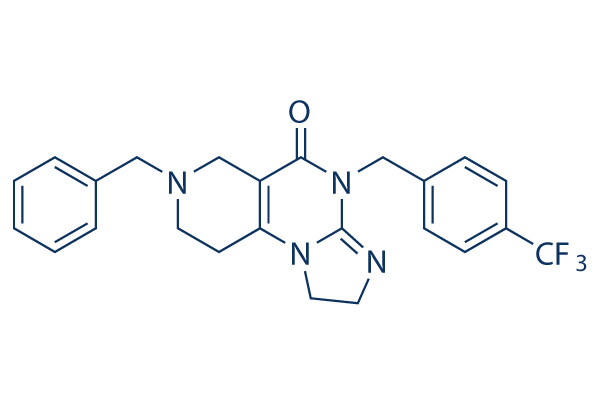
Chemische structuur
Molecuulgewicht: 440.46
Kwaliteitscontrole
| Gerelateerde doelwitten | CXCR Hedgehog/Smoothened PKA Adrenergic Receptor AChR 5-HT Receptor Histamine Receptor Dopamine Receptor Ras KRas |
|---|---|
| Overig GPR Inhibitoren | Fasiglifam(TAK-875) Hemihydrate GW9508 AH7614 3-chloro-5-hydroxybenzoic Acid JMS-17-2 GSK1292263 AZD1981 TC-G-1008 (GPR39-C3) SNAP94847 hydrochloride 6-OAU |
Chemische informatie, opslag en stabiliteit
| Molecuulgewicht | 440.46 | Formule | C24H23F3N4O |
Opslag (vanaf de datum van ontvangst) | |
|---|---|---|---|---|---|
| CAS-nr. | 1807861-48-8 | SDF downloaden | Opslag van stamoplossingen |
|
|
| Synoniemen | N/A | Smiles | C1CN(CC2=C1N3CCN=C3N(C2=O)CC4=CC=C(C=C4)C(F)(F)F)CC5=CC=CC=C5 | ||
Oplosbaarheid
|
In vitro |
DMSO
: 88 mg/mL
(199.79 mM)
Ethanol : 88 mg/mL Water : Insoluble |
Molariteitscalculator
|
In vivo |
|||||
In vivo formulatiecalculator (heldere oplossing)
Stap 1: Voer onderstaande informatie in (Aanbevolen: een extra dier om rekening te houden met verlies tijdens het experiment)
Stap 2: Voer de in vivo formulering in (Dit is alleen de calculator, geen formulering. Neem eerst contact met ons op als er geen in vivo formulering is in de sectie oplosbaarheid.)
Berekeningsresultaten:
Werkconcentratie: mg/ml;
Methode voor het bereiden van DMSO-moedervloeistof: mg geneesmiddel vooropgelost in μL DMSO ( Concentratie moedervloeistof mg/mL, Neem eerst contact met ons op als de concentratie de DMSO-oplosbaarheid van de batch van het geneesmiddel overschrijdt. )
Methode voor het bereiden van in vivo formulering: Neem μL DMSO moedervloeistof, voeg daarna toeμL PEG300, mengen en verhelderen, daarna toevoegenμL Tween 80, mengen en verhelderen, daarna toevoegen μL ddH2O, mengen en verhelderen.
Methode voor het bereiden van in vivo formulering: Neem μL DMSO moedervloeistof, voeg daarna toe μL Maïsolie, mengen en verhelderen.
Opmerking: 1. Zorg ervoor dat de vloeistof helder is voordat u het volgende oplosmiddel toevoegt.
2. Zorg ervoor dat u het/de oplosmiddel(en) in de juiste volgorde toevoegt. U moet ervoor zorgen dat de verkregen oplossing, bij de vorige toevoeging, een heldere oplossing is voordat u verdergaat met het toevoegen van het volgende oplosmiddel. Fysieke methoden zoals vortexen, ultrasoon of een warmwaterbad kunnen worden gebruikt om het oplossen te bevorderen.
Werkingsmechanisme
| In vitro |
ONC212 vertoont een anti-proliferatief effect in een groot panel van alvleesklierkankercellijnen, waarbij deze verbinding minstens tienmaal potenter is dan ONC201. Het induceert apoptose eerder en bij lagere concentraties dan ONC201 in gevoelige alvleesklierkankercellijnen. Deze verbinding oefent potente en prominente apoptogene effecten uit op cellijnen van acute myeloïde leukemie (AML) en mantelcellymfoom (MCL) (bijv. ED50's van 141,0 nM in p53 wild-type OCI-AML3-cellen, 105,7 nM in MOLM13-cellen en 265,2 nM in p53-null JeKo-1-cellijnen). Tijdverloopanalyse van apoptose in OCI-AML3-cellen toont aan dat het meer dan 36 uur duurt voordat apoptose wordt geïnduceerd. Deze chemische stof induceert significant Sub-G1 apoptotische cellen en/of celcyclusarrest.
|
|---|---|
| In vivo |
ONC212 toont verbeterde werkzaamheid in melanoom- en hepatocellulair carcinoom xenograftmodellen. Deze verbinding heeft een breed therapeutisch venster, een acceptabel PK-profiel en wordt oraal goed verdragen bij muizen zonder bewijs van toxiciteit bij werkzame doses in zowel darm- als tripel-negatieve borstkanker. Het vertoont snelle activiteitskinetiek. Deze chemische stof heeft een iets kortere halfwaardetijd dan ONC201, met een klaring uit het bloed na 12 uur, een T1/2 van 4,3 uur en een Cmax van 1,4 mg/mL. Het heeft een verlengd farmacodynamisch effect ondanks systemische klaring. Orale toediening toont een krachtige antitumorale werkzaamheid in een humaan melanoom xenograft en hepatocellulair model. ONC206 en ONC201 remmen beide de invasie en migratie van tumorcellen, terwijl deze verbinding alleen de invasie remt.
|
Referenties |
|
Technische ondersteuning
Tel: +1-832-582-8158 Ext:3
Als u nog andere vragen heeft, laat dan een bericht achter.

Producten zijn uitsluitend voor onderzoeksdoeleinden. Niet voor menselijk gebruik. Wij verkopen niet aan patiënten.
©Copyright 2013 Selleck Chemicals. Alle rechten voorbehouden.