
alleen voor onderzoeksdoeleinden
ARN-509 (Apalutamide) AR-antagonist
Cat.nr.S2840
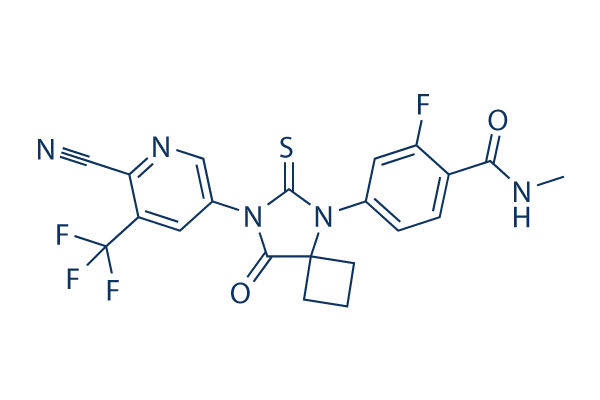
Chemische structuur
Molecuulgewicht: 477.43
Kwaliteitscontrole
| Gerelateerde doelwitten | Adrenergic Receptor Estrogen/progestogen Receptor GPR Glucocorticoid Receptor ACE RAAS Progesterone Receptor Opioid Receptor PGES THR |
|---|---|
| Overig Androgen Receptor Inhibitoren | Bavdegalutamide (ARV-110) RU58841 EPI-001 Galeterone Cyproterone Acetate 3,3'-Diindolylmethane Ailanthone Proxalutamide (GT0918) AZD3514 Chlormadinone acetate |
Celkweek, behandeling & werkzame concentratie
| Cellijnen | Assaytype | Concentratie | Incubatietijd | Formulering | Activiteitsbeschrijving | PMID |
|---|---|---|---|---|---|---|
| LNCAP cells | Proliferation assay | 3 days | Antiproliferative activity against human LNCAP cells after 3 days, IC50=0.174 μM | 26046313 | ||
| PSN1 cells | Cytotoxicity assay | 96 h | Cytotoxicity against human PSN1 cells after 96 hrs by ATP-lite luminescence assay, IC50=0.06 μM | 22247788 | ||
| PSN1 cells | Function assay | 30 nM | 24 h | Induction of cell cycle arrest in human PSN1 cells assessed as accumulation at G2/M phase cells at 30 nM after 24 hrs by flow cytometry | 22247788 | |
| LNCaP | Function assay | 30 mins | Displacement of [3H]-R1881 from AR in human LNCaP cells preincubated for 30 mins followed by [3H]-R1881 addition measured after 30 mins by microbeta scintillation counter method, IC50 = 0.01625 μM. | 28478926 | ||
| U-2 OS | qHTS assay | qHTS of pediatric cancer cell lines to identify multiple opportunities for drug repurposing: Primary screen for U-2 OS cells | 29435139 | |||
| A673 | qHTS assay | qHTS of pediatric cancer cell lines to identify multiple opportunities for drug repurposing: Primary screen for A673 cells | 29435139 | |||
| DAOY | qHTS assay | qHTS of pediatric cancer cell lines to identify multiple opportunities for drug repurposing: Primary screen for DAOY cells | 29435139 | |||
| BT-37 | qHTS assay | qHTS of pediatric cancer cell lines to identify multiple opportunities for drug repurposing: Primary screen for BT-37 cells | 29435139 | |||
| RD | qHTS assay | qHTS of pediatric cancer cell lines to identify multiple opportunities for drug repurposing: Primary screen for RD cells | 29435139 | |||
| SK-N-SH | qHTS assay | qHTS of pediatric cancer cell lines to identify multiple opportunities for drug repurposing: Primary screen for SK-N-SH cells | 29435139 | |||
| BT-12 | qHTS assay | qHTS of pediatric cancer cell lines to identify multiple opportunities for drug repurposing: Primary screen for BT-12 cells | 29435139 | |||
| MG 63 (6-TG R) | qHTS assay | qHTS of pediatric cancer cell lines to identify multiple opportunities for drug repurposing: Primary screen for MG 63 (6-TG R) cells | 29435139 | |||
| NB1643 | qHTS assay | qHTS of pediatric cancer cell lines to identify multiple opportunities for drug repurposing: Primary screen for NB1643 cells | 29435139 | |||
| Fibroblast cells | qHTS assay | qHTS of pediatric cancer cell lines to identify multiple opportunities for drug repurposing: Primary screen for control Hh wild type fibroblast cells | 29435139 | |||
| Rh41 | qHTS assay | qHTS of pediatric cancer cell lines to identify multiple opportunities for drug repurposing: Primary screen for Rh41 cells | 29435139 | |||
| Rh30 | qHTS assay | qHTS of pediatric cancer cell lines to identify multiple opportunities for drug repurposing: Primary screen for Rh30 cells | 29435139 | |||
| SJ-GBM2 | qHTS assay | qHTS of pediatric cancer cell lines to identify multiple opportunities for drug repurposing: Primary screen for SJ-GBM2 cells | 29435139 | |||
| SK-N-MC | qHTS assay | qHTS of pediatric cancer cell lines to identify multiple opportunities for drug repurposing: Primary screen for SK-N-MC cells | 29435139 | |||
| NB-EBc1 | qHTS assay | qHTS of pediatric cancer cell lines to identify multiple opportunities for drug repurposing: Primary screen for NB-EBc1 cells | 29435139 | |||
| LAN-5 | qHTS assay | qHTS of pediatric cancer cell lines to identify multiple opportunities for drug repurposing: Primary screen for LAN-5 cells | 29435139 | |||
| Rh18 | qHTS assay | qHTS of pediatric cancer cell lines to identify multiple opportunities for drug repurposing: Primary screen for Rh18 cells | 29435139 | |||
| Klik om meer experimentele gegevens over cellijnen te bekijken | ||||||
Chemische informatie, opslag en stabiliteit
| Molecuulgewicht | 477.43 | Formule | C21H15F4N5O2S |
Opslag (vanaf de datum van ontvangst) | |
|---|---|---|---|---|---|
| CAS-nr. | 956104-40-8 | SDF downloaden | Opslag van stamoplossingen |
|
|
| Synoniemen | N/A | Smiles | CNC(=O)C1=C(C=C(C=C1)N2C(=S)N(C(=O)C23CCC3)C4=CC(=C(N=C4)C#N)C(F)(F)F)F | ||
Oplosbaarheid
|
In vitro |
DMSO
: 95 mg/mL
(198.98 mM)
Ethanol : 7 mg/mL Water : Insoluble |
Molariteitscalculator
|
In vivo |
|||||
In vivo formulatiecalculator (heldere oplossing)
Stap 1: Voer onderstaande informatie in (Aanbevolen: een extra dier om rekening te houden met verlies tijdens het experiment)
Stap 2: Voer de in vivo formulering in (Dit is alleen de calculator, geen formulering. Neem eerst contact met ons op als er geen in vivo formulering is in de sectie oplosbaarheid.)
Berekeningsresultaten:
Werkconcentratie: mg/ml;
Methode voor het bereiden van DMSO-moedervloeistof: mg geneesmiddel vooropgelost in μL DMSO ( Concentratie moedervloeistof mg/mL, Neem eerst contact met ons op als de concentratie de DMSO-oplosbaarheid van de batch van het geneesmiddel overschrijdt. )
Methode voor het bereiden van in vivo formulering: Neem μL DMSO moedervloeistof, voeg daarna toeμL PEG300, mengen en verhelderen, daarna toevoegenμL Tween 80, mengen en verhelderen, daarna toevoegen μL ddH2O, mengen en verhelderen.
Methode voor het bereiden van in vivo formulering: Neem μL DMSO moedervloeistof, voeg daarna toe μL Maïsolie, mengen en verhelderen.
Opmerking: 1. Zorg ervoor dat de vloeistof helder is voordat u het volgende oplosmiddel toevoegt.
2. Zorg ervoor dat u het/de oplosmiddel(en) in de juiste volgorde toevoegt. U moet ervoor zorgen dat de verkregen oplossing, bij de vorige toevoeging, een heldere oplossing is voordat u verdergaat met het toevoegen van het volgende oplosmiddel. Fysieke methoden zoals vortexen, ultrasoon of een warmwaterbad kunnen worden gebruikt om het oplossen te bevorderen.
Werkingsmechanisme
| Targets/IC50/Ki |
Androgen Receptor
(Cell-free assay) 16 nM
|
|---|---|
| In vitro |
Apalutamide (ARN-509) (< 10 μM) remt androgeen-gemedieerde inductie of repressie van mRNA-expressieniveaus voor 13 endogene genen, waaronder PSA en TMPRSS2, in de LNCaP/AR-prostaatkankercellijn. Het remt ook het proliferatieve effect van R1881 (30 pM) in dezelfde cellijn. Bij 10 μM vermindert deze verbinding de nucleaire lokalisatie van AR en vermindert daardoor de concentratie van AR die beschikbaar is om androgeenrespons-elementen (ARE) te binden in LNCaP-cellen die AR-EYFP tot expressie brengen. Het is in staat om effectief te concurreren met R1881 (1 nM) en te voorkomen dat AR bindt aan promotorregio's. Bovendien remt het R1881-geïnduceerde VP16-AR-gemedieerde transcriptie met een IC50 van 0,2 μM in Hep-G2-cellen die een VP16-AR-fusie-eiwit en een ARE-gestuurde luciferase-reporter tot expressie brengen. |
| In vivo |
Apalutamide (ARN-509) (10 mg/kg/d, oraal) remt tumorgroei met een verlaagde proliferatieve index en een verhoogde apoptotische snelheid bij gecastreerde mannelijke immunodeficiënte muizen met LNCaP/AR-luc-xenografttumoren. Deze verbinding remt dosisafhankelijk de tumorgroei met de hoogste werkzaamheid bij een dosis van 30 mg/kg/dag bij gecastreerde mannelijke immunodeficiënte muizen met LNCaP/AR-luc-xenografttumoren. Een dosis van 10 mg/kg/d gedurende 28 dagen resulteert in een 3-voudige vermindering van het prostaatgewicht, geassocieerd met een gebrek aan glandulaire secretieactiviteit, en een 1,7-voudige vermindering van het epididymisgewicht bij volwassen mannelijke honden. De verbinding (10 mg/kg/d, oraal) remt celproliferatie van prostaatweefsels bij volwassen mannelijke honden. Het is veilig en goed verdraagbaar bij 24 patiënten met metastatische CRPC die progressie hadden vertoond na eerdere behandelingen, en piekplasmaconcentraties traden 2 tot 3 uur na toediening op. Dit middel resulteert in duurzame PSA-dalingen bij doses variërend van 30 tot 300 mg bij patiënten met metastatische CRPC. Het vertoont krachtige antikankeractiviteit en induceert duurzame remissies lang na voltooiing van de therapie in muismodellen voor castratieresistente prostaatkanker. |
Referenties |
|
Technische ondersteuning
Tel: +1-832-582-8158 Ext:3
Als u nog andere vragen heeft, laat dan een bericht achter.

Producten zijn uitsluitend voor onderzoeksdoeleinden. Niet voor menselijk gebruik. Wij verkopen niet aan patiënten.
©Copyright 2013 Selleck Chemicals. Alle rechten voorbehouden.