
alleen voor onderzoeksdoeleinden
Quinine HCl Dihydrate Potassium Channel remmer
Cat.nr.S2502
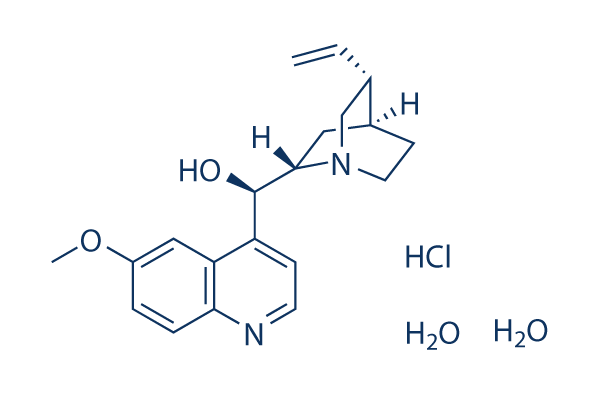
Chemische structuur
Molecuulgewicht: 396.91
Kwaliteitscontrole
| Gerelateerde doelwitten | CFTR CRM1 CD markers AChR Calcium Channel Sodium Channel GABA Receptor TRP Channel ATPase GluR |
|---|---|
| Overig Potassium Channel Inhibitoren | TRAM-34 Nicorandil ML133 HCl Sophocarpine Hydralazine HCl Nigericin Gliquidone E-4031 dihydrochloride PAP-1 Ajmaline |
Chemische informatie, opslag en stabiliteit
| Molecuulgewicht | 396.91 | Formule | C20H24N2O2.HCl.2H2O |
Opslag (vanaf de datum van ontvangst) | |
|---|---|---|---|---|---|
| CAS-nr. | 6119-47-7 | SDF downloaden | Opslag van stamoplossingen |
|
|
| Synoniemen | N/A | Smiles | COC1=CC2=C(C=CN=C2C=C1)C(C3CC4CCN3CC4C=C)O.O.O.Cl | ||
Oplosbaarheid
|
In vitro |
DMSO
: 79 mg/mL
(199.03 mM)
Ethanol : 79 mg/mL Water : 43 mg/mL |
Molariteitscalculator
|
In vivo |
|||||
In vivo formulatiecalculator (heldere oplossing)
Stap 1: Voer onderstaande informatie in (Aanbevolen: een extra dier om rekening te houden met verlies tijdens het experiment)
Stap 2: Voer de in vivo formulering in (Dit is alleen de calculator, geen formulering. Neem eerst contact met ons op als er geen in vivo formulering is in de sectie oplosbaarheid.)
Berekeningsresultaten:
Werkconcentratie: mg/ml;
Methode voor het bereiden van DMSO-moedervloeistof: mg geneesmiddel vooropgelost in μL DMSO ( Concentratie moedervloeistof mg/mL, Neem eerst contact met ons op als de concentratie de DMSO-oplosbaarheid van de batch van het geneesmiddel overschrijdt. )
Methode voor het bereiden van in vivo formulering: Neem μL DMSO moedervloeistof, voeg daarna toeμL PEG300, mengen en verhelderen, daarna toevoegenμL Tween 80, mengen en verhelderen, daarna toevoegen μL ddH2O, mengen en verhelderen.
Methode voor het bereiden van in vivo formulering: Neem μL DMSO moedervloeistof, voeg daarna toe μL Maïsolie, mengen en verhelderen.
Opmerking: 1. Zorg ervoor dat de vloeistof helder is voordat u het volgende oplosmiddel toevoegt.
2. Zorg ervoor dat u het/de oplosmiddel(en) in de juiste volgorde toevoegt. U moet ervoor zorgen dat de verkregen oplossing, bij de vorige toevoeging, een heldere oplossing is voordat u verdergaat met het toevoegen van het volgende oplosmiddel. Fysieke methoden zoals vortexen, ultrasoon of een warmwaterbad kunnen worden gebruikt om het oplossen te bevorderen.
Werkingsmechanisme
| Targets/IC50/Ki |
Potassium channel
|
|---|---|
| In vitro |
Kinine blokkeert Cx36- en Cx50-junctiestromen op een reversibele en concentratie-afhankelijke manier met halfmaximale blokkerende concentraties van respectievelijk 32 mM en 73 mM. Kinine induceert langzame overgangen tussen open en volledig gesloten toestanden die de open waarschijnlijkheid van het kanaal verminderden. Kinine biedt dus een potentieel nuttige methode om bepaalde typen gap junction-kanalen te blokkeren, inclusief die tussen neuronen die worden gevormd door Cx36. Kinine, een K+-kanaalblokker, voorkomt de vorming van tumornecrosefactor (TNF) en de daaropvolgende hepatische DNA-fragmentatie en lekkage van leverenzymen. Kinine veroorzaakt Fos-achtige immunoreactiviteit (FLI) geconcentreerd in het mediale derde deel van de nucleus; zuur veroorzaakte een breder verdeelde FLI die verder lateraal geconcentreerd was. Kinine heeft een relatief zwak effect op doxorubicine-accumulatie, maar was in staat om de doxorubicine-gevoeligheid in de resistente cellen volledig te herstellen. Kinine modificeert ook de intracellulaire tolerantie voor doxorubicine, wat suggereert dat het in staat is de medicijndistributie binnen de cellen te modificeren. Kinine blokkeert voornamelijk de hele cel kaliumstromen (IK) op een spanningsafhankelijke manier. Kinine vermindert ook de grootte van natriumstromen (INa) op een gebruiksafhankelijke manier, terwijl calciumstromen (ICa) relatief onaangetast blijven.
|
Referenties |
|
Informatie over klinische proeven
(gegevens van https://clinicaltrials.gov, bijgewerkt op 2024-05-22)
| NCT-nummer | Werving | Aandoeningen | Sponsor/medewerkers | Startdatum | Fasen |
|---|---|---|---|---|---|
| NCT04873011 | Unknown status | Obesity |
Universitaire Ziekenhuizen KU Leuven |
October 29 2020 | Phase 1 |
| NCT02817919 | Completed | Malaria |
African Collaborating Centre for Pharmacovigilance|Kintampo Health Research Centre Ghana|University of Health and Allied Sciences |
May 2016 | -- |
| NCT02598713 | Recruiting | Pneumonia|Aspiration |
Massachusetts General Hospital |
December 2015 | Phase 1 |
Technische ondersteuning
Tel: +1-832-582-8158 Ext:3
Als u nog andere vragen heeft, laat dan een bericht achter.

Producten zijn uitsluitend voor onderzoeksdoeleinden. Niet voor menselijk gebruik. Wij verkopen niet aan patiënten.
©Copyright 2013 Selleck Chemicals. Alle rechten voorbehouden.