
alleen voor onderzoeksdoeleinden
Latrepirdine 2HCl GluR antagonist
Cat.nr.S1245
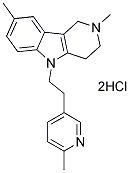
Chemische structuur
Molecuulgewicht: 392.37
Kwaliteitscontrole
Chemische informatie, opslag en stabiliteit
| Molecuulgewicht | 392.37 | Formule | C21H25N3.2HCl |
Opslag (vanaf de datum van ontvangst) | |
|---|---|---|---|---|---|
| CAS-nr. | 97657-92-6 | -- | Opslag van stamoplossingen |
|
|
| Synoniemen | N/A | Smiles | CC1=CC2=C(C=C1)N(C3=C2CN(CC3)C)CCC4=CN=C(C=C4)C.Cl.Cl | ||
Oplosbaarheid
|
In vitro |
DMSO
: 78 mg/mL
(198.79 mM)
Ethanol : 26 mg/mL Water : Insoluble |
Molariteitscalculator
|
In vivo |
|||||
In vivo formulatiecalculator (heldere oplossing)
Stap 1: Voer onderstaande informatie in (Aanbevolen: een extra dier om rekening te houden met verlies tijdens het experiment)
Stap 2: Voer de in vivo formulering in (Dit is alleen de calculator, geen formulering. Neem eerst contact met ons op als er geen in vivo formulering is in de sectie oplosbaarheid.)
Berekeningsresultaten:
Werkconcentratie: mg/ml;
Methode voor het bereiden van DMSO-moedervloeistof: mg geneesmiddel vooropgelost in μL DMSO ( Concentratie moedervloeistof mg/mL, Neem eerst contact met ons op als de concentratie de DMSO-oplosbaarheid van de batch van het geneesmiddel overschrijdt. )
Methode voor het bereiden van in vivo formulering: Neem μL DMSO moedervloeistof, voeg daarna toeμL PEG300, mengen en verhelderen, daarna toevoegenμL Tween 80, mengen en verhelderen, daarna toevoegen μL ddH2O, mengen en verhelderen.
Methode voor het bereiden van in vivo formulering: Neem μL DMSO moedervloeistof, voeg daarna toe μL Maïsolie, mengen en verhelderen.
Opmerking: 1. Zorg ervoor dat de vloeistof helder is voordat u het volgende oplosmiddel toevoegt.
2. Zorg ervoor dat u het/de oplosmiddel(en) in de juiste volgorde toevoegt. U moet ervoor zorgen dat de verkregen oplossing, bij de vorige toevoeging, een heldere oplossing is voordat u verdergaat met het toevoegen van het volgende oplosmiddel. Fysieke methoden zoals vortexen, ultrasoon of een warmwaterbad kunnen worden gebruikt om het oplossen te bevorderen.
Werkingsmechanisme
| Targets/IC50/Ki |
GluR
Histamine receptor
5-HT
|
|---|---|
| In vitro |
Latrepirdine verhoogt de succinaatdehydrogenase-activiteit (MTT-test), het mitochondriale membraanpotentiaal (DeltaPsim) en de cellulaire ATP-niveaus in primaire muizencorticale neuronen en menselijke neuroblastoomcellen (SH-SY5Y). Latrepirdine verbetert de mitochondriale functie zowel in afwezigheid als in aanwezigheid van stress, en met Dimebon behandelde cellen zijn gedeeltelijk beschermd om de cellevensvatbaarheid te behouden. Latrepirdine leidt tot verbeterde mTOR- en Atg5-afhankelijke autofagie in gekweekte zoogdiercellen. Latrepirdine stimuleert MTOR- en ATG5-afhankelijke autofagie, wat leidt tot de vermindering van intracellulaire niveaus van APP-metabolieten, waaronder Aβ in gekweekte cellen. Latrepirdine stimuleert de afbraak van α-syn in gedifferentieerde SH-SY5Y-neuronen, en in de hersenen van muizen na chronische toediening, parallel met een verhoging van de niveaus van markers van autofagische activiteit. Latrepirdine verhoogt intracellulaire ATP-niveaus en glucose transporter 3 translocatie naar het plasmamembraan in primaire neuronen.
|
| In vivo |
Behandeling met Latrepirdine van TgCRND8 transgene muizen is geassocieerd met verbeterd leergedrag en met een vermindering van de accumulatie van Aβ42 en α-synucleïne. Toediening van Latrepirdine resulteert in verhoogde niveaus van de biomarkers die naar verluidt correleren met autofagie-activering in de hersenen van TgCRND8 (APP K670M, N671L, V717F) of wild-type muizen, en die behandeling is geassocieerd met opheffing van gedragsstoornissen, vermindering van Aβ-neuropathologie en preventie van autofagisch falen bij TgCRND8-muizen.
|
Referenties |
|
Technische ondersteuning
Tel: +1-832-582-8158 Ext:3
Als u nog andere vragen heeft, laat dan een bericht achter.

Producten zijn uitsluitend voor onderzoeksdoeleinden. Niet voor menselijk gebruik. Wij verkopen niet aan patiënten.
©Copyright 2013 Selleck Chemicals. Alle rechten voorbehouden.