
alleen voor onderzoeksdoeleinden
Rotundine Dopamine Receptor antagonist
Cat.nr.S2437
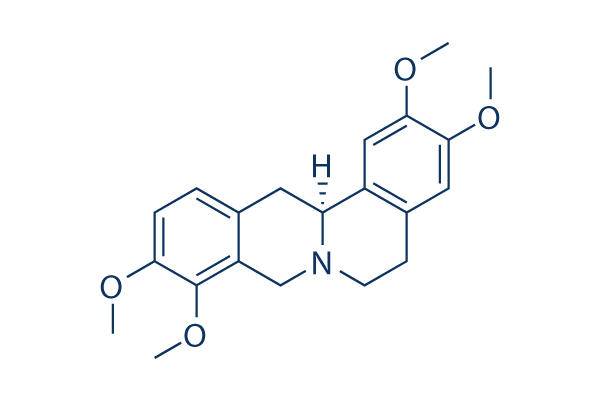
Chemische structuur
Molecuulgewicht: 355.43
Kwaliteitscontrole
| Gerelateerde doelwitten | Adrenergic Receptor AChR 5-HT Receptor COX Calcium Channel Histamine Receptor GABA Receptor TRP Channel Cholinesterase (ChE) GluR |
|---|---|
| Overig Dopamine Receptor Inhibitoren | MPTP Hydrochloride Trifluoperazine Trifluoperazine 2HCl Penfluridol Sulpiride Levosulpiride SCH-23390 hydrochloride Domperidone Azaperone SKF38393 HCl |
Chemische informatie, opslag en stabiliteit
| Molecuulgewicht | 355.43 | Formule | C21H25NO4 |
Opslag (vanaf de datum van ontvangst) | |
|---|---|---|---|---|---|
| CAS-nr. | 483-14-7 | SDF downloaden | Opslag van stamoplossingen |
|
|
| Synoniemen | L-tetrahydropalmatine, L-THP | Smiles | COC1=C(C2=C(CC3C4=CC(=C(C=C4CCN3C2)OC)OC)C=C1)OC | ||
Oplosbaarheid
|
In vitro |
DMSO
: 8 mg/mL
(22.5 mM)
Water : Insoluble Ethanol : Insoluble |
Molariteitscalculator
|
In vivo |
|||||
In vivo formulatiecalculator (heldere oplossing)
Stap 1: Voer onderstaande informatie in (Aanbevolen: een extra dier om rekening te houden met verlies tijdens het experiment)
Stap 2: Voer de in vivo formulering in (Dit is alleen de calculator, geen formulering. Neem eerst contact met ons op als er geen in vivo formulering is in de sectie oplosbaarheid.)
Berekeningsresultaten:
Werkconcentratie: mg/ml;
Methode voor het bereiden van DMSO-moedervloeistof: mg geneesmiddel vooropgelost in μL DMSO ( Concentratie moedervloeistof mg/mL, Neem eerst contact met ons op als de concentratie de DMSO-oplosbaarheid van de batch van het geneesmiddel overschrijdt. )
Methode voor het bereiden van in vivo formulering: Neem μL DMSO moedervloeistof, voeg daarna toeμL PEG300, mengen en verhelderen, daarna toevoegenμL Tween 80, mengen en verhelderen, daarna toevoegen μL ddH2O, mengen en verhelderen.
Methode voor het bereiden van in vivo formulering: Neem μL DMSO moedervloeistof, voeg daarna toe μL Maïsolie, mengen en verhelderen.
Opmerking: 1. Zorg ervoor dat de vloeistof helder is voordat u het volgende oplosmiddel toevoegt.
2. Zorg ervoor dat u het/de oplosmiddel(en) in de juiste volgorde toevoegt. U moet ervoor zorgen dat de verkregen oplossing, bij de vorige toevoeging, een heldere oplossing is voordat u verdergaat met het toevoegen van het volgende oplosmiddel. Fysieke methoden zoals vortexen, ultrasoon of een warmwaterbad kunnen worden gebruikt om het oplossen te bevorderen.
Werkingsmechanisme
| Targets/IC50/Ki |
D1 receptor
166 nM
5-HT1A
347 nM
D2 receptor
1.47 μM
D3 receptor
3.25 μM
|
|---|---|
| In vitro |
Rotundine vertoont een hogere affiniteit voor de Dopamine D1 dan voor de D2 receptor met een Ki van respectievelijk 124 nM en 388 nM, terwijl de IC50-waarden respectievelijk 166 nM (D1) en 1,47 μM (D2) zijn. Deze verbinding vertoont een zwakke remmende activiteit tegen Dopamine D3 met een IC50 van 3,25 μM. Het remt ook potent 5-HT1A met een IC50 van 374 nM en een Ki van 340 nM. Naast het antagonisme van postsynaptische Dopamine receptors leidt de remming van presynaptische autoreceptoren door deze chemische stof tot een verhoogde dopaminerge afgifte, wat waarschijnlijk wordt toegeschreven aan de lagere affiniteit van deze verbinding voor D2 receptors. Samen met Dopamine receptors kan het interageren met een aantal andere receptortypen, waaronder α-1 adrenerge receptoren, waar het functioneert als een antagonist, en γ-aminoboterzuurreceptoren, waar het de γ-aminoboterzuurbinding vergemakkelijkt door positieve allosterische effecten. |
| In vivo |
Rotundine-behandeling beïnvloedt de locomotorische activiteit niet bij doses van 6,25 mg/kg, 12,5 mg/kg of 18,75 mg/kg, maar antagoniseert significant de door oxycodon (5 mg/kg) geïnduceerde hyperactiviteit. Orale toediening van deze verbinding (10-25 mg/kg) verhoogt significant de hot-plate latentie bij muizen, wat aangeeft dat deze verbinding een opmerkelijke analgetische activiteit uitoefent, die geassocieerd is met β-endorfine-neuronen in de nucleus arcuatus en supraspinale D2 receptor. Toediening van deze chemische stof (1-10 mg/kg) verhoogt dosisafhankelijk, terwijl 20 mg/kg de frequentie van cocaïne-zelfadministratie onder fixed-ratio (FR)-versterking verlaagt, als gevolg van een postsynaptisch, in plaats van presynaptisch, DA receptor blokkerend mechanisme. In tegenstelling tot de effecten op de werking van cocaïne, produceert alleen de 10 mg/kg dosis van deze verbinding, maar niet 1 mg/kg of 3 mg/kg, een remmend effect op sucrose-zelfadministratie en locomotie. LD50: Muizen 1160 mg/kg (i.g.) |
Referenties |
|
Technische ondersteuning
Tel: +1-832-582-8158 Ext:3
Als u nog andere vragen heeft, laat dan een bericht achter.

Producten zijn uitsluitend voor onderzoeksdoeleinden. Niet voor menselijk gebruik. Wij verkopen niet aan patiënten.
©Copyright 2013 Selleck Chemicals. Alle rechten voorbehouden.