
alleen voor onderzoeksdoeleinden
CP-91149 Phosphorylase remmer
Cat.nr.S2717
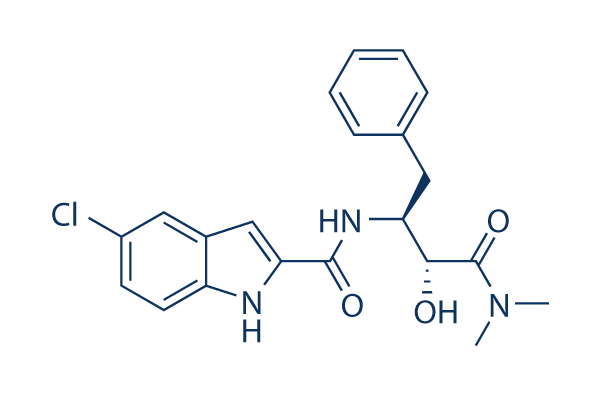
Chemische structuur
Molecuulgewicht: 399.87
Kwaliteitscontrole
| Gerelateerde doelwitten | Dehydrogenase HSP Transferase P450 (e.g. CYP17) PDE phosphatase PPAR Vitamin Carbohydrate Metabolism Mitochondrial Metabolism |
|---|---|
| Overig Phosphorylase Inhibitoren | Iso-H7 dihydrochloride Ingliforib |
Chemische informatie, opslag en stabiliteit
| Molecuulgewicht | 399.87 | Formule | C21H22ClN3O3 |
Opslag (vanaf de datum van ontvangst) | |
|---|---|---|---|---|---|
| CAS-nr. | 186392-40-5 | SDF downloaden | Opslag van stamoplossingen |
|
|
| Synoniemen | N/A | Smiles | CN(C)C(=O)C(C(CC1=CC=CC=C1)NC(=O)C2=CC3=C(N2)C=CC(=C3)Cl)O | ||
Oplosbaarheid
|
In vitro |
DMSO
: 80 mg/mL
(200.06 mM)
Water : Insoluble Ethanol : Insoluble |
Molariteitscalculator
|
In vivo |
|||||
In vivo formulatiecalculator (heldere oplossing)
Stap 1: Voer onderstaande informatie in (Aanbevolen: een extra dier om rekening te houden met verlies tijdens het experiment)
Stap 2: Voer de in vivo formulering in (Dit is alleen de calculator, geen formulering. Neem eerst contact met ons op als er geen in vivo formulering is in de sectie oplosbaarheid.)
Berekeningsresultaten:
Werkconcentratie: mg/ml;
Methode voor het bereiden van DMSO-moedervloeistof: mg geneesmiddel vooropgelost in μL DMSO ( Concentratie moedervloeistof mg/mL, Neem eerst contact met ons op als de concentratie de DMSO-oplosbaarheid van de batch van het geneesmiddel overschrijdt. )
Methode voor het bereiden van in vivo formulering: Neem μL DMSO moedervloeistof, voeg daarna toeμL PEG300, mengen en verhelderen, daarna toevoegenμL Tween 80, mengen en verhelderen, daarna toevoegen μL ddH2O, mengen en verhelderen.
Methode voor het bereiden van in vivo formulering: Neem μL DMSO moedervloeistof, voeg daarna toe μL Maïsolie, mengen en verhelderen.
Opmerking: 1. Zorg ervoor dat de vloeistof helder is voordat u het volgende oplosmiddel toevoegt.
2. Zorg ervoor dat u het/de oplosmiddel(en) in de juiste volgorde toevoegt. U moet ervoor zorgen dat de verkregen oplossing, bij de vorige toevoeging, een heldere oplossing is voordat u verdergaat met het toevoegen van het volgende oplosmiddel. Fysieke methoden zoals vortexen, ultrasoon of een warmwaterbad kunnen worden gebruikt om het oplossen te bevorderen.
Werkingsmechanisme
| Targets/IC50/Ki |
Glycogen phosphorylase (GP)
0.13 μM
|
|---|---|
| In vitro |
CP-91149 vertoont een 200-voudig hogere remmende activiteit tegen humane lever glycogeenfosforylase a (HLGPa) dan cafeïne (IC50 = 26 μM). Deze verbinding (10-100 μM) remt -gestimuleerde glycogenolyse in geïsoleerde rattenhepatocyten op een dosisafhankelijke manier, en in primaire humane hepatocyten met een IC50 van ~2,1 μM. Het remt ook potent de activiteiten van humane spierfosforylase a en b met IC50 van respectievelijk 0,2 μM en ~0,3 μM. Behandeling met deze chemische stof bij 2,5 μM induceert inactivatie van phosphorylase en sequentiële activering van glycogeen synthase in hepatocyten, en verhoogt de glycogeensynthese 7-voudig bij 5 mM glucose en 2-voudig bij 20 mM glucose. Het kan de effecten van phosphorylase-overexpressie gedeeltelijk tegengaan. Deze verbinding remt ook potent hersen-GP met IC50 van 0,5 μM in A549-cellen. Behandeling bij 10-30 μM veroorzaakt een significante glycogeenaccumulatie in A549- en HSF55-cellen. De behandeling verhoogt G1-fasecellen met een significante vermindering van de S-fasepopulatie in HSF55-cellen, gecorreleerd met verhoogde expressie van p21 en p27. Deze chemische stof bevordert ook de defosforylering en activering van GS (glycogeen synthase) in niet-gemodificeerde of GP-overexpresserende gekweekte humane spiercellen, maar uitsluitend in glucose-deprived cellen. |
| Kinase Assay |
Phosphorylase enzymtest
|
|
De activiteit van humane lever glycogeenfosforylase a (HLGPa, 85 ng) wordt gemeten in de richting van glycogeensynthese door de afgifte van fosfaat uit glucose-1-fosfaat bij 22°C in 100 μL buffer die 50 mM Hepes (pH 7,2), 100 mM KCl, 2,5 mM EGTA, 2,5 mM MgCl2, 0,5 mM glucose-1-fosfaat en 1 mg/mL glycogeen bevat. Fosfaat wordt gemeten bij 620 nm, 20 minuten na toevoeging van 150 μL 1 M HCl dat 10 mg/mL ammoniummolybdaat en 0,38 mg/mL malachietgroen bevat. Toenemende concentraties van deze verbinding worden aan de assay toegevoegd in 5 μL 14% DMSO.
|
|
| In vivo |
Orale toediening van CP-91149 aan diabetische ob/ob-muizen bij 25-50 mg/kg veroorzaakt een snelle (3 uur) glucoseverlaging met 100-120 mg/dl zonder hypoglykemie te veroorzaken, als gevolg van de remming van glycogenolyse in vivo. Deze behandeling met het middel verlaagt de glucosespiegels niet bij normoglycemische, niet-diabetische muizen. Bij niet-nuchtere Goto-Kakizaki (GK)-ratten onderdrukt toediening van deze chemische stof in combinatie met CS-917 de hepatische glycogeenreductie door CS-917 en verlaagt het plasma glucose meer dan enkelvoudige toediening van CS-917. |
Referenties |
|
Technische ondersteuning
Tel: +1-832-582-8158 Ext:3
Als u nog andere vragen heeft, laat dan een bericht achter.

Producten zijn uitsluitend voor onderzoeksdoeleinden. Niet voor menselijk gebruik. Wij verkopen niet aan patiënten.
©Copyright 2013 Selleck Chemicals. Alle rechten voorbehouden.