
alleen voor onderzoeksdoeleinden
CH5132799 PI3K remmer
Cat.nr.S2699
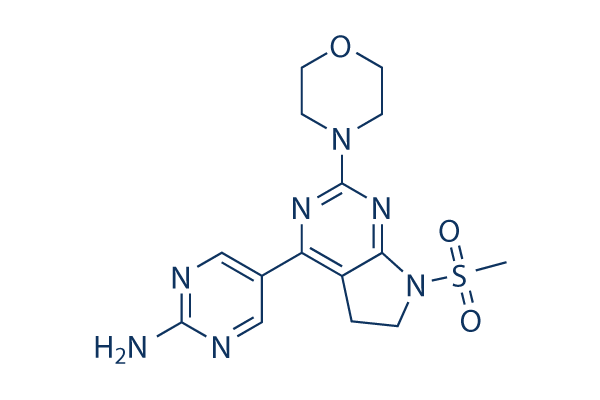
Chemische structuur
Molecuulgewicht: 377.42
Kwaliteitscontrole
| Gerelateerde doelwitten | Akt mTOR GSK-3 ATM/ATR DNA-PK AMPK PDPK1 PTEN PP2A PDK |
|---|---|
| Overig PI3K Inhibitoren | GDC-0077 (Inavolisib) SAR405 Quercetin (Sophoretin) LY294002 XL147 analogue Tersolisib (STX-478) Buparlisib (BKM120) 740 Y-P (PDGFR 740Y-P) GO-203 TFA Eganelisib (IPI-549) |
Chemische informatie, opslag en stabiliteit
| Molecuulgewicht | 377.42 | Formule | C15H19N7O3S |
Opslag (vanaf de datum van ontvangst) | |
|---|---|---|---|---|---|
| CAS-nr. | 1007207-67-1 | SDF downloaden | Opslag van stamoplossingen |
|
|
| Synoniemen | MEN1611, PA799 | Smiles | CS(=O)(=O)N1CCC2=C(N=C(N=C21)N3CCOCC3)C4=CN=C(N=C4)N | ||
Oplosbaarheid
|
In vitro |
DMSO
: 12 mg/mL
(31.79 mM)
Water : Insoluble Ethanol : Insoluble |
Molariteitscalculator
|
In vivo |
|||||
In vivo formulatiecalculator (heldere oplossing)
Stap 1: Voer onderstaande informatie in (Aanbevolen: een extra dier om rekening te houden met verlies tijdens het experiment)
Stap 2: Voer de in vivo formulering in (Dit is alleen de calculator, geen formulering. Neem eerst contact met ons op als er geen in vivo formulering is in de sectie oplosbaarheid.)
Berekeningsresultaten:
Werkconcentratie: mg/ml;
Methode voor het bereiden van DMSO-moedervloeistof: mg geneesmiddel vooropgelost in μL DMSO ( Concentratie moedervloeistof mg/mL, Neem eerst contact met ons op als de concentratie de DMSO-oplosbaarheid van de batch van het geneesmiddel overschrijdt. )
Methode voor het bereiden van in vivo formulering: Neem μL DMSO moedervloeistof, voeg daarna toeμL PEG300, mengen en verhelderen, daarna toevoegenμL Tween 80, mengen en verhelderen, daarna toevoegen μL ddH2O, mengen en verhelderen.
Methode voor het bereiden van in vivo formulering: Neem μL DMSO moedervloeistof, voeg daarna toe μL Maïsolie, mengen en verhelderen.
Opmerking: 1. Zorg ervoor dat de vloeistof helder is voordat u het volgende oplosmiddel toevoegt.
2. Zorg ervoor dat u het/de oplosmiddel(en) in de juiste volgorde toevoegt. U moet ervoor zorgen dat de verkregen oplossing, bij de vorige toevoeging, een heldere oplossing is voordat u verdergaat met het toevoegen van het volgende oplosmiddel. Fysieke methoden zoals vortexen, ultrasoon of een warmwaterbad kunnen worden gebruikt om het oplossen te bevorderen.
Werkingsmechanisme
| Targets/IC50/Ki |
PI3Kα
14 nM
PI3Kγ
36 nM
PI3Kβ
0.12 μM
PI3Kδ
0.50 μM
|
|---|---|
| In vitro |
CH5132799 remt selectief klasse I PI3K's, PI3Kα (IC50 = 0,014 μM), PI3Kβ (IC50 = 0,12 μM), PI3Kδ (IC50 = 0,50 μM), PI3Kγ (IC50 = 0,036 μM), maar vertoont minder remming van klasse II PI3K's, klasse III PI3k en mTOR en ook geen remmende activiteit (IC50 > 10 μM) tegen 26 proteïnekinasen. Deze verbinding vertoont meer remmende activiteiten tegen PI3Kα met oncogene mutaties E542K (IC50 = 6,7 nM), E545K (IC50 = 6,7 nM) en H1047R (IC50 = 5,6 nM) dan wild-type PI3Kα. Bij chemisch behandelde borstkanker KPL-4-cellen, die de PIK3CA-mutatie bevatten, worden de fosforylering van Akt en zijn directe substraten, PRAS40 en FoxO1/3a, en de fosforylering van stroomafwaartse factoren, waaronder S6K, S6 en 4E-BP1, effectief onderdrukt. Kankercellijnen die PIK3CA-mutaties bevatten, zijn significant gevoelig voor deze verbinding In menselijke tumorcellijnen met PI3K-route-activering door mutatie, vertoont het een potente antiproliferatieve activiteit [HCT116(CRC): IC50 = 0,20 lM, KPL-4(BC):13 IC50 = 0,032 lM, T-47D(BC): IC50 = 0,056 lM, SK-OV-3(Ovarieel): IC50 = 0,12 lM]. Het onderdrukt effectief de fosforylering van AKT in KPL-4-cellen.
|
| Kinase Assay |
PI3K-test
|
|
De E542K-, E545K- en H1047R-mutanten van PI3Kα worden bereid met een overlappende extensie-polymeraseketenreactie. Glutathion S-transferase-getagde PI3Kα-mutanten en His-getagde p85α worden co-uitgedrukt met het BAC-TO-BAC Baculovirus Expressiesysteem. De remmende activiteiten van deze verbinding op PI3Kα (p110α/p85α), PI3Kβ(p110β/p85α), PI3Kδ (p110δ/p85α), PI3Kγ (p110γ), PI3KC2α, PI3KC2β, Vps34 en PI3Kα-mutanten worden bepaald met de Adapta Universal Kinase Assay Kit. Tijd-opgeloste fluorescentie wordt gemeten met een EnVision HTS microplaatlezer. IC50-waarden worden berekend met XLfit.
|
|
| In vivo |
CH5132799 vertoont een potente in vivo antitumoractiviteit in verschillende xenograftmodellen met PIK3CA-mutaties. Deze verbinding overwint mTORC1-remming-gemedieerde Akt-activering en hergroei van xenografttumoren door langdurige everolimus-toediening. Het is een klinische kandidaat die uitstekende orale biologische beschikbaarheid (BA) (101% bij muizen), humane microsomale leverstabiliteit en in vivo antitumoractiviteit in het PC-3 xenograftmodel (TGI: 101% bij 25 mg/kg, po, q.d. × 11 dagen) vertoont. Deze chemische stof vertoont een goede orale BA bij muizen, ratten, apen en honden (F: 54,2-101%). In een humaan borstkanker (KPL-4: PI3Ka H1047R) xenograftmodel bij muizen, toont orale behandeling met deze verbinding (12,5 mg/kg, q.d.) een sterke tumorregressie. De sterke regressie wordt gedurende de 6 weken durende toediening gehandhaafd, zelfs in het intermitterende doseringsschema (q.d., 2 weken aan/1 week af; q.d., 5 dagen aan/2 dagen af), wat suggereert dat een flexibel toedieningsschema toepasbaar kan zijn in de kliniek.
|
Referenties |
|
Informatie over klinische proeven
(gegevens van https://clinicaltrials.gov, bijgewerkt op 2024-05-22)
| NCT-nummer | Werving | Aandoeningen | Sponsor/medewerkers | Startdatum | Fasen |
|---|---|---|---|---|---|
| NCT01222546 | Completed | Solid Tumors |
Chugai Pharma Europe Ltd. |
August 2010 | Phase 1 |
Technische ondersteuning
Tel: +1-832-582-8158 Ext:3
Als u nog andere vragen heeft, laat dan een bericht achter.

Producten zijn uitsluitend voor onderzoeksdoeleinden. Niet voor menselijk gebruik. Wij verkopen niet aan patiënten.
©Copyright 2013 Selleck Chemicals. Alle rechten voorbehouden.