
alleen voor onderzoeksdoeleinden
Adavosertib (AZD1775, MK-1775) Wee1 remmer
Cat.nr.S1525
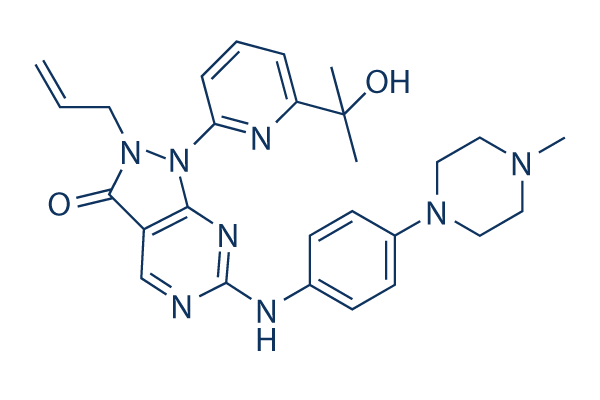
Chemische structuur
Molecuulgewicht: 500.6
Kwaliteitscontrole
| Gerelateerde doelwitten | CDK HSP PD-1/PD-L1 ROCK DNA/RNA Synthesis Microtubule Associated Ras KRas Aurora Kinase Casein Kinase |
|---|---|
| Overig Wee1 Inhibitoren | PD0166285 Zedoresertib (Debio-0123, WEE1-IN-5) Azenosertib (Zn-C3) Potrasertib |
Celkweek, behandeling & werkzame concentratie
| Cellijnen | Assaytype | Concentratie | Incubatietijd | Formulering | Activiteitsbeschrijving | PMID |
|---|---|---|---|---|---|---|
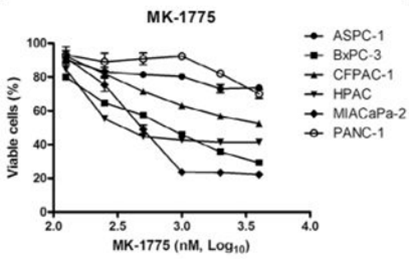
| ASPC-1 | Growth Inhibition Assay | IC50=13.2 ± 1.1 μM | 25458954 | |||
| BxPC-3 | Growth Inhibition Assay | IC50=0.8 ± 0.03 μM | 25458954 | |||
| CFPAC-1 | Growth Inhibition Assay | IC50=3.3 ± 0.2 μM | 25458954 | |||
| HPAC | Growth Inhibition Assay | IC50=0.5 ± 0.01 μM | 25458954 | |||
| MIAPaCa-2 | Growth Inhibition Assay | IC50=0.5 ± 0.05 μM | 25458954 | |||
| PANC-1 | Growth Inhibition Assay | IC50=10.6 ± 1.1 μM | 25458954 | |||
| SK-N-BE (2) | Growth Inhibition Assay | IC50=2.4 ± 0.3 μM | 25308916 | |||
| SK-N-BE (2), PAN→MK | Growth Inhibition Assay | IC50=26.6 ± 9.6 μM | 25308916 | |||
| SK-N-BE (2), MK→PAN | Growth Inhibition Assay | IC50=2.4 ± 0.3 μM | 25308916 | |||
| SK-N-AS | Growth Inhibition Assay | IC50=0.50 ± 0.02 μM | 25308916 | |||
| SK-N-DZ | Growth Inhibition Assay | IC50=0.36 ± 0.01 μM | 25308916 | |||
| SK-N-AS | Apoptosis Assay | 500 nM | 48 h | induces cell apoptosis | 25308916 | |
| SK-N-DZ | Apoptosis Assay | 500 nM | 48 h | induces cell apoptosis | 25308916 | |
| THP-1 | Growth Inhibition Assay | 125/250/500 nM | 48 h | increases cell death in a concentration-dependent manner | 25084614 | |
| MV4-11 | Growth Inhibition Assay | 125/250/500 nM | 48 h | increases cell death in a concentration-dependent manner | 25084614 | |
| U937 | Growth Inhibition Assay | 125/250/500 nM | 48 h | increases cell death in a concentration-dependent manner | 25084614 | |
| HL-60 | Growth Inhibition Assay | 125/250/500 nM | 48 h | increases cell death in a concentration-dependent manner | 25084614 | |
| OCI-AML3 | Growth Inhibition Assay | 125/250/500 nM | 48 h | increases cell death in a concentration-dependent manner | 25084614 | |
| MOLM-13 | Growth Inhibition Assay | 125/250/500 nM | 48 h | increases cell death in a concentration-dependent manner | 25084614 | |
| CMK | Cell Viability Assay | 10-10000 nM | 72 h | reduces cell vialibity in a concentration-dependent manner | 24962331 | |
| CMY | Cell Viability Assay | 10-10000 nM | 72 h | reduces cell vialibity in a concentration-dependent manner | 24962331 | |
| Dayo | Growth Inhibition Assay | IC50=150 nM | 24661910 | |||
| UW228 | Growth Inhibition Assay | IC50=232 nM | 24661910 | |||
| IST-MES1 | Cell Viability Assay | 150/250 nM | 72 h | enhances the cisplatin cytotoxic effect in a concentration-dependent manner | 24365782 | |
| IST-MES2 | Cell Viability Assay | 150/250 nM | 72 h | enhances the cisplatin cytotoxic effect in a concentration-dependent manner | 24365782 | |
| REN | Cell Viability Assay | 150/250 nM | 72 h | enhances the cisplatin cytotoxic effect in a concentration-dependent manner | 24365782 | |
| NCI-H2452 | Cell Viability Assay | 150/250 nM | 72 h | enhances the cisplatin cytotoxic effect in a concentration-dependent manner | 24365782 | |
| MSTO-211H | Cell Viability Assay | 150/250 nM | 72 h | enhances the cisplatin cytotoxic effect in a concentration-dependent manner | 24365782 | |
| NCI-H2052 | Cell Viability Assay | 150/250 nM | 72 h | enhances the cisplatin cytotoxic effect in a concentration-dependent manner | 24365782 | |
| WEE1 | Growth Inhibition Assay | IC50=5.2 nM | 23699655 | |||
| CDC2 | Growth Inhibition Assay | IC50>1000 nM | 23699655 | |||
| CDK7 | Growth Inhibition Assay | IC50>1000 nM | 23699655 | |||
| MYT1 | Growth Inhibition Assay | IC50=530 nM | 23699655 | |||
| T98G | Apoptosis Assay | 100/250 nM | 6 h | enhances radiation-induced cell killing | 21992793 | |
| A549 | Apoptosis Assay | 200 nM | 1 h | radiosensitizes NSCLC cells in a p53-dependent manner | 21799033 | |
| H460 | Apoptosis Assay | 200 nM | 1 h | radiosensitizes NSCLC cells in a p53-dependent manner | 21799033 | |
| H1299 | Apoptosis Assay | 200 nM | 1 h | radiosensitizes NSCLC cells in a p53-dependent manner | 21799033 | |
| Calu-6 | Apoptosis Assay | 200 nM | 1 h | radiosensitizes NSCLC cells in a p53-dependent manner | 21799033 | |
| WiDr | Kinase Assays | 10-10000 nM | 8 h | inhibits phosphorylation of CDC2 at Tyr15 with an EC50 value of 85 nmol/L pretreated with gemcitabine | 19887545 | |
| Function assay | Expi293F | Binding affinity to recombinant human full-length N-terminal His8-tagged Wee1 (1 to 646 residues) expressed in human Expi293F cells assessed as dessociation constant by quantitative real-time PCR method, Kd = 0.0032 μM. | 28792760 | |||
| Function assay | Expi293F | Binding affinity to recombinant human full-length N-terminal His8-tagged Wee2 (1 to 567 residues) expressed in human Expi293F cells assessed as dessociation constant by quantitative real-time PCR method, Kd = 0.0039 μM. | 28792760 | |||
| Antiproliferative assay | MDA-MB-231 | 72 hrs | Antiproliferative activity against human MDA-MB-231 cells measured after 72 hrs by CellTiter-Blue assay, IC50 = 0.26 μM. | 28792760 | ||
| Antiproliferative assay | HEK293T | 72 hrs | Antiproliferative activity against HEK293T cells measured after 72 hrs by CellTiter-Blue assay, IC50 = 0.29 μM. | 28792760 | ||
| Antiproliferative assay | MM1S | 72 hrs | Antiproliferative activity against human MM1S cells measured after 72 hrs by CellTiter-Blue assay, IC50 = 0.31 μM. | 28792760 | ||
| Function assay | HEK293 | 1 hr | Inhibition of human full length PKMYT1 expressed in HEK293 cells using EFS (247 to 259 residues) as substrate after 1 hr by fluorescence polarization immunoasay, Ki = 0.47 μM. | 29941193 | ||
| Function assay | HEK293 | 1 hr | Inhibition of human full length PKMYT1 expressed in HEK293 cells using EFS (247 to 259 residues) as substrate after 1 hr by fluorescence polarization immunoasay, IC50 = 4.94 μM. | 29941193 | ||
| Function assay | MDA-MB-231 | 0.1 to 10 uM | 6 hrs | Inhibition of Wee1 in human MDA-MB-231 cells assessed as decrease in CDK1 phosphorylation at Tyr 15 at 0.1 to 10 uM after 6 hrs by Western blot method | 28792760 | |
| Function assay | HEK293T | 0.1 to 10 uM | 6 hrs | Inhibition of Wee1 in HEK293T cells assessed as decrease in CDK1 phosphorylation at Tyr15 at 0.1 to 10 uM after 6 hrs by Western blot method | 28792760 | |
| Function assay | HEK293T | 0.1 to 10 uM | 6 hrs | Inhibition of PLK1 in HEK293T cells assessed as decrease in TCTP phosphorylation at 0.1 to 10 uM after 6 hrs by Western blot method | 28792760 | |
| Function assay | MDA-MB-23 | 0.1 to 10 uM | 6 hrs | Inhibition of PLK1 in human MDA-MB-23 cells assessed as decrease in TCTP phosphorylation at 0.1 to 10 uM after 6 hrs by Western blot method | 28792760 | |
| qHTS assay | TC32 | qHTS of pediatric cancer cell lines to identify multiple opportunities for drug repurposing: Primary screen for TC32 cells | 29435139 | |||
| qHTS assay | U-2 OS | qHTS of pediatric cancer cell lines to identify multiple opportunities for drug repurposing: Primary screen for U-2 OS cells | 29435139 | |||
| qHTS assay | A673 | qHTS of pediatric cancer cell lines to identify multiple opportunities for drug repurposing: Primary screen for A673 cells | 29435139 | |||
| qHTS assay | DAOY | qHTS of pediatric cancer cell lines to identify multiple opportunities for drug repurposing: Primary screen for DAOY cells | 29435139 | |||
| qHTS assay | Saos-2 | qHTS of pediatric cancer cell lines to identify multiple opportunities for drug repurposing: Primary screen for Saos-2 cells | 29435139 | |||
| qHTS assay | BT-37 | qHTS of pediatric cancer cell lines to identify multiple opportunities for drug repurposing: Primary screen for BT-37 cells | 29435139 | |||
| qHTS assay | RD | qHTS of pediatric cancer cell lines to identify multiple opportunities for drug repurposing: Primary screen for RD cells | 29435139 | |||
| qHTS assay | SK-N-SH | qHTS of pediatric cancer cell lines to identify multiple opportunities for drug repurposing: Primary screen for SK-N-SH cells | 29435139 | |||
| qHTS assay | BT-12 | qHTS of pediatric cancer cell lines to identify multiple opportunities for drug repurposing: Primary screen for BT-12 cells | 29435139 | |||
| qHTS assay | NB1643 | qHTS of pediatric cancer cell lines to identify multiple opportunities for drug repurposing: Primary screen for NB1643 cells | 29435139 | |||
| qHTS assay | OHS-50 | qHTS of pediatric cancer cell lines to identify multiple opportunities for drug repurposing: Primary screen for OHS-50 cells | 29435139 | |||
| qHTS assay | BT-12 | qHTS of pediatric cancer cell lines to identify multiple opportunities for drug repurposing: Confirmatory screen for BT-12 cells | 29435139 | |||
| qHTS assay | DAOY | qHTS of pediatric cancer cell lines to identify multiple opportunities for drug repurposing: Confirmatory screen for DAOY cells | 29435139 | |||
| qHTS assay | SK-N-SH | qHTS of pediatric cancer cell lines to identify multiple opportunities for drug repurposing: Confirmatory screen for SK-N-SH cells | 29435139 | |||
| qHTS assay | Rh41 | qHTS of pediatric cancer cell lines to identify multiple opportunities for drug repurposing: Primary screen for Rh41 cells | 29435139 | |||
| qHTS assay | A673 | qHTS of pediatric cancer cell lines to identify multiple opportunities for drug repurposing: Confirmatory screen for A673 cells) | 29435139 | |||
| qHTS assay | MG 63 (6-TG R) | qHTS of pediatric cancer cell lines to identify multiple opportunities for drug repurposing: Confirmatory screen for MG 63 (6-TG R) cells | 29435139 | |||
| qHTS assay | U-2 OS | qHTS of pediatric cancer cell lines to identify multiple opportunities for drug repurposing: Confirmatory screen for U-2 OS cells | 29435139 | |||
| qHTS assay | OHS-50 | qHTS of pediatric cancer cell lines to identify multiple opportunities for drug repurposing: Confirmatory screen for OHS-50 cells | 29435139 | |||
| qHTS assay | Rh41 | qHTS of pediatric cancer cell lines to identify multiple opportunities for drug repurposing: Confirmatory screen for Rh41 cells | 29435139 | |||
| qHTS assay | RD | qHTS of pediatric cancer cell lines to identify multiple opportunities for drug repurposing: Confirmatory screen for RD cells | 29435139 | |||
| qHTS assay | SJ-GBM2 | qHTS of pediatric cancer cell lines to identify multiple opportunities for drug repurposing: Primary screen for SJ-GBM2 cells | 29435139 | |||
| qHTS assay | SK-N-MC | qHTS of pediatric cancer cell lines to identify multiple opportunities for drug repurposing: Primary screen for SK-N-MC cells | 29435139 | |||
| qHTS assay | NB-EBc1 | qHTS of pediatric cancer cell lines to identify multiple opportunities for drug repurposing: Primary screen for NB-EBc1 cells | 29435139 | |||
| qHTS assay | LAN-5 | qHTS of pediatric cancer cell lines to identify multiple opportunities for drug repurposing: Primary screen for LAN-5 cells | 29435139 | |||
| qHTS assay | Rh18 | qHTS of pediatric cancer cell lines to identify multiple opportunities for drug repurposing: Primary screen for Rh18 cells | 29435139 | |||
| qHTS assay | SJ-GBM2 | qHTS of pediatric cancer cell lines to identify multiple opportunities for drug repurposing: Confirmatory screen for SJ-GBM2 cells | 29435139 | |||
| qHTS assay | Saos-2 | qHTS of pediatric cancer cell lines to identify multiple opportunities for drug repurposing: Confirmatory screen for Saos-2 cells | 29435139 | |||
| Klik om meer experimentele gegevens over cellijnen te bekijken | ||||||
Chemische informatie, opslag en stabiliteit
| Molecuulgewicht | 500.6 | Formule | C27H32N8O2 |
Opslag (vanaf de datum van ontvangst) | |
|---|---|---|---|---|---|
| CAS-nr. | 955365-80-7 | SDF downloaden | Opslag van stamoplossingen |
|
|
| Synoniemen | AZD1775 | Smiles | CC(C)(C1=NC(=CC=C1)N2C3=NC(=NC=C3C(=O)N2CC=C)NC4=CC=C(C=C4)N5CCN(CC5)C)O | ||
Oplosbaarheid
|
In vitro |
DMSO
: 100 mg/mL
(199.76 mM)
Water : Insoluble Ethanol : Insoluble |
Molariteitscalculator
|
In vivo |
|||||
In vivo formulatiecalculator (heldere oplossing)
Stap 1: Voer onderstaande informatie in (Aanbevolen: een extra dier om rekening te houden met verlies tijdens het experiment)
Stap 2: Voer de in vivo formulering in (Dit is alleen de calculator, geen formulering. Neem eerst contact met ons op als er geen in vivo formulering is in de sectie oplosbaarheid.)
Berekeningsresultaten:
Werkconcentratie: mg/ml;
Methode voor het bereiden van DMSO-moedervloeistof: mg geneesmiddel vooropgelost in μL DMSO ( Concentratie moedervloeistof mg/mL, Neem eerst contact met ons op als de concentratie de DMSO-oplosbaarheid van de batch van het geneesmiddel overschrijdt. )
Methode voor het bereiden van in vivo formulering: Neem μL DMSO moedervloeistof, voeg daarna toeμL PEG300, mengen en verhelderen, daarna toevoegenμL Tween 80, mengen en verhelderen, daarna toevoegen μL ddH2O, mengen en verhelderen.
Methode voor het bereiden van in vivo formulering: Neem μL DMSO moedervloeistof, voeg daarna toe μL Maïsolie, mengen en verhelderen.
Opmerking: 1. Zorg ervoor dat de vloeistof helder is voordat u het volgende oplosmiddel toevoegt.
2. Zorg ervoor dat u het/de oplosmiddel(en) in de juiste volgorde toevoegt. U moet ervoor zorgen dat de verkregen oplossing, bij de vorige toevoeging, een heldere oplossing is voordat u verdergaat met het toevoegen van het volgende oplosmiddel. Fysieke methoden zoals vortexen, ultrasoon of een warmwaterbad kunnen worden gebruikt om het oplossen te bevorderen.
Werkingsmechanisme
| Kenmerken |
The first reported Wee1 inhibitor.
|
|---|---|
| Targets/IC50/Ki |
Wee1
(Cell-free assay) 5.2 nM
|
| In vitro |
Adavosertib (MK-1775) remt Wee1 kinase op een ATP-competitieve manier. Vergeleken met Wee1 vertoont het 2- tot 3-voudig minder potentie tegen Yes met een IC50 van 14 nM, 10-voudig minder potentie tegen zeven andere kinases met >80% remming bij 1 µM, en >100-voudige selectiviteit ten opzichte van humaan Myt 1, een ander kinase dat cycline-afhankelijke kinase 1 (CDC2) remt door fosforylering op een alternatieve site (Thr14). Door het DNA-schadecheckpoint op te heffen via blokkade van Wee1-activiteit in WiDr-cellen met gemuteerd p53, remt deze verbinding de basale fosforylering van CDC2 op Tyr15 (CDC2Y15) met een EC50 van 49 nM, en onderdrukt het de geïnduceerde fosforylering van CDC2 en Cell Cycle-arrest op een dosisafhankelijke manier, met EC50 van respectievelijk 82 nM en 81 nM, 180 nM en 163 nM, evenals 159 nM en 160 nM. De behandeling alleen bij 30-100 nM heeft geen significant antiproliferatief effect in WiDr- en H1299-cellen, terwijl bij 300 nM, voldoende om Wee1 met >80% te remmen, het matige maar significante antiproliferatieve effecten vertoont van 34,1% in WiDr-cellen en 28,4% in H1299-cellen. |
| Kinase Assay |
In vitro kinase assays
|
|
Recombinant humaan Wee1 wordt gebruikt. De kinasereactie wordt uitgevoerd met 10 μM ATP, 1,0 μCi [γ-33P]ATP en 2,5 μg poly(Lys, Tyr) als substraat in aanwezigheid van toenemende concentraties Adavosertib (MK-1775) bij 30°C gedurende 30 minuten. Radioactiviteit die in het substraat is opgenomen, wordt opgevangen op MultiScreen-PH-platen en geteld met een vloeistofscintillatieteller.
|
|
| In vivo |
Adavosertib (MK-1775) behandeling alleen bij ~20 mg/kg vertoont minimale antitumorale effecten tegen WiDr xenografts bij ratten met T/C van 69% op dag 3. De antitumorale werkzaamheid in de naakte rat HeLa-luc en TOV21G-shp53 xenograft modellen is ook matig. |
Referenties |
Toepassingen
| Methoden | Biomarkers | Afbeeldingen | PMID |
|---|---|---|---|
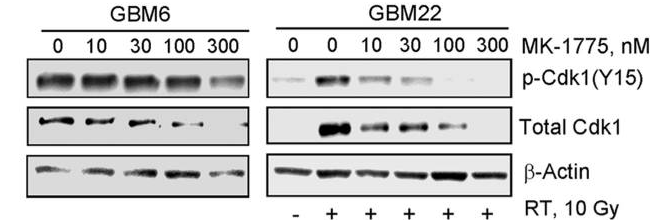
| Western blot | p-Cdk1(Y15) / Cdk1 p-KAP1(S824) / p-Chk2(T68) / p-Chk1(S345) PARP / CF-PARP / pH3(S10) / p-CDC25c(S216) / p-CDK2(Y15) WEE1 |
|
25609063 |
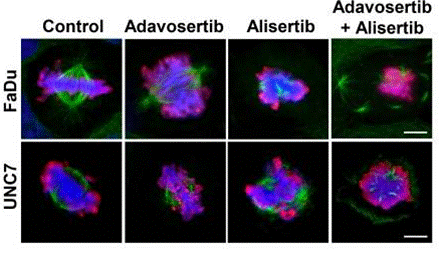
| Immunofluorescence | tubulin / p-HH3(S10) γH2AX Cleaved caspase-3 / pH3 |
|
30755439 |
| Growth inhibition assay | Cell viability IC50 |
|
25458954 |
Informatie over klinische proeven
(gegevens van https://clinicaltrials.gov, bijgewerkt op 2024-05-22)
| NCT-nummer | Werving | Aandoeningen | Sponsor/medewerkers | Startdatum | Fasen |
|---|---|---|---|---|---|
| NCT03253679 | Completed | Advanced Malignant Solid Neoplasm|Refractory Malignant Solid Neoplasm |
National Cancer Institute (NCI) |
January 16 2019 | Phase 2 |
| NCT03668340 | Active not recruiting | Uterine Cancer |
Dana-Farber Cancer Institute|AstraZeneca |
October 22 2018 | Phase 2 |
| NCT03028766 | Completed | Hypopharynx Squamous Cell Carcinoma|Oral Cavity Squamous Cell Carcinoma|Larynx Cancer |
University of Birmingham|AstraZeneca|Cancer Research UK |
June 22 2017 | Phase 1 |
Technische ondersteuning
Tel: +1-832-582-8158 Ext:3
Als u nog andere vragen heeft, laat dan een bericht achter.
Veelgestelde vragen
Vraag 1:
How to prepare its methylcellulose solution? and how to prepare methylcellulose itself? Once make the solution, how should i keep it?
Antwoord:
It is a suspension or emulsion in 0.5% methylcellulose, and it is ok to treat mice orally. It is recommended to dissolve methylcellulose in saline. It will take some time to dissolve methylcellulose, and you can vortex it for a while. The methylcellulose solution of this compound can be stored at 4°C for a week.

Producten zijn uitsluitend voor onderzoeksdoeleinden. Niet voor menselijk gebruik. Wij verkopen niet aan patiënten.
©Copyright 2013 Selleck Chemicals. Alle rechten voorbehouden.