
alleen voor onderzoeksdoeleinden
Volasertib (BI6727) PLK1-remmer
Cat.nr.S2235
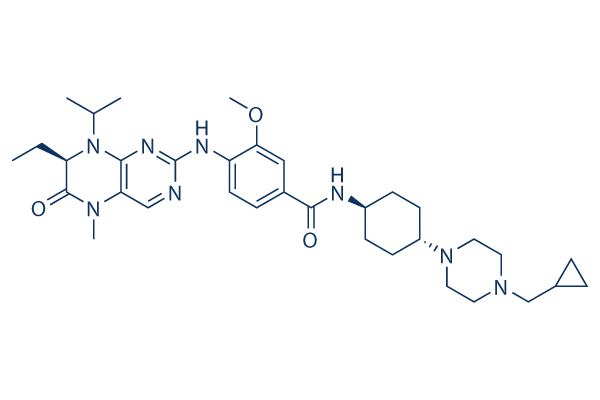
Chemische structuur
Molecuulgewicht: 618.81
Kwaliteitscontrole
| Gerelateerde doelwitten | CDK HSP PD-1/PD-L1 ROCK Wee1 DNA/RNA Synthesis Microtubule Associated Ras KRas Aurora Kinase |
|---|---|
| Overig PLK Inhibitoren | BI 2536 Rigosertib (ON-01910) GSK461364 Onvansertib (NMS-1286937, NMS-P937) CFI-400945 HMN-214 Ro3280 SBE 13 HCl MLN0905 Centrinone (LCR-263) |
Celkweek, behandeling & werkzame concentratie
| Cellijnen | Assaytype | Concentratie | Incubatietijd | Formulering | Activiteitsbeschrijving | PMID |
|---|---|---|---|---|---|---|
| KASUMI-1 | Growth Inhibition Assay | 72 h | IC50=170±51 nM | 25576074 | ||
| KG-1 | Growth Inhibition Assay | 72 h | IC50=150±67 nM | 25576074 | ||
| MOLM-13 | Growth Inhibition Assay | 72 h | IC50=57±44 nM | 25576074 | ||
| MV-4-11 | Growth Inhibition Assay | 72 h | IC50=16±6 nM | 25576074 | ||
| NOMO-1 | Growth Inhibition Assay | 72 h | IC50=145±7 nM | 25576074 | ||
| OCI-AML3 | Growth Inhibition Assay | 72 h | IC50=90±51 nM | 25576074 | ||
| SKM-1 | Growth Inhibition Assay | 72 h | IC50=95±52 nM | 25576074 | ||
| THP-1 | Growth Inhibition Assay | 72 h | IC50=56±39 nM | 25576074 | ||
| MCF7/LTED | Growth Inhibition Assay | 2.5-40 nM | 5 d | inhibits cell growth in a dose-dependent manner | 25480943 | |
| HCC1428/LTED | Growth Inhibition Assay | 2.5-40 nM | 5 d | inhibits cell growth in a dose-dependent manner | 25480943 | |
| A431 | Growth Inhibition Assay | 0-30 nM | 1-4 d | inhibits cell growth in both dose- and time-dependent manner | 23891096 | |
| FaDu | Growth Inhibition Assay | 0-1000 nM | 1-4 d | inhibits cell growth in both dose- and time-dependent manner | 23891096 | |
| SF188 | Growth Inhibition Assay | 50-150 nM | 72 h | DMSO | inhibits cell proliferation | 23887645 |
| T98G | Growth Inhibition Assay | 50-150 nM | 72 h | DMSO | inhibits cell proliferation | 23887645 |
| DU145 | Growth Inhibition Assay | 10/50/250 nM | 24 h | IC50<10 nM | 23884428 | |
| LNCaP | Growth Inhibition Assay | 10/50/250 nM | 24 h | IC50<10 nM | 23884428 | |
| PC3 | Growth Inhibition Assay | 10/50/250 nM | 24 h | IC50∼600 nM | 23884428 | |
| RT4 | Growth Inhibition Assay | 48 h | IC50=111.27 nM | 23792639 | ||
| 5637 | Growth Inhibition Assay | 48 h | IC50=1165.14 nM | 23792639 | ||
| T24 | Growth Inhibition Assay | 48 h | IC50=204.91 nM | 23792639 | ||
| KMCH-1 | Apoptosis Assay | 200 nM | 24 h | induces apoptosis | 23703673 | |
| Mz-ChA-1 | Apoptosis Assay | 200 nM | 24 h | induces apoptosis | 23703673 | |
| HUCCT-1 | Apoptosis Assay | 200 nM | 24 h | induces apoptosis | 23703673 | |
| HCT 116 | Growth Inhibition Assay | EC50 = 23 nM | 19383823 | |||
| NCI-H460 | Growth Inhibition Assay | EC50 = 21 nM | 19383823 | |||
| BRO | Growth Inhibition Assay | EC50 = 11 nM | 19383823 | |||
| GRANTA-519 | Growth Inhibition Assay | EC50 = 15 nM | 19383823 | |||
| HL-60 | Growth Inhibition Assay | EC50 = 32 nM | 19383823 | |||
| THP-1 | Growth Inhibition Assay | EC50 = 36 nM | 19383823 | |||
| Raji | Growth Inhibition Assay | EC50 = 37 nM | 19383823 | |||
| TC32 | qHTS assay | qHTS of pediatric cancer cell lines to identify multiple opportunities for drug repurposing: Primary screen for TC32 cells | 29435139 | |||
| U-2 OS | qHTS assay | qHTS of pediatric cancer cell lines to identify multiple opportunities for drug repurposing: Primary screen for U-2 OS cells | 29435139 | |||
| A673 | qHTS assay | qHTS of pediatric cancer cell lines to identify multiple opportunities for drug repurposing: Primary screen for A673 cells | 29435139 | |||
| DAOY | qHTS assay | qHTS of pediatric cancer cell lines to identify multiple opportunities for drug repurposing: Primary screen for DAOY cells | 29435139 | |||
| Saos-2 | qHTS assay | qHTS of pediatric cancer cell lines to identify multiple opportunities for drug repurposing: Primary screen for Saos-2 cells | 29435139 | |||
| BT-37 | qHTS assay | qHTS of pediatric cancer cell lines to identify multiple opportunities for drug repurposing: Primary screen for BT-37 cells | 29435139 | |||
| RD | qHTS assay | qHTS of pediatric cancer cell lines to identify multiple opportunities for drug repurposing: Primary screen for RD cells | 29435139 | |||
| SK-N-SH | qHTS assay | qHTS of pediatric cancer cell lines to identify multiple opportunities for drug repurposing: Primary screen for SK-N-SH cells | 29435139 | |||
| BT-12 | qHTS assay | qHTS of pediatric cancer cell lines to identify multiple opportunities for drug repurposing: Primary screen for BT-12 cells | 29435139 | |||
| MG 63 (6-TG R) | qHTS assay | qHTS of pediatric cancer cell lines to identify multiple opportunities for drug repurposing: Primary screen for MG 63 (6-TG R) cells | 29435139 | |||
| NB1643 | qHTS assay | qHTS of pediatric cancer cell lines to identify multiple opportunities for drug repurposing: Primary screen for NB1643 cells | 29435139 | |||
| OHS-50 | qHTS assay | qHTS of pediatric cancer cell lines to identify multiple opportunities for drug repurposing: Primary screen for OHS-50 cells | 29435139 | |||
| Rh41 | qHTS assay | qHTS of pediatric cancer cell lines to identify multiple opportunities for drug repurposing: Primary screen for Rh41 cells | 29435139 | |||
| Rh30 | qHTS assay | qHTS of pediatric cancer cell lines to identify multiple opportunities for drug repurposing: Primary screen for Rh30 cells | 29435139 | |||
| SJ-GBM2 | qHTS assay | qHTS of pediatric cancer cell lines to identify multiple opportunities for drug repurposing: Primary screen for SJ-GBM2 cells | 29435139 | |||
| SK-N-MC | qHTS assay | qHTS of pediatric cancer cell lines to identify multiple opportunities for drug repurposing: Primary screen for SK-N-MC cells | 29435139 | |||
| NB-EBc1 | qHTS assay | qHTS of pediatric cancer cell lines to identify multiple opportunities for drug repurposing: Primary screen for NB-EBc1 cells | 29435139 | |||
| LAN-5 | qHTS assay | qHTS of pediatric cancer cell lines to identify multiple opportunities for drug repurposing: Primary screen for LAN-5 cells | 29435139 | |||
| Rh18 | qHTS assay | qHTS of pediatric cancer cell lines to identify multiple opportunities for drug repurposing: Primary screen for Rh18 cells | 29435139 | |||
| SKBR3 | Cytotoxicity assay | 24 hrs | Cytotoxicity against human SKBR3 cells after 24 hrs by MTT assay | 29288948 | ||
| MDA-MB-231 | Cytotoxicity assay | 24 hrs | Cytotoxicity against human MDA-MB-231 cells after 24 hrs by MTT assay | 29288948 | ||
| MDA-MB-468 | Cytotoxicity assay | 24 hrs | Cytotoxicity against human MDA-MB-468 cells after 24 hrs by MTT assay | 29288948 | ||
| BT474 | Cytotoxicity assay | 24 hrs | Cytotoxicity against human BT474 cells after 24 hrs by MTT assay | 29288948 | ||
| ZR-75-1 | Cytotoxicity assay | 24 hrs | Cytotoxicity against human ZR-75-1 cells after 24 hrs by MTT assay | 29288948 | ||
| Klik om meer experimentele gegevens over cellijnen te bekijken | ||||||
Chemische informatie, opslag en stabiliteit
| Molecuulgewicht | 618.81 | Formule | C34H50N8O3 |
Opslag (vanaf de datum van ontvangst) | |
|---|---|---|---|---|---|
| CAS-nr. | 755038-65-4 | SDF downloaden | Opslag van stamoplossingen |
|
|
| Synoniemen | BI 6727 | Smiles | CCC1C(=O)N(C2=CN=C(N=C2N1C(C)C)NC3=C(C=C(C=C3)C(=O)NC4CCC(CC4)N5CCN(CC5)CC6CC6)OC)C | ||
Oplosbaarheid
|
In vitro |
DMSO
: 35 mg/mL
(56.56 mM)
Water : Insoluble Ethanol : Insoluble |
Molariteitscalculator
|
In vivo |
|||||
In vivo formulatiecalculator (heldere oplossing)
Stap 1: Voer onderstaande informatie in (Aanbevolen: een extra dier om rekening te houden met verlies tijdens het experiment)
Stap 2: Voer de in vivo formulering in (Dit is alleen de calculator, geen formulering. Neem eerst contact met ons op als er geen in vivo formulering is in de sectie oplosbaarheid.)
Berekeningsresultaten:
Werkconcentratie: mg/ml;
Methode voor het bereiden van DMSO-moedervloeistof: mg geneesmiddel vooropgelost in μL DMSO ( Concentratie moedervloeistof mg/mL, Neem eerst contact met ons op als de concentratie de DMSO-oplosbaarheid van de batch van het geneesmiddel overschrijdt. )
Methode voor het bereiden van in vivo formulering: Neem μL DMSO moedervloeistof, voeg daarna toeμL PEG300, mengen en verhelderen, daarna toevoegenμL Tween 80, mengen en verhelderen, daarna toevoegen μL ddH2O, mengen en verhelderen.
Methode voor het bereiden van in vivo formulering: Neem μL DMSO moedervloeistof, voeg daarna toe μL Maïsolie, mengen en verhelderen.
Opmerking: 1. Zorg ervoor dat de vloeistof helder is voordat u het volgende oplosmiddel toevoegt.
2. Zorg ervoor dat u het/de oplosmiddel(en) in de juiste volgorde toevoegt. U moet ervoor zorgen dat de verkregen oplossing, bij de vorige toevoeging, een heldere oplossing is voordat u verdergaat met het toevoegen van het volgende oplosmiddel. Fysieke methoden zoals vortexen, ultrasoon of een warmwaterbad kunnen worden gebruikt om het oplossen te bevorderen.
Werkingsmechanisme
| Kenmerken |
A high volume of distribution, indicating good tissue penetration, and a long terminal half-life.
|
|---|---|
| Targets/IC50/Ki |
PLK1
(Cell-free assay) 0.87 nM
|
| In vitro |
Net als BI2536 is BI6727 een ATP-competitieve kinaseremmer uit de dihydropteridinone-klasse van verbindingen. Naast Plk1 remt deze verbinding ook potent twee nauw verwante kinasen Plk2 en Plk3 met een IC50 van respectievelijk 5 nM en 56 nM. Deze chemische stof vertoont bij concentraties tot 10 μM geen remmende activiteit tegen een panel van >50 andere kinasen. Het remt de proliferatie van meerdere cellijnen afkomstig van verschillende kankerweefsels, waaronder HCT116, NCI-H460, BRO, GRANTA-519, HL-60, THP-1 en Raji-cellen met een EC50 van respectievelijk 23 nM, 21 nM, 11 nM, 15 nM, 32 nM, 36 nM en 37 nM. Deze behandeling met de verbinding (100 nM) in NCI-H460-cellen induceert een accumulatie van mitotische cellen met monopolaire spoelen en positieve kleuring voor histone H3 fosfoserine 10, wat bevestigt dat cellen vroeg in de M-fase worden gearresteerd, gevolgd door inductie van apoptose. Lage nanomolaire concentraties van deze remmer vertonen potente remmende activiteit tegen neuroblastoom (NB) tumor-initiërende cellen (NB TIC) met een EC50 van 21 nM, terwijl slechts micromolaire concentraties ervan cytotoxisch zijn voor normale pediatrische neurale stamcellen. Het induceert groeiremming van Daoy- en ONS-76-medulloblastoomcellen, vergelijkbaar met BI 2536. |
| Kinase Assay |
In vitro kinase assays
|
|
Recombinant humaan Plk1 (residuen 1-603) wordt tot expressie gebracht als NH2-terminaal, GST-gelabeld fusie-eiwit met behulp van een baculoviraal expressiesysteem en gezuiverd door affiniteitschromatografie met glutathion-agarose. Enzymactiviteitsbepalingen voor Plk1 worden uitgevoerd in aanwezigheid van serieel verdunde deze verbinding, met gebruikmaking van 20 ng recombinante kinase en 10 μg caseïne uit koemelk als substraat. Kinase reacties worden uitgevoerd in een eindvolume van 60 μL gedurende 45 minuten bij 30 °C [15 mM MgCl2, 25 mM MOPS (pH 7.0), 1 mM DTT, 1% DMSO, 7.5 μM ATP, 0.3 μCi γ-32P-ATP]. Reacties worden beëindigd door toevoeging van 125 μL ijskoude 5% TCA. Na overbrengen van de precipitaten naar MultiScreen gemengde ester cellulose filterplaten, worden de platen gewassen met 1% TCA en radiometrisch gekwantificeerd. Dosis-respons-curven worden gebruikt voor het berekenen van de IC50-waarde.
|
|
| In vivo |
Toediening van BI6727 remt significant de groei van meerdere humane carcinoomxenografts, waaronder HCT116, NCI-H460 en taxaanresistent CXB1-coloncarcinoom, gepaard gaand met een toename van de mitotische index en een toename van apoptose. In in vivo studies vertoont deze verbinding een beter toxiciteits- en farmacokinetisch profiel in vergelijking met BI2536. |
Referenties |
|
Toepassingen
| Methoden | Biomarkers | Afbeeldingen | PMID |
|---|---|---|---|
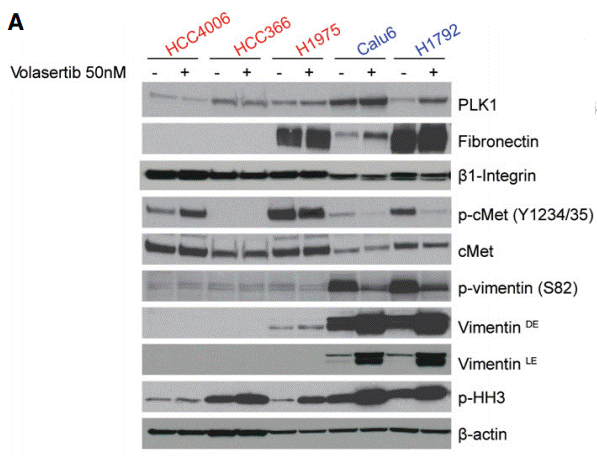
| Western blot | Fibronectin / β-integrin / p-vimentin / Vimentin / p-HH3 p-c-Met / c-Met / p-FAK / FAK / p-Src / Src PARP / c-myc p-AKT / AKT / p-MAPK / MAPK p-PLK1 / PLK1 |
|
31040125 |
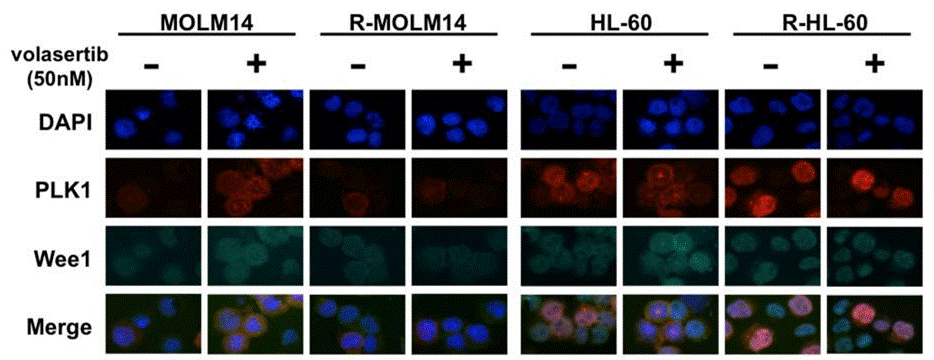
| Immunofluorescence | PLK1 / Wee1 |
|
29108241 |
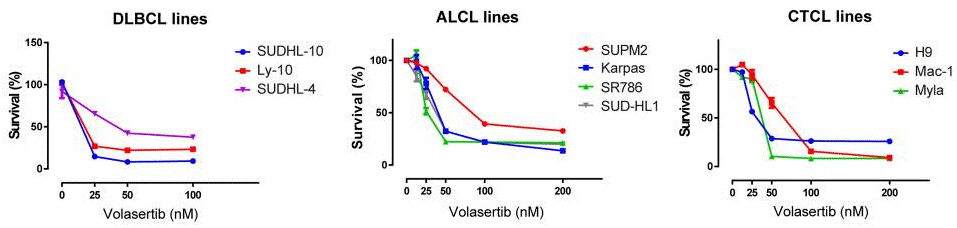
| Growth inhibition assay | Cell viability |
|
29383095 |
Informatie over klinische proeven
(gegevens van https://clinicaltrials.gov, bijgewerkt op 2024-05-22)
| NCT-nummer | Werving | Aandoeningen | Sponsor/medewerkers | Startdatum | Fasen |
|---|---|---|---|---|---|
| NCT02722135 | Withdrawn | Leukemia Myeloid Acute |
Boehringer Ingelheim |
November 2016 | Phase 1 |
| NCT02721875 | Terminated | Myelodysplastic Syndromes |
Boehringer Ingelheim |
April 28 2016 | Phase 1 |
| NCT02201329 | Completed | Myelodysplastic Syndromes|Leukemia Myelomonocytic Chronic |
Boehringer Ingelheim |
August 2014 | Phase 1 |
| NCT01971476 | Completed | Leukemia|Neoplasms |
Boehringer Ingelheim |
October 22 2013 | Phase 1 |
| NCT01772563 | Completed | Neoplasms |
Boehringer Ingelheim |
February 4 2013 | Phase 1 |
| NCT01662505 | Completed | Leukemia Myeloid Acute |
Boehringer Ingelheim |
August 2012 | Phase 1 |
Technische ondersteuning
Tel: +1-832-582-8158 Ext:3
Als u nog andere vragen heeft, laat dan een bericht achter.
Veelgestelde vragen
Vraag 1:
I wonder how to reconstitute it for in vivo studies?
Antwoord:
It can be dissolved in 4% DMSO+Corn oil at 2mg/ml for i.p. injection in mice. For oral administration, this compound can be formulated in hydrochloric acid (0.1 N), and diluted with 0.9% NaCl, or suspended in 0.5% Natrosol 250 hydroxyethyl-cellulose as indicated in the publications. We also suggest the vehicle 30% PEG400/0.5% Tween80/5% propylene glycol for a suspension which we tested in house.

Producten zijn uitsluitend voor onderzoeksdoeleinden. Niet voor menselijk gebruik. Wij verkopen niet aan patiënten.
©Copyright 2013 Selleck Chemicals. Alle rechten voorbehouden.