
alleen voor onderzoeksdoeleinden
SB269970 HCl 5-HT Receptor antagonist
Cat.nr.S2849
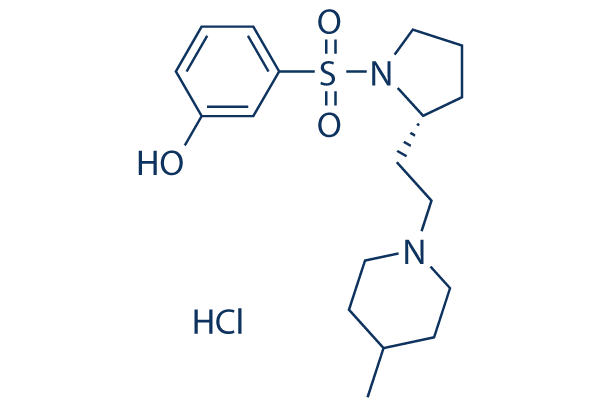
Chemische structuur
Molecuulgewicht: 388.95
Kwaliteitscontrole
| Gerelateerde doelwitten | Adrenergic Receptor AChR COX Calcium Channel Histamine Receptor Dopamine Receptor GABA Receptor TRP Channel Cholinesterase (ChE) GluR |
|---|---|
| Overig 5-HT Receptor Inhibitoren | WAY-100635 Maleate Serotonin (5-HT) HCl Puerarin BRL-15572 Dihydrochloride Ketanserin RS-127445 Nuciferine Flopropione BRL-54443 SB742457 |
Chemische informatie, opslag en stabiliteit
| Molecuulgewicht | 388.95 | Formule | C18H28N2O3S.HCl |
Opslag (vanaf de datum van ontvangst) | |
|---|---|---|---|---|---|
| CAS-nr. | 261901-57-9 | SDF downloaden | Opslag van stamoplossingen |
|
|
| Synoniemen | N/A | Smiles | CC1CCN(CC1)CCC2CCCN2S(=O)(=O)C3=CC=CC(=C3)O.Cl | ||
Oplosbaarheid
|
In vitro |
DMSO
: 11 mg/mL
(28.28 mM)
Water : Insoluble Ethanol : Insoluble |
Molariteitscalculator
|
In vivo |
|||||
In vivo formulatiecalculator (heldere oplossing)
Stap 1: Voer onderstaande informatie in (Aanbevolen: een extra dier om rekening te houden met verlies tijdens het experiment)
Stap 2: Voer de in vivo formulering in (Dit is alleen de calculator, geen formulering. Neem eerst contact met ons op als er geen in vivo formulering is in de sectie oplosbaarheid.)
Berekeningsresultaten:
Werkconcentratie: mg/ml;
Methode voor het bereiden van DMSO-moedervloeistof: mg geneesmiddel vooropgelost in μL DMSO ( Concentratie moedervloeistof mg/mL, Neem eerst contact met ons op als de concentratie de DMSO-oplosbaarheid van de batch van het geneesmiddel overschrijdt. )
Methode voor het bereiden van in vivo formulering: Neem μL DMSO moedervloeistof, voeg daarna toeμL PEG300, mengen en verhelderen, daarna toevoegenμL Tween 80, mengen en verhelderen, daarna toevoegen μL ddH2O, mengen en verhelderen.
Methode voor het bereiden van in vivo formulering: Neem μL DMSO moedervloeistof, voeg daarna toe μL Maïsolie, mengen en verhelderen.
Opmerking: 1. Zorg ervoor dat de vloeistof helder is voordat u het volgende oplosmiddel toevoegt.
2. Zorg ervoor dat u het/de oplosmiddel(en) in de juiste volgorde toevoegt. U moet ervoor zorgen dat de verkregen oplossing, bij de vorige toevoeging, een heldere oplossing is voordat u verdergaat met het toevoegen van het volgende oplosmiddel. Fysieke methoden zoals vortexen, ultrasoon of een warmwaterbad kunnen worden gebruikt om het oplossen te bevorderen.
Werkingsmechanisme
| Kenmerken |
A hydrochloride salt form of SB-269970 which is a potent 5-HT 7 receptor antagonist.
|
|---|---|
| Targets/IC50/Ki |
5-HT7
8.3(pKi)
|
| In vitro |
SB-269970 remt de 5-CT-gestimuleerde adenylylcyclaseactiviteit in hippocampusmembranen van cavia's. SB-269970 (0,03 μM, 0,1 μM, 0,3 μM en 1 μM) veroorzaakt een concentratieafhankelijke verschuiving naar rechts van de 5-CT-concentratie-responscurve zonder significante verandering in de maximale respons op 5-CT. SB-269970 (1 μM) heeft geen effect op de 5-HT-efflux wanneer het alleen wordt gesuperfuseerd.
|
| In vivo |
SB-269970 (10 mg/kg en 30 mg/kg) vermindert de effecten van amfetamine significant met respectievelijk 25 en 27%, en blokkeert de effecten van ketamine met 38% (10 mg/kg) en 30% (30 mg/kg). SB-269970 vermindert significant amfetamine-geïnduceerde hyperactiviteit bij wildtype muizen en heeft geen effecten bij 5-HT7-knock-out muizen. Systemische toediening van SB-269970 (30 mg/kg) keert de amfetamine-verstoring van PPI significant om en verhoogde de PPI op zichzelf niet vergeleken met de controle. SB-269970 keert de tekorten veroorzaakt door MK-801, maar niet door scopolamine, significant om. SB-269970 normaliseert de MK-801-geïnduceerde glutamaat-, maar niet dopaminerelease in de cortex. SB-269970 (in een gemiddelde dosis van 0,5 of 1 mg/kg) oefent een specifiek anxiolytisch effect uit in de Vogel-drinktest bij ratten, in de verhoogde plus-maze-test bij ratten en in de vier-platen-test bij muizen. Bovendien toont SB-269970 (in een gemiddelde dosis van 5 of 10 mg/kg) antidepressivum-achtige activiteit in de geforceerde zwem- en staartophangingstesten bij muizen. SB-269970 in doses van 0,3, 1 en 3 μg vertoont een anticonflicteffect dat zwakker is dan dat van diazepam (40 μg), terwijl SB-269970 in doses van 3 en 10 μg een duidelijke anti-immobilisatieactie had die vergelijkbaar is met die van imipramine (0,1 μg).
|
Referenties |
|
Technische ondersteuning
Tel: +1-832-582-8158 Ext:3
Als u nog andere vragen heeft, laat dan een bericht achter.

Producten zijn uitsluitend voor onderzoeksdoeleinden. Niet voor menselijk gebruik. Wij verkopen niet aan patiënten.
©Copyright 2013 Selleck Chemicals. Alle rechten voorbehouden.