
alleen voor onderzoeksdoeleinden
Prucalopride 5-HT Receptor Agonist
Cat.nr.: S2875
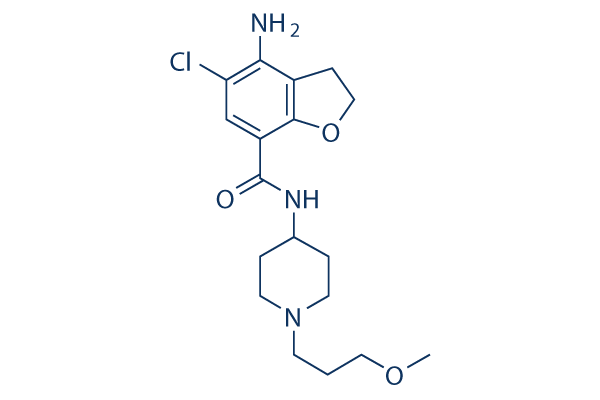
Chemische structuur
Molecuulgewicht: 367.87
Kwaliteitscontrole (Quality Control)
| Gerelateerde doelwitten | Adrenergic Receptor AChR COX Calcium Channel Histamine Receptor Dopamine Receptor GABA Receptor TRP Channel Cholinesterase (ChE) GluR |
|---|---|
| Overig 5-HT Receptor Inhibitoren | Serotonin Hydrochloride (5-HT HCl) WAY-100635 Maleate Puerarin SB269970 HCl Ketanserin BRL-15572 Dihydrochloride RS-127445 Nuciferine Flopropione BRL-54443 |
Chemische informatie, opslag en stabiliteit (Chemical Information, Storage & Stability)
| Molecuulgewicht | 367.87 | Formule | C18H26ClN3O3 |
Opslag (vanaf de datum van ontvangst) | |
|---|---|---|---|---|---|
| CAS-nr. | 179474-81-8 | SDF downloaden | Opslag van stamoplossingen |
|
|
| Synoniemen | R-93877 | Smiles | COCCCN1CCC(CC1)NC(=O)C2=CC(=C(C3=C2OCC3)N)Cl | ||
Oplosbaarheid (Solubility)
|
In vitro |
DMSO
: 74 mg/mL
(201.15 mM)
Ethanol : 74 mg/mL Water : Insoluble |
Molariteitscalculator
|
In vivo |
|||||
In vivo formulatiecalculator (heldere oplossing)
Stap 1: Voer onderstaande informatie in (Aanbevolen: een extra dier om rekening te houden met verlies tijdens het experiment)
Stap 2: Voer de in vivo formulering in (Dit is alleen de calculator, geen formulering. Neem eerst contact met ons op als er geen in vivo formulering is in de sectie oplosbaarheid.)
Berekeningsresultaten:
Werkconcentratie: mg/ml;
Methode voor het bereiden van DMSO-moedervloeistof: mg geneesmiddel vooropgelost in μL DMSO ( Concentratie moedervloeistof mg/mL, Neem eerst contact met ons op als de concentratie de DMSO-oplosbaarheid van de batch van het geneesmiddel overschrijdt. )
Methode voor het bereiden van in vivo formulering: Neem μL DMSO moedervloeistof, voeg daarna toeμL PEG300, mengen en verhelderen, daarna toevoegenμL Tween 80, mengen en verhelderen, daarna toevoegen μL ddH2O, mengen en verhelderen.
Methode voor het bereiden van in vivo formulering: Neem μL DMSO moedervloeistof, voeg daarna toe μL Maïsolie, mengen en verhelderen.
Opmerking: 1. Zorg ervoor dat de vloeistof helder is voordat u het volgende oplosmiddel toevoegt.
2. Zorg ervoor dat u het/de oplosmiddel(en) in de juiste volgorde toevoegt. U moet ervoor zorgen dat de verkregen oplossing, bij de vorige toevoeging, een heldere oplossing is voordat u verdergaat met het toevoegen van het volgende oplosmiddel. Fysieke methoden zoals vortexen, ultrasoon of een warmwaterbad kunnen worden gebruikt om het oplossen te bevorderen.
Werkingsmechanisme (Mechanism of Action)
| Targets/IC50/Ki |
5-HT4A
2.5 nM(Ki)
5-HT4B
8 nM(Ki)
|
|---|---|
| In vitro |
Prucalopride induces contractions in a concentration-dependent manner with pEC50 of 7.5. This compound (1 mM) significantly amplifies the rebound contraction of the guinea-pig proximal colon after electrical field stimulation. It induces relaxation of the rat oesophagus preparation of rat oesophagus tunica muscularis mucosae with pEC50 of 7.8, yielding a monophasic concentration–response curve.
|
| In vivo |
Complete bowel movements per week is 30.9% of those receiving 2 mg of Prucalopride and 28.4% of those receiving 4 mg of this compound, as compared with 12.0% in the placebo group. 47.3% of patients receiving 2 mg of this compound and 46.6% of those receiving 4 mg of it has an increase in the number of spontaneous, complete bowel movements of one or more per week, on average, as compared with 25.8% in the placebo group. This compound (2 mg or 4 mg) significantly improves all other secondary efficacy end points, including patients' satisfaction with their bowel function and treatment and their perception of the severity of their constipation symptoms. It (4 mg daily) accelerates overall gastric emptying and small bowel transit in patients with constipation without a rectal evacuation disorder. This chemical (4 mg daily) tends to accelerate overall colonic transit with significantly faster overall colonic transit and ascending colon emptying. Higher proportions of patients on this compound 2 mg (19.5%), 4 mg (23.6%) has three or more spontaneous complete bowel movements(SCBM)/week compared with placebo (9.6%). It also significantly improves secondary efficacy and quality of life endpoints, including the proportion of patients with an increase of one or more SCBM/week, evacuation completeness, perceived disease severity and treatment effectiveness and quality of life. This compound alters colonic contractile motility patterns in a dose-dependent fashion by stimulating high-amplitude clustered contractions in the proximal colon and by inhibiting contractile activity in the distal colon of fasted dogs. It also causes a dose-dependent decrease in the time to the first giant migrating contraction (GMC); at higher doses of this chemical, the first GMC generally occurres within the first half-hour after treatment.
|
Referenties |
|
Informatie over klinische proeven (Clinical Trial Information)
(gegevens van https://clinicaltrials.gov, bijgewerkt op 2025-08-11)
| NCT-nummer | Werving | Aandoeningen | Sponsor/medewerkers | Startdatum | Fasen |
|---|---|---|---|---|---|
| NCT06883175 | RECRUITING | Dysphagia; Achalasia, Esophageal; Ineffective Esophageal Motility |
Northwestern University |
2024-09-01 | |
| NCT05455359 | RECRUITING | Esophageal Motility Disorders; Gastric Motor Dysfunction; Aspiration Pneumonia; Gastro Esophageal Reflux |
Boston Children's Hospital |
2025-02-13 | PHASE4 |
| NCT06474286 | NOT_YET_RECRUITING | Schizophrenia |
University of Pittsburgh |
2026-07-31 | |
| NCT07127237 | NOT_YET_RECRUITING | Bowel Preparation |
Hospital de Clínicas Dr. Manuel Quintela |
2025-09 | EARLY_PHASE1 |
| NCT06816407 | RECRUITING | Post-Op Complication |
Future University in Egypt |
2025-03-02 | PHASE3 |
| NCT05220228 | COMPLETED | Depression in Remission |
University of Oxford |
2022-01-04 |

Producten zijn uitsluitend voor onderzoeksdoeleinden. Niet voor menselijk gebruik. Wij verkopen niet aan patiënten.
©Copyright 2013 Selleck Chemicals. Alle rechten voorbehouden.