
alleen voor onderzoeksdoeleinden
(+)-Dizocilpine (MK 801) Maleate NMDAR Antagonist
Cat.nr.: S2876
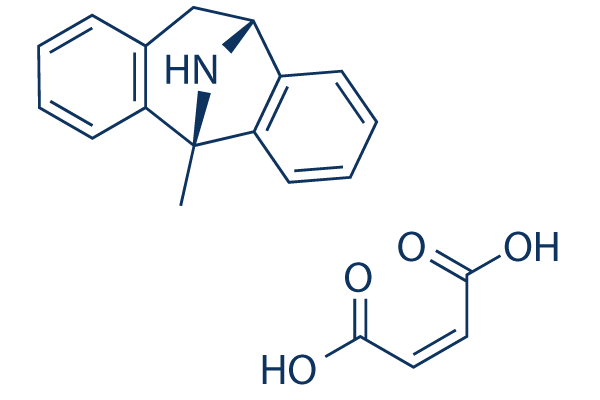
Chemische structuur
Molecuulgewicht: 337.37
Spring naar
Kwaliteitscontrole (Quality Control)
Batch:
Zuiverheid:
99.94%
99.94
Chemische informatie, opslag en stabiliteit (Chemical Information, Storage & Stability)
| Molecuulgewicht | 337.37 | Formule | C16H15N.C4H4O4 |
Opslag (vanaf de datum van ontvangst) | |
|---|---|---|---|---|---|
| CAS-nr. | 77086-22-7 | SDF downloaden | Opslag van stamoplossingen |
|
|
| Synoniemen | N/A | Smiles | CC12C3=CC=CC=C3CC(N1)C4=CC=CC=C24.C(=CC(=O)O)C(=O)O | ||
Oplosbaarheid (Solubility)
|
In vitro |
DMSO
: 67 mg/mL
(198.59 mM)
Water : Insoluble Ethanol : Insoluble |
Molariteitscalculator
Verdunningscalculator
Molecuulgewichtcalculator
|
In vivo |
|||||
In vivo formulatiecalculator (heldere oplossing)
Stap 1: Voer onderstaande informatie in (Aanbevolen: een extra dier om rekening te houden met verlies tijdens het experiment)
mg/kg
g
μL
Stap 2: Voer de in vivo formulering in (Dit is alleen de calculator, geen formulering. Neem eerst contact met ons op als er geen in vivo formulering is in de sectie oplosbaarheid.)
% DMSO
%
% Tween 80
% ddH2O
%DMSO
%
Berekeningsresultaten:
Werkconcentratie: mg/ml;
Methode voor het bereiden van DMSO-moedervloeistof: mg geneesmiddel vooropgelost in μL DMSO ( Concentratie moedervloeistof mg/mL, Neem eerst contact met ons op als de concentratie de DMSO-oplosbaarheid van de batch van het geneesmiddel overschrijdt. )
Methode voor het bereiden van in vivo formulering: Neem μL DMSO moedervloeistof, voeg daarna toeμL PEG300, mengen en verhelderen, daarna toevoegenμL Tween 80, mengen en verhelderen, daarna toevoegen μL ddH2O, mengen en verhelderen.
Methode voor het bereiden van in vivo formulering: Neem μL DMSO moedervloeistof, voeg daarna toe μL Maïsolie, mengen en verhelderen.
Opmerking: 1. Zorg ervoor dat de vloeistof helder is voordat u het volgende oplosmiddel toevoegt.
2. Zorg ervoor dat u het/de oplosmiddel(en) in de juiste volgorde toevoegt. U moet ervoor zorgen dat de verkregen oplossing, bij de vorige toevoeging, een heldere oplossing is voordat u verdergaat met het toevoegen van het volgende oplosmiddel. Fysieke methoden zoals vortexen, ultrasoon of een warmwaterbad kunnen worden gebruikt om het oplossen te bevorderen.
Werkingsmechanisme (Mechanism of Action)
| Targets/IC50/Ki |
NMDA receptor
37.2 nM(Kd)
|
|---|---|
| In vitro |
[3H]MK-801 labels high-affinity binding sites in rat cerebral cortical membranes in a saturable manner. MK-801 produces a potent blockade of depolarizing responses to NMDA in rat cerebral cortical slices. The only compounds that are able to compete for [3H]MK-801 binding sites are substances known to block the responses of excitatory amino acids mediated by the NMDA receptor subtype. MK-801 inhibits N-methyl-D-aspartate-induced [3H](NE) release and [3H]TCP binding in the hippocampus with IC50 of 20 nM and 9 nM, respectively. MK-801 causes a progressive, long-lasting blockade of current induced by NMDA. Mg2+ (10 mM) prevents MK-801 from blocking the N-Me-D-Asp-induced current, even when MK-801 is applied for a long time in the presence of NMDA. MK-801 is also effective at blocking NMDA-activated single-channel activity in outside-out patches. MK-801 (< 500 μM) prevents LPS-induced activation of microglia in a concentration-dependent manner with increased Cox-2 protein expression in BV-2 cells. MK-801 (< 500 μM) reduces microglial TNF-α output with EC50 of 400 μM in BV-2 cells. |
| In vivo |
Treatment of mice with MK-801 (1 mg/kg) before each METH injection reduced the extent of DA depletion by 55% in striatal of mice. MK-801 (1 mg/kg) attenuates the effects of METH on microglial activation in striatal of mice. MK-801 (0.05 mg/kg or 0.2 mg/kg, i.p.) in rats just prior to reactivation of the cocaine-associated memory in the CPP context attenuates subsequent cocaine-primed reinstatement, while no disruption occurres in rats that do not receive reactivation in the CPP context. MK-801 (0.2 mg/kg, i.p.) prior to two reactivation sessions in the home cage does not suppress subsequent cocaine-primed reinstatement. |
Referenties |
|

Producten zijn uitsluitend voor onderzoeksdoeleinden. Niet voor menselijk gebruik. Wij verkopen niet aan patiënten.
©Copyright 2013 Selleck Chemicals. Alle rechten voorbehouden.