
alleen voor onderzoeksdoeleinden
Quinolinic acid NMDAR Agonist
Cat.nr.: S3624
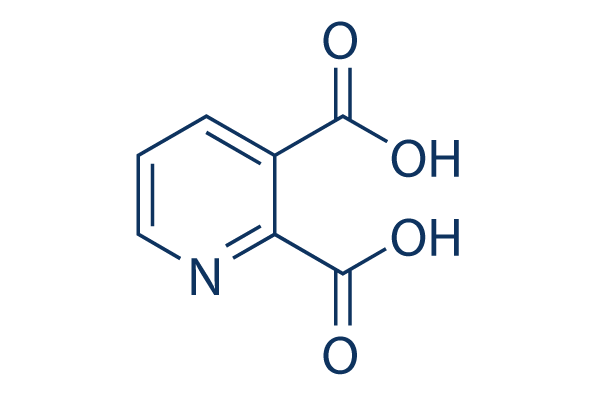
Chemische structuur
Molecuulgewicht: 167.12
Kwaliteitscontrole (Quality Control)
Chemische informatie, opslag en stabiliteit (Chemical Information, Storage & Stability)
| Molecuulgewicht | 167.12 | Formule | C7H5NO4 |
Opslag (vanaf de datum van ontvangst) | |
|---|---|---|---|---|---|
| CAS-nr. | 89-00-9 | SDF downloaden | Opslag van stamoplossingen |
|
|
| Synoniemen | pyridine-2,3-dicarboxylic acid, QUIN | Smiles | C1=CC(=C(N=C1)C(=O)O)C(=O)O | ||
Oplosbaarheid (Solubility)
|
In vitro |
DMSO
: 25 mg/mL
(149.59 mM)
Water : 3 mg/mL Ethanol : Insoluble |
Molariteitscalculator
|
In vivo |
|||||
In vivo formulatiecalculator (heldere oplossing)
Stap 1: Voer onderstaande informatie in (Aanbevolen: een extra dier om rekening te houden met verlies tijdens het experiment)
Stap 2: Voer de in vivo formulering in (Dit is alleen de calculator, geen formulering. Neem eerst contact met ons op als er geen in vivo formulering is in de sectie oplosbaarheid.)
Berekeningsresultaten:
Werkconcentratie: mg/ml;
Methode voor het bereiden van DMSO-moedervloeistof: mg geneesmiddel vooropgelost in μL DMSO ( Concentratie moedervloeistof mg/mL, Neem eerst contact met ons op als de concentratie de DMSO-oplosbaarheid van de batch van het geneesmiddel overschrijdt. )
Methode voor het bereiden van in vivo formulering: Neem μL DMSO moedervloeistof, voeg daarna toeμL PEG300, mengen en verhelderen, daarna toevoegenμL Tween 80, mengen en verhelderen, daarna toevoegen μL ddH2O, mengen en verhelderen.
Methode voor het bereiden van in vivo formulering: Neem μL DMSO moedervloeistof, voeg daarna toe μL Maïsolie, mengen en verhelderen.
Opmerking: 1. Zorg ervoor dat de vloeistof helder is voordat u het volgende oplosmiddel toevoegt.
2. Zorg ervoor dat u het/de oplosmiddel(en) in de juiste volgorde toevoegt. U moet ervoor zorgen dat de verkregen oplossing, bij de vorige toevoeging, een heldere oplossing is voordat u verdergaat met het toevoegen van het volgende oplosmiddel. Fysieke methoden zoals vortexen, ultrasoon of een warmwaterbad kunnen worden gebruikt om het oplossen te bevorderen.
Werkingsmechanisme (Mechanism of Action)
| Targets/IC50/Ki |
NMDAR
|
|---|---|
| In vitro |
QUIN is an agonist of N-methyl-D-aspartate (NMDA) receptor, and it has a high in vivo potency as an excitotoxin. Although QUIN has an uptake system, its neuronal degradation enzyme is rapidly saturated, and the rest of extracellular QUIN can continue stimulating the NMDA receptor. QUIN (10 μM) prevents of glutamate-induced excitotoxicity in primary cultures of rat cerebellar granule neurons, nevertheless mature organotypic cultures of rat corticostriatal system or caudate nucleus chronically exposed to 100 nM QUIN for up to 7 weeks show focal degeneration characterized by the presence of vacuoles in neuropil, swollen dendrites, occasional swollen post-synaptic elements, and degenerated neurons. In vitro QUIN treatment of human primary foetal neurons leads to a substantial increase of tau phosphorylation at multiple positions. The increase in QUIN-induced phosphorylation of tau is attributed to a decrease in the expression and activity of the major tau phosphatases. QUIN can inhibit B monoamine oxidase (MAO-B) in human brain synaptosomal mitochondria and also can be a potent inhibitor of phosphoenolpyruvate carboxykinase (EC 4.1.1.32) from rat liver cytoplasm, an important enzyme in the gluconeogenesis pathway that converts oxaloacetate to phosphoenolpyruvate. QUIN can increase free radical production by inducing NOS activity in astrocytes and neurons, leading to oxidative stress, increasing both poly(ADP-ribose) polymerase (PARP) activity and extracellular lactate dehydrogenase (LDH) activity.
|
| In vivo |
Quinolinic acid (QUIN), a neuroactive metabolite of the kynurenine pathway, is normally presented in nanomolar concentrations in human brain and cerebrospinal fluid (CSF) and is often implicated in the pathogenesis of a variety of human neurological diseases. The concentration of QUIN varies among different brain regions, with the cerebral cortex containing approximately 1.8 nmol/g wet weight; almost 2-fold than that found in the hippocampus (1 nmol/g wet weight). Intraarterial administration of either micromolar or millimolar concentrations of QUIN results in only negligible accumulations of this metabolite in the brain, suggesting that the central nervous system (CNS) appears to be well protected by the blood brain barrier (BBB) from peripheral QUIN. QUIN can also increase glutamate release and inhibit its reuptake by astrocytes, thus increasing its concentration in the microenvironments, causing neurotoxicity and also limiting glutamate to glutamine recycling in astrocytes by decreasing glutamine synthetase activity. Intrastriatal injection of QUIN provokes a decrease of cellular respiration and ATP levels.
|
Referenties |
|
Informatie over klinische proeven (Clinical Trial Information)
(gegevens van https://clinicaltrials.gov, bijgewerkt op 2024-05-22)
| NCT-nummer | Werving | Aandoeningen | Sponsor/medewerkers | Startdatum | Fasen |
|---|---|---|---|---|---|
| NCT05513807 | Not yet recruiting | Delayed Graft Function |
Assistance Publique - Hôpitaux de Paris|Institut National de la Santé Et de la Recherche Médicale France|Centre National de la Recherche Scientifique France |
2022-11 | Phase 3 |
| NCT05718310 | Recruiting | Migraine|Migraine Disorders|Pain |
IRCCS National Neurological Institute C. Mondino Foundation|University of Pavia |
2022-11-01 | Not Applicable |
| NCT05969990 | Recruiting | Migraine in Children |
Qilu Hospital of Shandong University |
2022-01-01 | -- |
| NCT04342975 | Completed | AKI |
Mayo Clinic|Elysium Health |
2020-12-01 | Phase 2 |

Producten zijn uitsluitend voor onderzoeksdoeleinden. Niet voor menselijk gebruik. Wij verkopen niet aan patiënten.
©Copyright 2013 Selleck Chemicals. Alle rechten voorbehouden.