
alleen voor onderzoeksdoeleinden
OSU-03012 (AR-12) PDPK1 remmer
Cat.nr.S1106
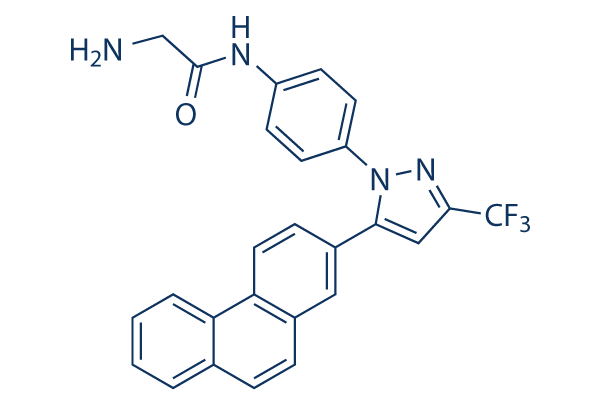
Chemische structuur
Molecuulgewicht: 460.45
Kwaliteitscontrole
Celkweek, behandeling & werkzame concentratie
| Cellijnen | Assaytype | Concentratie | Incubatietijd | Formulering | Activiteitsbeschrijving | PMID |
|---|---|---|---|---|---|---|
| mouse RAW264.7 cells | Function assay | 8 h | Antimicrobial activity against Salmonella enterica serovar Typhimurium ATCC 14028 infected in mouse RAW264.7 cells assessed as inhibition of intracellular bacterial growth after 8 hrs, IC50=0.2 μM | |||
| mouse RAW264.7 cells | Cytotoxic assay | 24 h | Cytotoxicity against mouse RAW264.7 cells assessed as cell viability after 24 hrs by MTT assay, IC50=10 μM | |||
| Klik om meer experimentele gegevens over cellijnen te bekijken | ||||||
Chemische informatie, opslag en stabiliteit
| Molecuulgewicht | 460.45 | Formule | C26H19F3N4O |
Opslag (vanaf de datum van ontvangst) | |
|---|---|---|---|---|---|
| CAS-nr. | 742112-33-0 | SDF downloaden | Opslag van stamoplossingen |
|
|
| Synoniemen | N/A | Smiles | C1=CC=C2C(=C1)C=CC3=C2C=CC(=C3)C4=CC(=NN4C5=CC=C(C=C5)NC(=O)CN)C(F)(F)F | ||
Oplosbaarheid
|
In vitro |
DMSO
: 11 mg/mL
(23.88 mM)
Water : Insoluble Ethanol : Insoluble |
Molariteitscalculator
|
In vivo |
|||||
In vivo formulatiecalculator (heldere oplossing)
Stap 1: Voer onderstaande informatie in (Aanbevolen: een extra dier om rekening te houden met verlies tijdens het experiment)
Stap 2: Voer de in vivo formulering in (Dit is alleen de calculator, geen formulering. Neem eerst contact met ons op als er geen in vivo formulering is in de sectie oplosbaarheid.)
Berekeningsresultaten:
Werkconcentratie: mg/ml;
Methode voor het bereiden van DMSO-moedervloeistof: mg geneesmiddel vooropgelost in μL DMSO ( Concentratie moedervloeistof mg/mL, Neem eerst contact met ons op als de concentratie de DMSO-oplosbaarheid van de batch van het geneesmiddel overschrijdt. )
Methode voor het bereiden van in vivo formulering: Neem μL DMSO moedervloeistof, voeg daarna toeμL PEG300, mengen en verhelderen, daarna toevoegenμL Tween 80, mengen en verhelderen, daarna toevoegen μL ddH2O, mengen en verhelderen.
Methode voor het bereiden van in vivo formulering: Neem μL DMSO moedervloeistof, voeg daarna toe μL Maïsolie, mengen en verhelderen.
Opmerking: 1. Zorg ervoor dat de vloeistof helder is voordat u het volgende oplosmiddel toevoegt.
2. Zorg ervoor dat u het/de oplosmiddel(en) in de juiste volgorde toevoegt. U moet ervoor zorgen dat de verkregen oplossing, bij de vorige toevoeging, een heldere oplossing is voordat u verdergaat met het toevoegen van het volgende oplosmiddel. Fysieke methoden zoals vortexen, ultrasoon of een warmwaterbad kunnen worden gebruikt om het oplossen te bevorderen.
Werkingsmechanisme
| Targets/IC50/Ki |
PDPK1
(Cell-free assay) 5 μM
|
|---|---|
| In vitro |
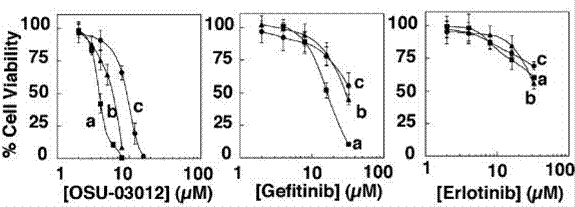
OSU-03012 (AR-12) induceert apoptotische celdood in PC-3-cellen met een IC50 van 5 µM en vermindert de activiteit van geïmmunoprecipiteerd p70S6K. Het onderdrukt volledig de celgroei in een diverse reeks tumorcellijnen bij concentraties van 3–5 μm, vergeleken met een concentratie van ten minste 50 μm. Deze verbinding bevordert celdoding in grotere mate in glioomcellen dan in niet-getransformeerde astrocyten. Het veroorzaakt een dosisafhankelijke inductie van celdood die niet wordt gewijzigd door p53-mutatie, expressie van ERBB1 VIII, of verlies van fosfatase- en tensinefunctie als gevolg van een homoloog deletie op chromosoom 10. OSU-03012 en ioniserende straling veroorzaken een additieve, caspase-onafhankelijke verhoging van celdoding. De letaliteit ervan als enkelvoudig middel of in combinatie met signaalmodulatoren wordt niet gewijzigd in cellen die geen expressie hebben van BIM of van BAX/BAK. Het bevordert de afgifte van cathepsine B uit het lysosomale compartiment en die van AIF uit mitochondriën. De letaliteit van deze verbinding wordt verminderd in proteïnekinase R-achtige endoplasmatisch reticulum kinase-/- cellen, wat correleerde met de verminderde splitsing van BID en onderdrukking van cathepsine B- en AIF-afgifte in het cytosol. Het remt de proliferatie, migratie en induceert apoptose van schildklierkankercellen (NPA-, WRO- en ARO-cellen), wat resulteert in een toename van cellen in de S-fase zonder een toename van cellen in G2. OSU-03012 is een ATP-competitieve remmer van PAK-activiteit en onderdrukt de fosforylering van AKT in schildklierkankercellen. Het remt de celgroei van hepatocellulaire carcinoomcellijnen, waaronder Huh7-, Hep3B- en HepG2-cellen met IC50-waarden onder 1 μM. Deze verbinding onderdrukt de PDK1- of AKT-activiteit niet en induceert geen cellulaire apoptose, maar induceert autofagie in Huh7-cellen. Bovendien wordt na behandeling een accumulatie van reactieve zuurstofsoorten (ROS) gedetecteerd. Een recente studie toont aan dat het de gevoeligheid van (Bcr)-Abl mutante cellijnen voor geïnduceerde apoptose zou kunnen vergroten. |
| Kinase Assay |
PDK-1 Kinase Test
|
|
Deze in vitro test wordt uitgevoerd met behulp van een PDK-1 kinase testkit. Deze celvrije test is gebaseerd op het vermogen van recombinant PDK-1, in aanwezigheid van DMSO-drager of OSU-03012 (AR-12), om zijn stroomafwaartse serum- en glucocorticoïd-gereguleerde kinase te activeren, dat op zijn beurt het Akt/serum- en glucocorticoïd-gereguleerde kinase-specifieke peptidesubstraat RPRAATF fosforyleert met [γ-32P]ATP. Het 32P-gefosforyleerde peptidesubstraat wordt vervolgens gescheiden van het resterende [γ-32P]-ATP door gebruik te maken van P81 fosfocellulosepapier en gekwantificeerd in een scintillatieteller na drie wassingen met 0,75% fosforzuur.
|
|
| In vivo |
OSU-03012 (AR-12) onderdrukt tumorgroei met 57,59% en verhoogt gekliefd LC3 in Huh7 tumorxenografts bij 200 mg/kg. Deze verbinding vermindert de expressie van EGFR-eiwit in de tumoren opmerkelijk met 48% vergeleken met vehikelcontroles en voorkomt ook dat YB-1 bindt aan de EGFR-promotor in MDA-MB-435/LCC6 xenografts. Het wordt goed verdragen en remt de groei van HMS-97 schwannoom xenografts met 55% na orale toediening. |
Referenties |
|
Toepassingen
| Methoden | Biomarkers | Afbeeldingen | PMID |
|---|---|---|---|
| Western blot | p-Akt / Akt |

|
18413750 |
| Growth inhibition assay | Cell viability |
|
18413750 |
Technische ondersteuning
Tel: +1-832-582-8158 Ext:3
Als u nog andere vragen heeft, laat dan een bericht achter.

Producten zijn uitsluitend voor onderzoeksdoeleinden. Niet voor menselijk gebruik. Wij verkopen niet aan patiënten.
©Copyright 2013 Selleck Chemicals. Alle rechten voorbehouden.