
alleen voor onderzoeksdoeleinden
Loratadine Histamine Receptor Antagonist
Cat.nr.: S1358
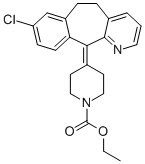
Chemische structuur
Molecuulgewicht: 382.88
Kwaliteitscontrole (Quality Control)
| Gerelateerde doelwitten | Adrenergic Receptor AChR 5-HT Receptor COX Calcium Channel Dopamine Receptor GABA Receptor TRP Channel Cholinesterase (ChE) GluR |
|---|---|
| Overig Histamine Receptor Inhibitoren | GSK2879552 Dihydrochloride JNJ-7777120 Ebastine Mianserin HCl Ciproxifan Maleate Astemizole Lafutidine Mizolastine Cloperastine hydrochloride Rupatadine |
Chemische informatie, opslag en stabiliteit (Chemical Information, Storage & Stability)
| Molecuulgewicht | 382.88 | Formule | C22H23ClN2O2 |
Opslag (vanaf de datum van ontvangst) | |
|---|---|---|---|---|---|
| CAS-nr. | 79794-75-5 | SDF downloaden | Opslag van stamoplossingen |
|
|
| Synoniemen | SCH29851 | Smiles | CCOC(=O)N1CCC(=C2C3=C(CCC4=C2N=CC=C4)C=C(C=C3)Cl)CC1 | ||
Oplosbaarheid (Solubility)
|
In vitro |
Ethanol : 77 mg/mL
DMSO
: 17 mg/mL
(44.4 mM)
Water : Insoluble |
Molariteitscalculator
|
In vivo |
|||||
In vivo formulatiecalculator (heldere oplossing)
Stap 1: Voer onderstaande informatie in (Aanbevolen: een extra dier om rekening te houden met verlies tijdens het experiment)
Stap 2: Voer de in vivo formulering in (Dit is alleen de calculator, geen formulering. Neem eerst contact met ons op als er geen in vivo formulering is in de sectie oplosbaarheid.)
Berekeningsresultaten:
Werkconcentratie: mg/ml;
Methode voor het bereiden van DMSO-moedervloeistof: mg geneesmiddel vooropgelost in μL DMSO ( Concentratie moedervloeistof mg/mL, Neem eerst contact met ons op als de concentratie de DMSO-oplosbaarheid van de batch van het geneesmiddel overschrijdt. )
Methode voor het bereiden van in vivo formulering: Neem μL DMSO moedervloeistof, voeg daarna toeμL PEG300, mengen en verhelderen, daarna toevoegenμL Tween 80, mengen en verhelderen, daarna toevoegen μL ddH2O, mengen en verhelderen.
Methode voor het bereiden van in vivo formulering: Neem μL DMSO moedervloeistof, voeg daarna toe μL Maïsolie, mengen en verhelderen.
Opmerking: 1. Zorg ervoor dat de vloeistof helder is voordat u het volgende oplosmiddel toevoegt.
2. Zorg ervoor dat u het/de oplosmiddel(en) in de juiste volgorde toevoegt. U moet ervoor zorgen dat de verkregen oplossing, bij de vorige toevoeging, een heldere oplossing is voordat u verdergaat met het toevoegen van het volgende oplosmiddel. Fysieke methoden zoals vortexen, ultrasoon of een warmwaterbad kunnen worden gebruikt om het oplossen te bevorderen.
Werkingsmechanisme (Mechanism of Action)
| Targets/IC50/Ki |
H1 receptor
B(0)AT2
4 μM
|
|---|---|
| In vitro |
Lororatadine is identified as a selective inhibitor of B(0)AT2 with an IC50 of 4 μM while being less active or inactive against several other members of the SLC6 family. This compound concentration-dependently inhibits the release of histamine and LTC4 when preincubating before Der p 1 antigen or anti-Fc epsilon RI challenge in human Fc epsilon RI+ cells. It also inhibits (10-40%) histamine, LTC4, and PGD2 release from purified HLMC (16-68%) activated by anti-Fc epsilon RI. This chemical causes concentration-dependent inhibition (10-40%) of histamine, tryptase, LTC4, and PGD2 release from purified HSMC (24-72%) immunologically challenged with anti-Fc epsilon RI. It inhibits significantly IL-6 and IL-8 secretion induced by histamine with a more powerful efficiency of the active metabolite in human umbilical vein endothelial cells (HUVEC). This compound blocks hKv1.5 channels in a concentration-, voltage-, time- and use-dependent manner but only at concentrations much higher than therapeutic plasma levels in man in Ltk- cells transfected with the gene encoding hKv1.5 channels. It inhibits rhinovirus-induced ICAM-1 upregulation in both primary bronchial or transformed (A549) respiratory epithelial cells. This chemical also inhibits ICAM-1 mRNA induction caused by rhinovirus infection in a dose-dependent manner, and they completely inhibits rhinovirus-induced ICAM-1 promoter activation. |
Referenties |
|
Informatie over klinische proeven (Clinical Trial Information)
(gegevens van https://clinicaltrials.gov, bijgewerkt op 2026-08-14)
| NCT-nummer | Werving | Aandoeningen | Sponsor/medewerkers | Startdatum | Fasen |
|---|---|---|---|---|---|
| NCT07661459 | RECRUITING | Solid Tumors |
Val Adams |
2026-06-26 | PHASE2 |
| NCT05263206 | RECRUITING | Pruritus |
Sanofi |
2022-02-15 | PHASE3 |
| NCT07300735 | RECRUITING | Hematologic Malignancy; Neutropenia; Bone Pain |
Alexandria University |
2025-03-01 | |
| NCT07532993 | NOT_YET_RECRUITING | Allergic Rhinitis (AR) |
Liaquat National Hospital & Medical College |
2026-09 | PHASE4 |
| NCT07101445 | RECRUITING | Multiple Myeloma |
Emory University |
2025-09-24 | PHASE4 |
| NCT05421416 | RECRUITING | Stem Cell Transplant Complications |
AHS Cancer Control Alberta |
2024-11-28 | PHASE2 |

Producten zijn uitsluitend voor onderzoeksdoeleinden. Niet voor menselijk gebruik. Wij verkopen niet aan patiënten.
©Copyright 2013 Selleck Chemicals. Alle rechten voorbehouden.