
alleen voor onderzoeksdoeleinden
Furosemide NKCC Remmer
Cat.nr.: S1603
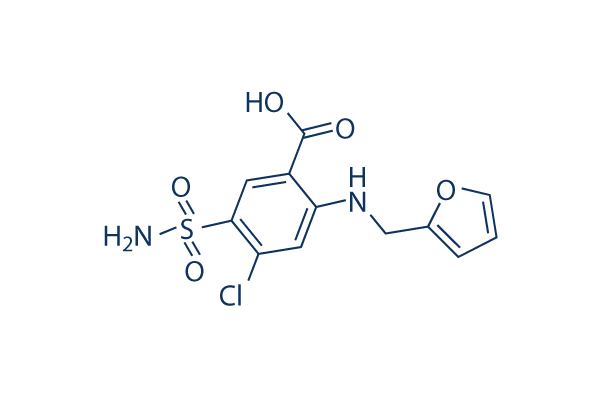
Chemische structuur
Molecuulgewicht: 330.74
Kwaliteitscontrole (Quality Control)
| Gerelateerde doelwitten | CFTR CRM1 CD markers AChR Calcium Channel Sodium Channel Potassium Channel GABA Receptor TRP Channel ATPase |
|---|---|
| Overig NKCC Inhibitoren | Azosemide IAMA-6 |
Chemische informatie, opslag en stabiliteit (Chemical Information, Storage & Stability)
| Molecuulgewicht | 330.74 | Formule | C12H11ClN2O5S |
Opslag (vanaf de datum van ontvangst) | |
|---|---|---|---|---|---|
| CAS-nr. | 54-31-9 | SDF downloaden | Opslag van stamoplossingen |
|
|
| Synoniemen | NSC 269420 | Smiles | C1=COC(=C1)CNC2=CC(=C(C=C2C(=O)O)S(=O)(=O)N)Cl | ||
Oplosbaarheid (Solubility)
|
In vitro |
DMSO
: 66 mg/mL
(199.55 mM)
Water : Insoluble Ethanol : Insoluble |
Molariteitscalculator
|
In vivo |
|||||
In vivo formulatiecalculator (heldere oplossing)
Stap 1: Voer onderstaande informatie in (Aanbevolen: een extra dier om rekening te houden met verlies tijdens het experiment)
Stap 2: Voer de in vivo formulering in (Dit is alleen de calculator, geen formulering. Neem eerst contact met ons op als er geen in vivo formulering is in de sectie oplosbaarheid.)
Berekeningsresultaten:
Werkconcentratie: mg/ml;
Methode voor het bereiden van DMSO-moedervloeistof: mg geneesmiddel vooropgelost in μL DMSO ( Concentratie moedervloeistof mg/mL, Neem eerst contact met ons op als de concentratie de DMSO-oplosbaarheid van de batch van het geneesmiddel overschrijdt. )
Methode voor het bereiden van in vivo formulering: Neem μL DMSO moedervloeistof, voeg daarna toeμL PEG300, mengen en verhelderen, daarna toevoegenμL Tween 80, mengen en verhelderen, daarna toevoegen μL ddH2O, mengen en verhelderen.
Methode voor het bereiden van in vivo formulering: Neem μL DMSO moedervloeistof, voeg daarna toe μL Maïsolie, mengen en verhelderen.
Opmerking: 1. Zorg ervoor dat de vloeistof helder is voordat u het volgende oplosmiddel toevoegt.
2. Zorg ervoor dat u het/de oplosmiddel(en) in de juiste volgorde toevoegt. U moet ervoor zorgen dat de verkregen oplossing, bij de vorige toevoeging, een heldere oplossing is voordat u verdergaat met het toevoegen van het volgende oplosmiddel. Fysieke methoden zoals vortexen, ultrasoon of een warmwaterbad kunnen worden gebruikt om het oplossen te bevorderen.
Werkingsmechanisme (Mechanism of Action)
| Targets/IC50/Ki |
NKCC2
|
|---|---|
| In vitro |
Furosemide reversibly alters the responses to tones and clicks of the chinchilla basilar membrane in hair cells, causing response-magnitude reductions that are largest (up to 61 dB, averaging 25-30 dB) at low stimulus intensities at the characteristic frequency (CF) and small or nonexistent at high intensities and at frequencies far removed from CF. This compound also induces response-phase lags that are largest at low stimulus intensities (averaging 77 degrees) and are confined to frequencies close to CF. This chemical concentration- and time-dependently increases the formation of nitric oxide andprostacyclin. It leads to an enhanced release of kinins into the supernatant of the cells. It reversibly suppresses low Ca2+-induced epileptiform activity in hippocampus proper and blocks or significantly reduces different types of epileptiform discharges in the low Mg2+ model and the 4-aminopyridine model. This compound significantly inhibits cell growth in MKN45 cells, but not in MKN28 cells. It diminishes cell growth by delaying the G(1)-S phase progression in poorly differentiated gastric adenocarcinoma cells, which show high expression and activity of NKCC, but not in moderately differentiated gastric adenocarcinoma cells with low expression and NKCC activity. |
| In vivo |
Furosemide (0.25 to 2 mg/kg), administered 4 hours before exercise, reduces right atrial pressure (RAP) and pulmonary arterial pressure (PAP) during exercise in dose-dependent manner in horse. |
Referenties |
|
Informatie over klinische proeven (Clinical Trial Information)
(gegevens van https://clinicaltrials.gov, bijgewerkt op 2026-06-16)
| NCT-nummer | Werving | Aandoeningen | Sponsor/medewerkers | Startdatum | Fasen |
|---|---|---|---|---|---|
| NCT06941415 | RECRUITING | Cirrhosis |
Stacy Johnson |
2026-06-03 | PHASE3 |
| NCT07737964 | NOT_YET_RECRUITING | Heart Failure |
University Hospital, Montpellier |
2026-10 | PHASE3 |
| NCT06229990 | RECRUITING | Acute Kidney Injury |
Chiang Mai University |
2024-01-01 | PHASE4 |
| NCT07018297 | NOT_YET_RECRUITING | Heart Failure; Acute Decompensated Heart Failure |
University of Texas Southwestern Medical Center |
2026-08 | PHASE3 |
| NCT07726134 | NOT_YET_RECRUITING | Delayed Graft Function; Kidney Transplantation |
London Health Sciences Centre Research Institute OR Lawson Research Institute of St. Joseph's |
2026-08 | |
| NCT07167862 | NOT_YET_RECRUITING | Preeclampsia; Preeclampsia Postpartum; Preeclampsia Severe or Mild |
University of California, Irvine |
2026-06-15 | PHASE4 |

Producten zijn uitsluitend voor onderzoeksdoeleinden. Niet voor menselijk gebruik. Wij verkopen niet aan patiënten.
©Copyright 2013 Selleck Chemicals. Alle rechten voorbehouden.