
alleen voor onderzoeksdoeleinden
Carbenicillin disodium Selection Antibiotics for Transfected Cell inhibitor
Cat.nr.S3179
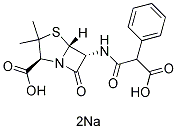
Chemische structuur
Molecuulgewicht: 422.36
Kwaliteitscontrole
| Gerelateerde doelwitten | Integrase Bacterial Antibiotics Anti-infection Fungal Antiviral COVID-19 Parasite Reverse Transcriptase HIV |
|---|---|
| Overig Selection Antibiotics for Transfected Cell Inhibitoren | Blasticidin S Hydrochloride Ribostamycin Sulfate D-Cycloserine |
Chemische informatie, opslag en stabiliteit
| Molecuulgewicht | 422.36 | Formule | C17H16N2Na2O6S |
Opslag (vanaf de datum van ontvangst) | |
|---|---|---|---|---|---|
| CAS-nr. | 4800-94-6 | SDF downloaden | Opslag van stamoplossingen |
|
|
| Synoniemen | BRL-2064,α-carboxybenzylpenicillin | Smiles | CC1(C(N2C(S1)C(C2=O)NC(=O)C(C3=CC=CC=C3)C(=O)[O-])C(=O)[O-])C.[Na+].[Na+] | ||
Molariteitscalculator
|
In vivo |
|||||
In vivo formulatiecalculator (heldere oplossing)
Stap 1: Voer onderstaande informatie in (Aanbevolen: een extra dier om rekening te houden met verlies tijdens het experiment)
Stap 2: Voer de in vivo formulering in (Dit is alleen de calculator, geen formulering. Neem eerst contact met ons op als er geen in vivo formulering is in de sectie oplosbaarheid.)
Berekeningsresultaten:
Werkconcentratie: mg/ml;
Methode voor het bereiden van DMSO-moedervloeistof: mg geneesmiddel vooropgelost in μL DMSO ( Concentratie moedervloeistof mg/mL, Neem eerst contact met ons op als de concentratie de DMSO-oplosbaarheid van de batch van het geneesmiddel overschrijdt. )
Methode voor het bereiden van in vivo formulering: Neem μL DMSO moedervloeistof, voeg daarna toeμL PEG300, mengen en verhelderen, daarna toevoegenμL Tween 80, mengen en verhelderen, daarna toevoegen μL ddH2O, mengen en verhelderen.
Methode voor het bereiden van in vivo formulering: Neem μL DMSO moedervloeistof, voeg daarna toe μL Maïsolie, mengen en verhelderen.
Opmerking: 1. Zorg ervoor dat de vloeistof helder is voordat u het volgende oplosmiddel toevoegt.
2. Zorg ervoor dat u het/de oplosmiddel(en) in de juiste volgorde toevoegt. U moet ervoor zorgen dat de verkregen oplossing, bij de vorige toevoeging, een heldere oplossing is voordat u verdergaat met het toevoegen van het volgende oplosmiddel. Fysieke methoden zoals vortexen, ultrasoon of een warmwaterbad kunnen worden gebruikt om het oplossen te bevorderen.
Werkingsmechanisme
| In vitro |
Carbenicillin (125 mg/L) onderdrukt de proliferatie van Agrobacterium volledig. Carbenicillin (250 mg/L-500 mg/L) verhoogt de toename van het verse gewicht van Callus. Carbenicillin (125 mg/L) resulteert in hogere percentages somatische embryo's en grotere aantallen somatische embryo's van de individuele callus. Carbenicillin (1g/L) beïnvloedt de scheutvorming negatief, aangezien de scheutfrequentie voor bladdiscusexplantaten na 2 maanden cultuur van Nicotiana tabacum Petit Havana wordt verminderd tot 56% en voor cotyledonen tot 51%. Carbenicillin voorkomt de ontwikkeling van volwassen somatische embryo's, vermindert vroege embryo's met >90% en weefselgroei met 50% van de sitkaspar. De leukocyten van de patiënten geven geen histamine vrij bij in vitro provocatie met Carbenicillin (0,1 g/mL). |
|---|---|
| In vivo |
Carbenicillin (0,1 g/mL) vertoont geen allergische medicatiereacties bij patiënten met cystische fibrose, zoals blijkt uit geen significante niveaus van antilichamen van de IgE-, IgG- of IgM-klassen. Carbenicillin (50 μg/mL) resulteert in fytotoxiciteit bij chrysant en TOB, met een toename in de concentratie, en met een parallelle verschuiving in de morfogenetische capaciteit (SRC) van drempeloverlevingsniveaus (TSLs). Carbenicillin resulteert in 100% acclimatisatie zonder verschillende morfologische bloeikenmerken na drie in vitro subculturen in chrysantenplantjes. |
Referenties |
|
Technische ondersteuning
Tel: +1-832-582-8158 Ext:3
Als u nog andere vragen heeft, laat dan een bericht achter.

Producten zijn uitsluitend voor onderzoeksdoeleinden. Niet voor menselijk gebruik. Wij verkopen niet aan patiënten.
©Copyright 2013 Selleck Chemicals. Alle rechten voorbehouden.