
alleen voor onderzoeksdoeleinden
LY2886721 BACE remmer
Cat.nr.S2156
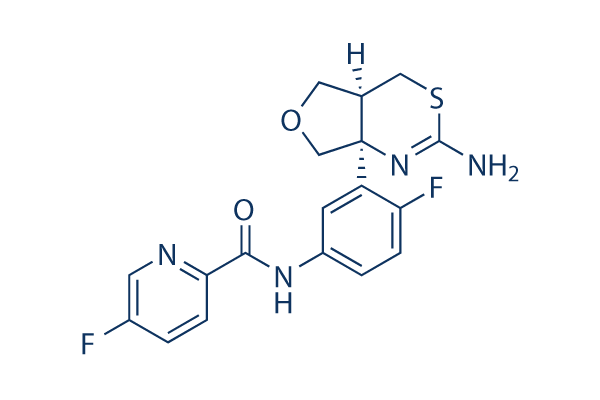
Chemische structuur
Molecuulgewicht: 390.41
Kwaliteitscontrole
| Gerelateerde doelwitten | Adrenergic Receptor AChR 5-HT Receptor COX Calcium Channel Histamine Receptor Dopamine Receptor GABA Receptor TRP Channel Cholinesterase (ChE) |
|---|---|
| Overig BACE Inhibitoren | Verubecestat (MK-8931) LY2811376 Verubecestat (MK-8931) Trifluoroacetate AZD3839 Lanabecestat (AZD3293) Elenbecestat Loganin LX2343 |
Chemische informatie, opslag en stabiliteit
| Molecuulgewicht | 390.41 | Formule | C18H16F2N4O2S |
Opslag (vanaf de datum van ontvangst) | |
|---|---|---|---|---|---|
| CAS-nr. | 1262036-50-9 | SDF downloaden | Opslag van stamoplossingen |
|
|
| Synoniemen | N/A | Smiles | C1C2CSC(=NC2(CO1)C3=C(C=CC(=C3)NC(=O)C4=NC=C(C=C4)F)F)N | ||
Oplosbaarheid
|
In vitro |
DMSO
: 35 mg/mL
(89.64 mM)
Water : Insoluble Ethanol : Insoluble |
Molariteitscalculator
|
In vivo |
|||||
In vivo formulatiecalculator (heldere oplossing)
Stap 1: Voer onderstaande informatie in (Aanbevolen: een extra dier om rekening te houden met verlies tijdens het experiment)
Stap 2: Voer de in vivo formulering in (Dit is alleen de calculator, geen formulering. Neem eerst contact met ons op als er geen in vivo formulering is in de sectie oplosbaarheid.)
Berekeningsresultaten:
Werkconcentratie: mg/ml;
Methode voor het bereiden van DMSO-moedervloeistof: mg geneesmiddel vooropgelost in μL DMSO ( Concentratie moedervloeistof mg/mL, Neem eerst contact met ons op als de concentratie de DMSO-oplosbaarheid van de batch van het geneesmiddel overschrijdt. )
Methode voor het bereiden van in vivo formulering: Neem μL DMSO moedervloeistof, voeg daarna toeμL PEG300, mengen en verhelderen, daarna toevoegenμL Tween 80, mengen en verhelderen, daarna toevoegen μL ddH2O, mengen en verhelderen.
Methode voor het bereiden van in vivo formulering: Neem μL DMSO moedervloeistof, voeg daarna toe μL Maïsolie, mengen en verhelderen.
Opmerking: 1. Zorg ervoor dat de vloeistof helder is voordat u het volgende oplosmiddel toevoegt.
2. Zorg ervoor dat u het/de oplosmiddel(en) in de juiste volgorde toevoegt. U moet ervoor zorgen dat de verkregen oplossing, bij de vorige toevoeging, een heldere oplossing is voordat u verdergaat met het toevoegen van het volgende oplosmiddel. Fysieke methoden zoals vortexen, ultrasoon of een warmwaterbad kunnen worden gebruikt om het oplossen te bevorderen.
Werkingsmechanisme
| Targets/IC50/Ki |
BACE2
(Cell-free assay) 10.2 nM
BACE1
(Cell-free assay) 20.3 nM
|
|---|---|
| In vitro |
LY2886721 is een oraal, klein molecuul van het β-site amyloïdeiwit-splitsend enzym (BACE) remmer met het potentieel om de synthese van β-amyloïde te remmen en daardoor de klinische progressie van AD te vertragen. Deze verbinding kan ook de γ-secretase targeten om de synthese van β-amyloïde te remmen. Het remt recombinant hBACE1 met een IC50 van 20,3 nM. In cellulaire assays remt deze chemische stof Abeta met een IC50 van respectievelijk 18,7 nM en 10,7 nM in HEK293Swe- en PDAPP-neurale culturen. Het heeft een hoge selectiviteit tegen belangrijke off-target proteasen, wat in vitro-activiteit efficiënt vertaalt naar robuuste in vivo amyloïde β-verlaging in niet-klinische diermodellen. Evaluatie van de activiteit tegen hBACE2 toont een IC50 van 10,2 nM. Evaluatie van de activiteit van de verbinding tegen cathepsine D, pepsine, renine of andere belangrijke aspartylproteasen toont in essentie geen remming (IC50 >100.000 nM), wat suggereert dat activiteit tegen deze veelvoorkomende aspartylproteasen waarschijnlijk niet significant zal zijn.
|
| In vivo |
Orale toediening van LY2886721 aan PDAPP-muizen produceert dosisafhankelijke reducties in hersen-Abeta, C99 en sAPPbeta. Hersen-Abeta-niveaus zijn met ~20%-65% verlaagd ten opzichte van voertuigbehandelde groepen drie uur na een dosis van 3-30 mg/kg van deze verbinding. Hersen-C99- en sAPPb-niveaus zijn ook op een dosisafhankelijke manier verlaagd, consistent met BACE1-remming in vivo. De farmacodynamische responsen op deze chemische stof houden aan tot 9 uur na de dosis in de hersenen van PDAPP-muizen. Farmacodynamische studies bij beagles onthullen robuuste en aanhoudende reducties in plasma-Abeta na een dosis van 1 mg/kg. Centrale effecten van BACE1-remming bij de hond manifesteren zich door een 50% reductie in CSF Abeta 9 uur na een dosis van 0,5 mg/kg. De geometrische gemiddelde terminale eliminatie t1/2 wordt bepaald op 17,2 uur (bereik 8,19-36,3 uur). De geometrische gemiddelde schijnbare orale klaring is 34,8 L/uur (38% CV) en het schijnbare verdelingsvolume tijdens de terminale fase was 863 L (56% CV) over dosisniveaus. Deze verbinding is vrij permeabel over de bloed-hersenbarrière.
|
Referenties |
|
Informatie over klinische proeven
(gegevens van https://clinicaltrials.gov, bijgewerkt op 2024-05-22)
| NCT-nummer | Werving | Aandoeningen | Sponsor/medewerkers | Startdatum | Fasen |
|---|---|---|---|---|---|
| NCT01807026 | Completed | Alzheimer Disease|Healthy Volunteers |
Eli Lilly and Company |
March 2013 | Phase 1 |
| NCT01534273 | Completed | Healthy Volunteers |
Eli Lilly and Company |
February 2012 | Phase 1 |
| NCT01367262 | Completed | Healthy Volunteers |
Eli Lilly and Company |
June 2011 | Phase 1 |
| NCT01227252 | Completed | Alzheimer''s Disease |
Eli Lilly and Company |
December 2010 | Phase 1 |
| NCT01133405 | Completed | Alzheimer''s Disease |
Eli Lilly and Company |
June 2010 | Phase 1 |
Technische ondersteuning
Tel: +1-832-582-8158 Ext:3
Als u nog andere vragen heeft, laat dan een bericht achter.

Producten zijn uitsluitend voor onderzoeksdoeleinden. Niet voor menselijk gebruik. Wij verkopen niet aan patiënten.
©Copyright 2013 Selleck Chemicals. Alle rechten voorbehouden.