
alleen voor onderzoeksdoeleinden
Atovaquone Fungal remmer
Cat.nr.S3079
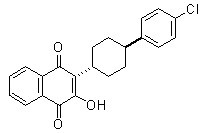
Chemische structuur
Molecuulgewicht: 366.84
Kwaliteitscontrole
| Gerelateerde doelwitten | Integrase Bacterial Antibiotics Anti-infection Antiviral COVID-19 Parasite Reverse Transcriptase HIV HCV Protease |
|---|---|
| Overig Fungal Inhibitoren | Cycloheximide Tolnaftate Manogepix (E1210) Amorolfine HCl Isavuconazole Thimerosal Allicin Neticonazole Hydrochloride Juglone Pseudolaric Acid B |
Chemische informatie, opslag en stabiliteit
| Molecuulgewicht | 366.84 | Formule | C22H19ClO3 |
Opslag (vanaf de datum van ontvangst) | |
|---|---|---|---|---|---|
| CAS-nr. | 95233-18-4 | SDF downloaden | Opslag van stamoplossingen |
|
|
| Synoniemen | Atavaquone | Smiles | C1CC(CCC1C2=CC=C(C=C2)Cl)C3=C(C4=CC=CC=C4C(=O)C3=O)O | ||
Oplosbaarheid
|
In vitro |
DMSO
: 11 mg/mL
(29.98 mM)
Water : Insoluble Ethanol : Insoluble |
Molariteitscalculator
|
In vivo |
|||||
In vivo formulatiecalculator (heldere oplossing)
Stap 1: Voer onderstaande informatie in (Aanbevolen: een extra dier om rekening te houden met verlies tijdens het experiment)
Stap 2: Voer de in vivo formulering in (Dit is alleen de calculator, geen formulering. Neem eerst contact met ons op als er geen in vivo formulering is in de sectie oplosbaarheid.)
Berekeningsresultaten:
Werkconcentratie: mg/ml;
Methode voor het bereiden van DMSO-moedervloeistof: mg geneesmiddel vooropgelost in μL DMSO ( Concentratie moedervloeistof mg/mL, Neem eerst contact met ons op als de concentratie de DMSO-oplosbaarheid van de batch van het geneesmiddel overschrijdt. )
Methode voor het bereiden van in vivo formulering: Neem μL DMSO moedervloeistof, voeg daarna toeμL PEG300, mengen en verhelderen, daarna toevoegenμL Tween 80, mengen en verhelderen, daarna toevoegen μL ddH2O, mengen en verhelderen.
Methode voor het bereiden van in vivo formulering: Neem μL DMSO moedervloeistof, voeg daarna toe μL Maïsolie, mengen en verhelderen.
Opmerking: 1. Zorg ervoor dat de vloeistof helder is voordat u het volgende oplosmiddel toevoegt.
2. Zorg ervoor dat u het/de oplosmiddel(en) in de juiste volgorde toevoegt. U moet ervoor zorgen dat de verkregen oplossing, bij de vorige toevoeging, een heldere oplossing is voordat u verdergaat met het toevoegen van het volgende oplosmiddel. Fysieke methoden zoals vortexen, ultrasoon of een warmwaterbad kunnen worden gebruikt om het oplossen te bevorderen.
Werkingsmechanisme
| In vitro |
Atovaquone (atavaquone) is een chemische verbinding die behoort tot de klasse van naftaleen. Deze verbinding is een hydroxy-1,4-naftochinon, een analoog van ubiquinon, met antipneumocystische activiteit. Het is een antiprotozoale mitochondriale elektrontransportremmer; antimalariamiddel; antipneumocystisch, en is ook gebruikt om toxoplasmose te behandelen. Deze chemische stof werkt door het cytochroom bc(1)-complex te remmen via interacties met het Rieske ijzer-zwavel-eiwit en cytochroom b in de ubiquinol oxidatiepocket.
|
|---|---|
| In vivo |
Atovaquone is een unieke naftochinon met breedspectrum antiprotozoale activiteit. Het is effectief voor de behandeling en preventie van Pneumocystis carinii-pneumonie (PCP), deze verbinding is effectief in combinatie met proguanil voor de behandeling en preventie van malaria, en het is effectief in combinatie met azitromycine voor de behandeling van babesiose.
|
Referenties |
|
Informatie over klinische proeven
(gegevens van https://clinicaltrials.gov, bijgewerkt op 2024-05-22)
| NCT-nummer | Werving | Aandoeningen | Sponsor/medewerkers | Startdatum | Fasen |
|---|---|---|---|---|---|
| NCT05458752 | Completed | Pneumocystis Jirovecii Infection |
Central Hospital Nancy France |
April 1 2020 | -- |
| NCT04002687 | Completed | Malaria |
Medicines for Malaria Venture|Richmond Pharmacology Limited |
April 4 2019 | Phase 1 |
| NCT02628080 | Completed | Carcinoma Non-Small-Cell Lung |
University of Oxford |
May 2016 | Early Phase 1 |
| NCT01858831 | Completed | Malaria |
GlaxoSmithKline |
April 2012 | Phase 1 |
Technische ondersteuning
Tel: +1-832-582-8158 Ext:3
Als u nog andere vragen heeft, laat dan een bericht achter.

Producten zijn uitsluitend voor onderzoeksdoeleinden. Niet voor menselijk gebruik. Wij verkopen niet aan patiënten.
©Copyright 2013 Selleck Chemicals. Alle rechten voorbehouden.