
alleen voor onderzoeksdoeleinden
Heparin Sodium Anticoagulans
Cat.nr.: S1346
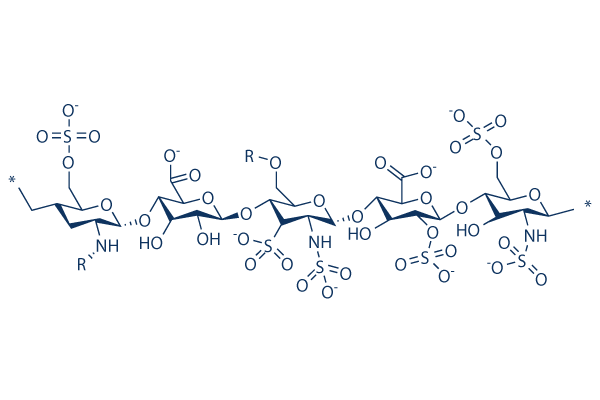
Chemische structuur
Kwaliteitscontrole (Quality Control)
| Gerelateerde doelwitten | HDAC Caspase Proteasome Secretase MMP HCV Protease Cysteine Protease Tyrosinase HIV Protease DPP |
|---|---|
| Uitgelichte producten | Y-27632 Dihydrochloride SB431542 CHIR-99021 (Laduviglusib) RMC-7977 RMC-6236 (Daraxonrasib) MRTX1133 MG132 Z-VAD-FMK VT3989 IAG933 |
Chemische informatie, opslag en stabiliteit (Chemical Information, Storage & Stability)
| Molecuulgewicht | Formule | (C12H16NS2Na3)20 |
Opslag (vanaf de datum van ontvangst) | ||
|---|---|---|---|---|---|
| CAS-nr. | 9041-08-1 | -- | Opslag van stamoplossingen |
|
|
| Synoniemen | N/A | Smiles | CCC1CC(N[R])C(OC1CO[S]([O-])(=O)=O)OC2C(O)C(O)C(OC3C(CO[R])OC(OC4C(O)C(O[S]([O-])(=O)=O)C(OC5C(O)C(N[S]([O-])(=O)=O)C(C)OC5CO[S]([O-])(=O)=O)OC4C([O-])=O)C(N[S]([O-])(=O)=O)C3[S]([O-])(=O)=O)OC2C([O-] | ||
Oplosbaarheid (Solubility)
|
In vitro |
Water : 162 mg/mL
DMSO
: Insoluble
Ethanol : Insoluble |
Molariteitscalculator
|
In vivo |
|||||
In vivo formulatiecalculator (heldere oplossing)
Stap 1: Voer onderstaande informatie in (Aanbevolen: een extra dier om rekening te houden met verlies tijdens het experiment)
Stap 2: Voer de in vivo formulering in (Dit is alleen de calculator, geen formulering. Neem eerst contact met ons op als er geen in vivo formulering is in de sectie oplosbaarheid.)
Berekeningsresultaten:
Werkconcentratie: mg/ml;
Methode voor het bereiden van DMSO-moedervloeistof: mg geneesmiddel vooropgelost in μL DMSO ( Concentratie moedervloeistof mg/mL, Neem eerst contact met ons op als de concentratie de DMSO-oplosbaarheid van de batch van het geneesmiddel overschrijdt. )
Methode voor het bereiden van in vivo formulering: Neem μL DMSO moedervloeistof, voeg daarna toeμL PEG300, mengen en verhelderen, daarna toevoegenμL Tween 80, mengen en verhelderen, daarna toevoegen μL ddH2O, mengen en verhelderen.
Methode voor het bereiden van in vivo formulering: Neem μL DMSO moedervloeistof, voeg daarna toe μL Maïsolie, mengen en verhelderen.
Opmerking: 1. Zorg ervoor dat de vloeistof helder is voordat u het volgende oplosmiddel toevoegt.
2. Zorg ervoor dat u het/de oplosmiddel(en) in de juiste volgorde toevoegt. U moet ervoor zorgen dat de verkregen oplossing, bij de vorige toevoeging, een heldere oplossing is voordat u verdergaat met het toevoegen van het volgende oplosmiddel. Fysieke methoden zoals vortexen, ultrasoon of een warmwaterbad kunnen worden gebruikt om het oplossen te bevorderen.
Werkingsmechanisme (Mechanism of Action)
| Targets/IC50/Ki |
Antithrombin III
|
|---|---|
| In vitro |
Heparin is widely used as an anticoagulant drug based on its ability to accelerate the rate at which antithrombin inhibits serine proteases in the blood coagulation cascade. Heparin and the structurally related heparan sulfate are complex linear polymers comprised of a mixture of chains of different length, having variable sequences. Heparin interactes most tightly with peptides containing a complementary binding site of high positive charge density. Heparin and heparan sulfate predominantly exhibit linear helical secondary structures with sulfo and carboxyl groups displayed at defined intervals and in defined orientations along the polysaccharide backbone. Heparin resembles DNA as both are highly charged linear polymers that behave as polyelectrolytes. Heparin is believed to function as an anticoagulant primarily through its interaction with AT III by enhancing AT-III-mediated inhibition of blood coagulation factors, including thrombin and factor Xa. Heparin binds to AT III and thrombin in a ternary complex, increasing the bimolecular rate constant for the inhibition of thrombin by a factor of 2000. Heparin is principally located in the granules of tissue mast cells that are closely associated with the immune response. Heparin makes numerous contacts with both FGF-2 and FGFR-1 stabilizing FGF–FGFR binding. Heparin also makes contacts with the FGFR-1 of the adjacent FGF–FGFR complex, thus seeming to promote FGFR dimerization. |
Referenties |
|
Informatie over klinische proeven (Clinical Trial Information)
(gegevens van https://clinicaltrials.gov, bijgewerkt op 2026-07-27)
| NCT-nummer | Werving | Aandoeningen | Sponsor/medewerkers | Startdatum | Fasen |
|---|---|---|---|---|---|
| NCT06494878 | RECRUITING | Venous Thromboembolism; Postpartum Period; Aspirin; Low Molecular Weight Heparin |
University of Calgary |
2026-06-04 | PHASE3 |
| NCT07140211 | RECRUITING | Venous Thromboembolism (VTE); Postpartum |
Marc Blondon |
2025-10-15 | PHASE3 |
| NCT07783880 | NOT_YET_RECRUITING | Myocardial Infarction; Percutaneous Coronary Intervention (PCI); Medical Treatment; Coronary Computed Tomographic Angiography; Computed Tomography; Optical Coherence Tomography (OCT) |
3W-Research Collaboration Group |
2026-10-01 | |
| NCT06753786 | RECRUITING | Venous Thromboembolism; Pulmonary Embolism; Intracerebral Hemorrhage; Deep Vein Thrombosis |
Pirogov Russian National Research Medical University |
2024-10-21 | |
| NCT06381661 | RECRUITING | Sepsis |
Assistance Publique - Hôpitaux de Paris |
2026-07-09 | PHASE2 |
| NCT06714864 | RECRUITING | Catheter-Related Infections |
CorMedix Therapeutics |
2025-07-08 | PHASE4 |

Producten zijn uitsluitend voor onderzoeksdoeleinden. Niet voor menselijk gebruik. Wij verkopen niet aan patiënten.
©Copyright 2013 Selleck Chemicals. Alle rechten voorbehouden.