
uitsluitend voor onderzoeksdoeleinden
Epothilone A Microtubule Associated remmer
Cat.Nr.S1297
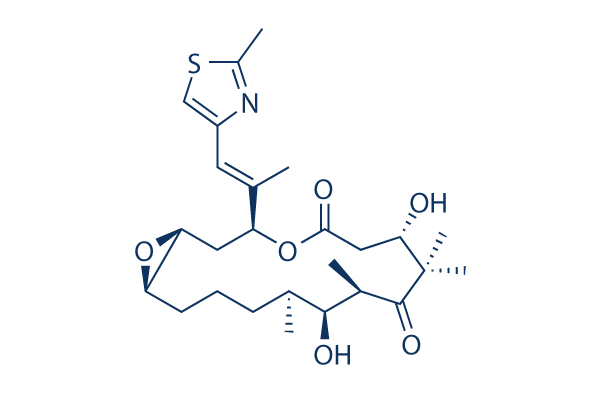
Chemische structuur
Moleculair gewicht: 493.66
Kwaliteitscontrole
| Gerelateerde doelwitten | Akt Wnt/beta-catenin PKC HSP ROCK Integrin Bcr-Abl Actin FAK Kinesin |
|---|---|
| Overige Microtubule Associated Inhibitoren | Nocodazole MMAF Patupilone (Epothilone B) Lexibulin (CYT997) CW069 Combretastatin A4 ABT-751 (E7010) TAI-1 Cucurbitacin B INH1 |
Chemische informatie, Opslag en Stabiliteit
| Moleculair gewicht | 493.66 | Formule | C26H39NO6S |
Opslag (Vanaf de ontvangstdatum) | |
|---|---|---|---|---|---|
| CAS-nr. | 152044-53-6 | SDF downloaden | Opslag van stamoplossingen |
|
|
| Synoniemen | N/A | Smiles | CC1CCCC2C(O2)CC(OC(=O)CC(C(C(=O)C(C1O)C)(C)C)O)C(=CC3=CSC(=N3)C)C | ||
Oplosbaarheid
|
In vitro |
DMSO
: 99 mg/mL
(200.54 mM)
Ethanol : 99 mg/mL Water : Insoluble |
Molariteitscalculator
|
In vivo |
|||||
In vivo Formuleringscalculator (Heldere oplossing)
Stap 1: Voer de onderstaande informatie in (Aanbevolen: Een extra dier voor het geval van verlies tijdens het experiment)
Stap 2: Voer de in vivo formulering in (Dit is alleen de calculator, geen formulering. Neem eerst contact met ons op als er geen in vivo formulering is in het gedeelte Oplosbaarheid.)
Berekeningsresultaten:
Werkconcentratie: mg/ml;
Methode voor het bereiden van DMSO-mastervloeistof: mg geneesmiddel vooraf opgelost in μL DMSO ( Concentratie mastervloeistof mg/mL, Neem eerst contact met ons op als de concentratie de DMSO-oplosbaarheid van de partij geneesmiddel overschrijdt. )
Methode voor het bereiden van in vivo formulering: Neem μL DMSO mastervloeistof, voeg vervolgens toeμL PEG300, mengen en helder maken, voeg vervolgens toeμL Tween 80, mengen en helder maken, voeg vervolgens toe μL ddH2O, mengen en helder maken.
Methode voor het bereiden van in vivo formulering: Neem μL DMSO mastervloeistof, voeg vervolgens toe μL Maïsolie, mengen en helder maken.
Opmerking: 1. Zorg ervoor dat de vloeistof helder is voordat u het volgende oplosmiddel toevoegt.
2. Zorg ervoor dat u het/de oplosmiddel(en) in de juiste volgorde toevoegt. U moet ervoor zorgen dat de verkregen oplossing, bij de vorige toevoeging, een heldere oplossing is voordat u verdergaat met het toevoegen van het volgende oplosmiddel. Fysische methoden zoals vortexen, echografie of een warmwaterbad kunnen worden gebruikt om het oplossen te bevorderen.
Werkingsmechanisme
| Targets/IC50/Ki |
Tubulin
2 μM(EC0.01)
|
|---|---|
| In vitro |
Epothilone A, ontdekt in de myxobacterie Sorangium cellulosum, is een Taxol-achtig Microtubule Associated-stabiliserend middel dat tubulinepolymerisatie induceert, wat leidt tot celcyclusarrestatie in de G2-M-overgang, cytotoxiciteit en apoptose. Dit compound remt krachtig celproliferatie in HCT116-cellen, met een IC50 van 4,4 nM. Het vertoont ook cytotoxiciteit in KB3-1-, KBV-1-, Hela- en Hs578T-cellen, met IC50-waarden variërend van 13 nM tot 160 nM. Deze chemische stof is beter oplosbaar in water dan Taxol en concurreert met Taxol bij het binden aan microtubules, met een IC50 van 2,3 μM. Echter, zowel dit compound als Taxol delen geen gemeenschappelijke farmacofoor en exploiteren de tubuline-bindingspocket uniek en onafhankelijk. Onlangs is gebleken dat microbiologische transformatie van dit compound door Aspergillus niger AS 3.739 verschillende metabolieten oplevert die ook toxisch zijn voor MCF-7-cellen, maar met veel hogere IC50-waarden.
|
| Kinase Assay |
Tubulinepolymerisatietest
|
|
Microtubule-eiwitten (MTP) van kalverhersenen worden gezuiverd, wat ongeveer 15%–20% microtubule associated proteins omvat. De buffer (MES-buffer) die wordt gebruikt voor de Epothilone A-microtubule-studies bevat 0,1 M 2-morfolinoethaansulfonzuur (MES), 1 mM EGTA, 0,5 mM MgCl2 en 3 M glycerol bij pH 6,6. Monsters voor elektronenmicroscopie worden op met koolstof beklede Parlodion-roosters (300 mesh) geplaatst en negatief gekleurd met 2% uranylacetaat. Microtubule-assemblage in aanwezigheid of afwezigheid van dit compound wordt spectrophotometrisch gecontroleerd met behulp van een spectrophotometer uitgerust met een thermostatsich gereguleerde vloeistofcirculator. De temperatuur wordt op 35 °C gehouden en veranderingen in troebelheid (representatief voor polymeermassa) worden gecontroleerd bij 350 nm. Effectieve concentratie (EC0.01), gedefinieerd als de geïnterpoleerde concentratie die in staat is om een initiële helling van 0,01 OD/min te induceren, wordt berekend met behulp van de formule EC0.01 = concentratie/helling en uitgedrukt als het gemiddelde met standaardafwijking verkregen uit drie verschillende concentraties.
|
Referenties |
|
Technische ondersteuning
Tel: +1-832-582-8158 Ext:3
Als u nog andere vragen heeft, kunt u een bericht achterlaten.

Producten zijn uitsluitend voor onderzoeksdoeleinden. Niet voor menselijk gebruik. Wij verkopen niet aan patiënten.
©Copyright 2013 Selleck Chemicals. Alle rechten voorbehouden.