
alleen voor onderzoeksdoeleinden
Chloramphenicol Antibiotics for Plant Cell Culture remmer
Cat.nr.S1677
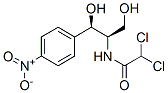
Chemische structuur
Molecuulgewicht: 323.13
Kwaliteitscontrole
Chemische informatie, opslag en stabiliteit
| Molecuulgewicht | 323.13 | Formule | C11H12Cl2N2O5 |
Opslag (vanaf de datum van ontvangst) | |
|---|---|---|---|---|---|
| CAS-nr. | 56-75-7 | SDF downloaden | Opslag van stamoplossingen |
|
|
| Synoniemen | Chloromycetin | Smiles | C1=CC(=CC=C1C(C(CO)NC(=O)C(Cl)Cl)O)[N+](=O)[O-] | ||
Oplosbaarheid
|
In vitro |
DMSO
: 65 mg/mL
(201.15 mM)
Ethanol : 65 mg/mL Water : Insoluble |
Molariteitscalculator
|
In vivo |
|||||
In vivo formulatiecalculator (heldere oplossing)
Stap 1: Voer onderstaande informatie in (Aanbevolen: een extra dier om rekening te houden met verlies tijdens het experiment)
Stap 2: Voer de in vivo formulering in (Dit is alleen de calculator, geen formulering. Neem eerst contact met ons op als er geen in vivo formulering is in de sectie oplosbaarheid.)
Berekeningsresultaten:
Werkconcentratie: mg/ml;
Methode voor het bereiden van DMSO-moedervloeistof: mg geneesmiddel vooropgelost in μL DMSO ( Concentratie moedervloeistof mg/mL, Neem eerst contact met ons op als de concentratie de DMSO-oplosbaarheid van de batch van het geneesmiddel overschrijdt. )
Methode voor het bereiden van in vivo formulering: Neem μL DMSO moedervloeistof, voeg daarna toeμL PEG300, mengen en verhelderen, daarna toevoegenμL Tween 80, mengen en verhelderen, daarna toevoegen μL ddH2O, mengen en verhelderen.
Methode voor het bereiden van in vivo formulering: Neem μL DMSO moedervloeistof, voeg daarna toe μL Maïsolie, mengen en verhelderen.
Opmerking: 1. Zorg ervoor dat de vloeistof helder is voordat u het volgende oplosmiddel toevoegt.
2. Zorg ervoor dat u het/de oplosmiddel(en) in de juiste volgorde toevoegt. U moet ervoor zorgen dat de verkregen oplossing, bij de vorige toevoeging, een heldere oplossing is voordat u verdergaat met het toevoegen van het volgende oplosmiddel. Fysieke methoden zoals vortexen, ultrasoon of een warmwaterbad kunnen worden gebruikt om het oplossen te bevorderen.
Werkingsmechanisme
| In vitro |
Chloramphenicol resulteert in een constitutieve toename van het cspA-transcriptniveau en constitutieve productie van CS7.4. Deze verbinding reguleert het mitochondriale DNA-gecodeerde Cox I-eiwit neerwaarts, maar niet de nucleair gecodeerde eiwitten. Het verhoogt de cellulaire niveaus van het p21(waf1/cip1)-eiwit en p21(waf1/cip1)-mRNA via een p53-onafhankelijke route. Deze chemische stof, in concentraties groter dan 0,1 g/L (0,3 mM), remt de denitrificerende enzymactiviteit (DEA) van slurries van humisol en zandige leemgronden door de activiteit van bestaande nitraatreductase-enzymen te verstoren. Het, in concentraties van 5 mM tot 2 mM, initieert apoptose in delende cellen van een niercel-lijn van apen en in hematopoietische progenitorcellen uit menselijk navelstrengbloed van pasgeborenen. Deze verbinding onderdrukt de groei van progenitorcellen.
|
|---|---|
| In vivo |
Chloramphenicol resulteert in een verhoogde t1/2(beta) (met 209%), en een verlaagde ClB (met 45%), en verlengde herstelindices (met 768 tot 946%) bij greyhounds. Deze verbinding onderdrukt toenames in het lichaamsgewicht en levergewicht van proefdieren en induceerde tegelijkertijd een opmerkelijke toename van lipidperoxidatie in de lever tijdens de vorming van megamitochondria. De door deze chemische stof geinduceerde vorming van megamitochondria wordt niet eenvoudigweg toegeschreven aan de onderdrukking van het delingsproces van mitochondria als gevolg van een verminderde eiwitsynthese in mitochondria, maar is intiem gerelateerd aan oxidatieve stress.
|
Referenties |
|
Technische ondersteuning
Tel: +1-832-582-8158 Ext:3
Als u nog andere vragen heeft, laat dan een bericht achter.

Producten zijn uitsluitend voor onderzoeksdoeleinden. Niet voor menselijk gebruik. Wij verkopen niet aan patiënten.
©Copyright 2013 Selleck Chemicals. Alle rechten voorbehouden.