
uitsluitend voor onderzoeksdoeleinden
Allitinib tosylate EGFR remmer
Cat.Nr.S2185
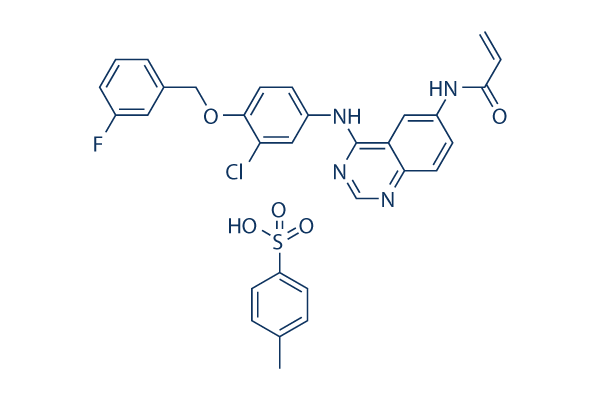
Chemische structuur
Moleculair gewicht: 621.08
Kwaliteitscontrole
| Gerelateerde doelwitten | VEGFR PDGFR FGFR c-Met Src MEK CSF-1R FLT3 HER2 c-Kit |
|---|---|
| Overige EGFR Inhibitoren | Lazertinib (YH25448) Icotinib Hydrochloride Sunvozertinib AG-490 AG-1478 Canertinib (CI-1033) WZ4002 Rociletinib (CO-1686) Poziotinib (NOV120101, HM781-36B) Genistein |
Celkweek, behandeling & werkconcentratie
| Cellijnen | Assaytype | Concentratie | Incubatietijd | Formulering | Activiteitsbeschrijving | PMID |
|---|---|---|---|---|---|---|
| A431 cells | Proliferation assay | 72 h | Antiproliferative activity against human A431 cells over-expressing EGFR gene after 72 hrs by SRB assay, IC50=0.2 μM | 22227214 | ||
| NCI-H1975 cells | Proliferation assay | 72 h | Antiproliferative activity against human NCI-H1975 cells over-expressing EGFR mutant gene after 72 hrs by SRB assay, IC50=0.7 μM | 22227214 | ||
| A549 cells | Proliferation assay | 72 h | Antiproliferative activity against human A549 cells over-expressing EGFR gene after 72 hrs by SRB assay, IC50=6.8 μM | 22227214 | ||
| TC32 | qHTS assay | qHTS of pediatric cancer cell lines to identify multiple opportunities for drug repurposing: Primary screen for TC32 cells | 29435139 | |||
| DAOY | qHTS assay | qHTS of pediatric cancer cell lines to identify multiple opportunities for drug repurposing: Primary screen for DAOY cells | 29435139 | |||
| SJ-GBM2 | qHTS assay | qHTS of pediatric cancer cell lines to identify multiple opportunities for drug repurposing: Primary screen for SJ-GBM2 cells | 29435139 | |||
| A673 | qHTS assay | qHTS of pediatric cancer cell lines to identify multiple opportunities for drug repurposing: Primary screen for A673 cells | 29435139 | |||
| SK-N-MC | qHTS assay | qHTS of pediatric cancer cell lines to identify multiple opportunities for drug repurposing: Primary screen for SK-N-MC cells | 29435139 | |||
| BT-37 | qHTS assay | qHTS of pediatric cancer cell lines to identify multiple opportunities for drug repurposing: Primary screen for BT-37 cells | 29435139 | |||
| NB-EBc1 | qHTS assay | qHTS of pediatric cancer cell lines to identify multiple opportunities for drug repurposing: Primary screen for NB-EBc1 cells | 29435139 | |||
| U-2 OS | qHTS assay | qHTS of pediatric cancer cell lines to identify multiple opportunities for drug repurposing: Primary screen for U-2 OS cells | 29435139 | |||
| Saos-2 | qHTS assay | qHTS of pediatric cancer cell lines to identify multiple opportunities for drug repurposing: Primary screen for Saos-2 cells | 29435139 | |||
| SK-N-SH | qHTS assay | qHTS of pediatric cancer cell lines to identify multiple opportunities for drug repurposing: Primary screen for SK-N-SH cells | 29435139 | |||
| NB1643 | qHTS assay | qHTS of pediatric cancer cell lines to identify multiple opportunities for drug repurposing: Primary screen for NB1643 cells | 29435139 | |||
| LAN-5 | qHTS assay | qHTS of pediatric cancer cell lines to identify multiple opportunities for drug repurposing: Primary screen for LAN-5 cells | 29435139 | |||
| BT-12 | qHTS assay | qHTS of pediatric cancer cell lines to identify multiple opportunities for drug repurposing: Primary screen for BT-12 cells | 29435139 | |||
| Rh18 | qHTS assay | qHTS of pediatric cancer cell lines to identify multiple opportunities for drug repurposing: Primary screen for Rh18 cells | 29435139 | |||
| OHS-50 | qHTS assay | qHTS of pediatric cancer cell lines to identify multiple opportunities for drug repurposing: Primary screen for OHS-50 cells | 29435139 | |||
| RD | qHTS assay | qHTS of pediatric cancer cell lines to identify multiple opportunities for drug repurposing: Primary screen for RD cells | 29435139 | |||
| MG 63 (6-TG R) | qHTS assay | qHTS of pediatric cancer cell lines to identify multiple opportunities for drug repurposing: Primary screen for MG 63 (6-TG R) cells | 29435139 | |||
| Rh41 | qHTS assay | qHTS of pediatric cancer cell lines to identify multiple opportunities for drug repurposing: Primary screen for Rh41 cells | 29435139 | |||
| NB1643 | qHTS assay | qHTS of pediatric cancer cell lines to identify multiple opportunities for drug repurposing: Confirmatory screen for NB1643 cells | 29435139 | |||
| A673 | qHTS assay | qHTS of pediatric cancer cell lines to identify multiple opportunities for drug repurposing: Confirmatory screen for A673 cells) | 29435139 | |||
| SK-N-MC | qHTS assay | qHTS of pediatric cancer cell lines to identify multiple opportunities for drug repurposing: Confirmatory screen for SK-N-MC cells | 29435139 | |||
| BT-12 | qHTS assay | qHTS of pediatric cancer cell lines to identify multiple opportunities for drug repurposing: Confirmatory screen for BT-12 cells | 29435139 | |||
| LAN-5 | qHTS assay | qHTS of pediatric cancer cell lines to identify multiple opportunities for drug repurposing: Confirmatory screen for LAN-5 cells | 29435139 | |||
| DAOY | qHTS assay | qHTS of pediatric cancer cell lines to identify multiple opportunities for drug repurposing: Confirmatory screen for DAOY cells | 29435139 | |||
| NB-EBc1 | qHTS assay | qHTS of pediatric cancer cell lines to identify multiple opportunities for drug repurposing: Confirmatory screen for NB-EBc1 cells | 29435139 | |||
| SJ-GBM2 | qHTS assay | qHTS of pediatric cancer cell lines to identify multiple opportunities for drug repurposing: Confirmatory screen for SJ-GBM2 cells | 29435139 | |||
| BT-37 | qHTS assay | qHTS of pediatric cancer cell lines to identify multiple opportunities for drug repurposing: Confirmatory screen for BT-37 cells | 29435139 | |||
| TC32 | qHTS assay | qHTS of pediatric cancer cell lines to identify multiple opportunities for drug repurposing: Confirmatory screen for TC32 cells | 29435139 | |||
| MG 63 (6-TG R) | qHTS assay | qHTS of pediatric cancer cell lines to identify multiple opportunities for drug repurposing: Confirmatory screen for MG 63 (6-TG R) cells | 29435139 | |||
| Rh41 | qHTS assay | qHTS of pediatric cancer cell lines to identify multiple opportunities for drug repurposing: Confirmatory screen for Rh41 cells | 29435139 | |||
| RD | qHTS assay | qHTS of pediatric cancer cell lines to identify multiple opportunities for drug repurposing: Confirmatory screen for RD cells | 29435139 | |||
| Rh18 | qHTS assay | qHTS of pediatric cancer cell lines to identify multiple opportunities for drug repurposing: Confirmatory screen for Rh18 cells | 29435139 | |||
| Saos-2 | qHTS assay | qHTS of pediatric cancer cell lines to identify multiple opportunities for drug repurposing: Confirmatory screen for Saos-2 cells | 29435139 | |||
| OHS-50 | qHTS assay | qHTS of pediatric cancer cell lines to identify multiple opportunities for drug repurposing: Confirmatory screen for OHS-50 cells | 29435139 | |||
| SK-N-SH | qHTS assay | qHTS of pediatric cancer cell lines to identify multiple opportunities for drug repurposing: Confirmatory screen for SK-N-SH cells | 29435139 | |||
| Klik om meer experimentele gegevens over de cellijn te bekijken | ||||||
Chemische informatie, Opslag en Stabiliteit
| Moleculair gewicht | 621.08 | Formule | C24H18ClFN4O2,C7H8O3S |
Opslag (Vanaf de ontvangstdatum) | |
|---|---|---|---|---|---|
| CAS-nr. | 1050500-29-2 | SDF downloaden | Opslag van stamoplossingen |
|
|
| Synoniemen | AST-1306 TsOH, AST-6 | Smiles | CC1=CC=C(C=C1)S(=O)(=O)O.C=CC(=O)NC1=CC2=C(C=C1)N=CN=C2NC3=CC(=C(C=C3)OCC4=CC(=CC=C4)F)Cl | ||
Oplosbaarheid
|
In vitro |
DMSO
: 124 mg/mL
(199.65 mM)
Water : Insoluble Ethanol : Insoluble |
Molariteitscalculator
|
In vivo |
|||||
In vivo Formuleringscalculator (Heldere oplossing)
Stap 1: Voer de onderstaande informatie in (Aanbevolen: Een extra dier voor het geval van verlies tijdens het experiment)
Stap 2: Voer de in vivo formulering in (Dit is alleen de calculator, geen formulering. Neem eerst contact met ons op als er geen in vivo formulering is in het gedeelte Oplosbaarheid.)
Berekeningsresultaten:
Werkconcentratie: mg/ml;
Methode voor het bereiden van DMSO-mastervloeistof: mg geneesmiddel vooraf opgelost in μL DMSO ( Concentratie mastervloeistof mg/mL, Neem eerst contact met ons op als de concentratie de DMSO-oplosbaarheid van de partij geneesmiddel overschrijdt. )
Methode voor het bereiden van in vivo formulering: Neem μL DMSO mastervloeistof, voeg vervolgens toeμL PEG300, mengen en helder maken, voeg vervolgens toeμL Tween 80, mengen en helder maken, voeg vervolgens toe μL ddH2O, mengen en helder maken.
Methode voor het bereiden van in vivo formulering: Neem μL DMSO mastervloeistof, voeg vervolgens toe μL Maïsolie, mengen en helder maken.
Opmerking: 1. Zorg ervoor dat de vloeistof helder is voordat u het volgende oplosmiddel toevoegt.
2. Zorg ervoor dat u het/de oplosmiddel(en) in de juiste volgorde toevoegt. U moet ervoor zorgen dat de verkregen oplossing, bij de vorige toevoeging, een heldere oplossing is voordat u verdergaat met het toevoegen van het volgende oplosmiddel. Fysische methoden zoals vortexen, echografie of een warmwaterbad kunnen worden gebruikt om het oplossen te bevorderen.
Werkingsmechanisme
| Targets/IC50/Ki |
EGFR
(Cell-free assay) 0.5 nM
ErbB4
(Cell-free assay) 0.8 nM
ErbB2
(Cell-free assay) 3.0 nM
EGFR (T790M/L858R)
(Cell-free assay) 12 nM
|
|---|---|
| In vitro |
AST-1306 dubbele mutant ook van ErB2 en EGFR T790M/L858R. AST-1306 is ongeveer 500 keer krachtiger dan lapatinib en meer dan 3000 keer selectiever voor ErbB-familiekinasen dan andere kinasefamilies, waaronder PDGFR, KDR en c-Met. AST-1306 zou covalent kunnen binden aan specifieke aminozuurresiduen van EGFR en ErbB2. AST-1306 remt de groei van HIH3T3-EGFR T790M/L858R-cellen significant op een concentratieafhankelijke manier. AST-1306 onderdrukt effectief de EGFR-fosforylering in HIH3T3-EGFR T790M/L858R-cellen. Bovendien blokkeert AST-1306 de groei van NCI-H1975-cellen die de EGFR T790M/L858R-mutatie bevatten, op een concentratieafhankelijke manier. AST-1306 blokkeert ook de fosforylering van EGFR en stroomafwaartse routes. Bovendien remt AST-1306 de EGF-geïnduceerde EGFR-fosforylering in A549-cellen dosisafhankelijk en aanzienlijk. AST-1306 remt de fosforylering van EGFR en ErbB2, en stroomafwaartse signalering in menselijke kankercellen, waaronder A549-cellen, Calu-3-cellen en SK-OV-3-cellen.
|
| Kinase Assay |
Tyrosinekinase assays
|
|
De tyrosinekinase-activiteiten worden bepaald in 96-well ELISA-platen, voorbekleed met 20 μg/mL Poly (Glu,Tyr)4:1. Eerst wordt 80 μL van een 5 μM ATP-oplossing, verdund in kinase-reactiebuffer (50 mM HEPES pH 7.4, 20 mM MgCl2, 0.1 mM MnCl2, 0.2 mM Na3VO4, 1 mM DTT), aan elke put toegevoegd. Verschillende concentraties van AST-1306, verdund in 10 μL van 1% DMSO (v/v), worden vervolgens aan elke reactieput toegevoegd, waarbij 1% DMSO (v/v) als negatieve controle wordt gebruikt. Vervolgens wordt de kinase-reactie geïnitieerd door de toevoeging van gezuiverde tyrosinekinase-eiwitten, verdund in 10 μL van kinase-reactiebufferoplossing. Experimenten bij elke concentratie worden in duplo uitgevoerd. Na incubatie gedurende 60 min bij 37 °C wordt de plaat driemaal gewassen met fosfaatgebufferde zoutoplossing (PBS) met 0,1% Tween 20 (T-PBS). Vervolgens wordt 100 μL anti-fosfotyrosine-antilichaam (PY99, 1:500 verdunning), verdund in T-PBS met 5 mg/mL BSA, toegevoegd. Na 30 min incubatie bij 37 °C wordt de plaat driemaal gewassen zoals voorheen. Mierikswortelperoxidase-geconjugeerd geit-anti-muis IgG (100 μL), verdund 1:2000 in T-PBS met 5 mg/mL BSA, wordt toegevoegd. De plaat wordt opnieuw geïncubeerd bij 37 °C gedurende 30 min en vervolgens gewassen met PBS. Ten slotte wordt 100 μL van een oplossing die 0,03% H2O2 en 2 mg/mL o-fenyleendiamine in 0,1 M citraatbuffer, pH 5.5, bevat, toegevoegd en worden monsters bij kamertemperatuur geïncubeerd totdat kleur verschijnt. De reactie wordt beëindigd door de toevoeging van 50 μL 2 M H2SO4, en de plaat wordt afgelezen met behulp van een multi-well spectrofotometer bij 490 nm. De remmingsgraad (%) wordt berekend met de volgende vergelijking: [1-(A490 behandeld /A490 controle)] ×100%. IC50-waarden worden bepaald uit de resultaten van ten minste drie onafhankelijke tests en berekend met de Logit-methode.
|
|
| In vivo |
Tweemaal daagse orale toediening van AST-1306 resulteert in een drastische preventie van tumorgroei in SK-OV-3- en Calu-3-xenograftmodellen. In SK-OV-3-modellen verdwijnen tumoren bijna volledig na behandeling met AST-1306 gedurende 7 dagen. Daarentegen remt AST-1306 de groei van tumoren in HO-8910- en A549-xenograftmodellen slechts licht. Daarom is de antitumorale werkzaamheid van AST-1306 groter in ErbB2-overexpresserende tumormodellen dan in modellen die lage niveaus van ErbB2 tot expressie brengen. AST-1306 wordt goed verdragen. Lapatinib vertoont antitumorale activiteit in deze ErbB2-overexpresserende tumormodellen, maar AST-1306 is werkzamer dan lapatinib in het SK-OV-3-xenografttumormodel wanneer het in dezelfde dosis en volgens hetzelfde schema wordt toegediend. Bovendien onderdrukt orale toediening van AST-1306 tweemaal daags gedurende 3 weken de tumorgroei in de FVB-2/Nneu-modellen dramatisch. Na behandeling gedurende 11 dagen verdwijnen de tumoren bijna volledig. De lichaamsgewichten van de muizen dalen tijdens de behandeling met minder dan 20%.
|
Referenties |
Technische ondersteuning
Tel: +1-832-582-8158 Ext:3
Als u nog andere vragen heeft, kunt u een bericht achterlaten.

Producten zijn uitsluitend voor onderzoeksdoeleinden. Niet voor menselijk gebruik. Wij verkopen niet aan patiënten.
©Copyright 2013 Selleck Chemicals. Alle rechten voorbehouden.