
uitsluitend voor onderzoeksdoeleinden
Ispinesib (SB-715992) Kinesin remmer
Cat.Nr.S1452
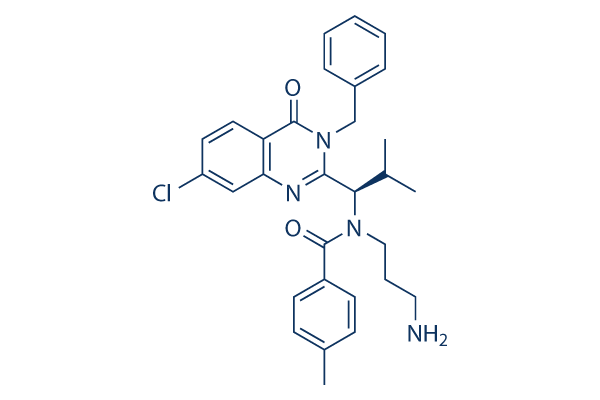
Chemische structuur
Moleculair gewicht: 517.06
Kwaliteitscontrole
| Gerelateerde doelwitten | Akt Wnt/beta-catenin PKC HSP ROCK Microtubule Associated Integrin Bcr-Abl Actin FAK |
|---|---|
| Overige Kinesin Inhibitoren | GSK923295 SB743921 HCl Monastrol ARQ 621 K 858 BTB-1 VLS-1488(KIF18A-IN-6 ) H-Cys(Trt)-OH Filanesib hydrochloride GW406108X |
Celkweek, behandeling & werkconcentratie
| Cellijnen | Assaytype | Concentratie | Incubatietijd | Formulering | Activiteitsbeschrijving | PMID |
|---|---|---|---|---|---|---|
| HCT116 | Antiproliferative assay | 72 hrs | Antiproliferative activity against human HCT116 cells after 72 hrs by Alamar blue assay, GI50=0.025μM | 22248262 | ||
| hTERT-HME1 | Antiproliferative assay | 72 hrs | Antiproliferative activity against human hTERT-HME1 cells after 72 hrs by Alamar blue assay, GI50=0.032μM | 22248262 | ||
| K562 | Antiproliferative assay | 72 hrs | Antiproliferative activity against human K562 cells after 72 hrs by Alamar blue assay, GI50=0.071μM | 22248262 | ||
| BxPC3 | Antiproliferative assay | 72 hrs | Antiproliferative activity against human BxPC3 cells after 72 hrs by Alamar blue assay, GI50=0.08μM | 22248262 | ||
| NCI-H1299 | Antiproliferative assay | 72 hrs | Antiproliferative activity against human NCI-H1299 cells after 72 hrs by Alamar blue assay, GI50=0.082μM | 22248262 | ||
| LNCAP | Growth inhibition assay | 72 hrs | Growth inhibition of human LNCAP cells after 72 hrs by Alamar blue assay, GI50=0.022μM | 23394180 | ||
| HCT116 | Growth inhibition assay | 72 hrs | Growth inhibition of human HCT116 cells after 72 hrs by Alamar blue assay, GI50=0.025μM | 23394180 | ||
| PC3 | Growth inhibition assay | 72 hrs | Growth inhibition of human PC3 cells after 72 hrs by Alamar blue assay, GI50=0.05μM | 23394180 | ||
| BxPC3 | Growth inhibition assay | 72 hrs | Growth inhibition of human BxPC3 cells after 72 hrs by Alamar blue assay, GI50=0.08μM | 23394180 | ||
| NCI-H1299 | Growth inhibition assay | 72 hrs | Growth inhibition of human NCI-H1299 cells after 72 hrs by Alamar blue assay, GI50=0.082μM | 23394180 | ||
| LXFS 538 | Antitumor assay | 6 mg/kg | Antitumor activity against human LXFS 538 cells xenografted in NMRI nu/nu mouse assessed as tumor regression at 6 mg/kg, ip measured on day 13 | 23394180 | ||
| HeLa | Antiproliferative assay | 48 hrs | Antiproliferative activity against human HeLa cells after 48 hrs by MTT assay, IC50=1μM | 24184776 | ||
| MCF7 | Antiproliferative assay | 48 hrs | Antiproliferative activity against human MCF7 cells after 48 hrs by MTT assay, IC50=1.3μM | 24184776 | ||
| HCT116 | Growth inhibition assay | 72 hrs | Growth inhibition of human HCT116 cells after 72 hrs by MTS assay, IC50=0.0011μM | 26396688 | ||
| TC32 | qHTS assay | qHTS of pediatric cancer cell lines to identify multiple opportunities for drug repurposing: Primary screen for TC32 cells | 29435139 | |||
| DAOY | qHTS assay | qHTS of pediatric cancer cell lines to identify multiple opportunities for drug repurposing: Primary screen for DAOY cells | 29435139 | |||
| SJ-GBM2 | qHTS assay | qHTS of pediatric cancer cell lines to identify multiple opportunities for drug repurposing: Primary screen for SJ-GBM2 cells | 29435139 | |||
| A673 | qHTS assay | qHTS of pediatric cancer cell lines to identify multiple opportunities for drug repurposing: Primary screen for A673 cells | 29435139 | |||
| SK-N-MC | qHTS assay | qHTS of pediatric cancer cell lines to identify multiple opportunities for drug repurposing: Primary screen for SK-N-MC cells | 29435139 | |||
| NB-EBc1 | qHTS assay | qHTS of pediatric cancer cell lines to identify multiple opportunities for drug repurposing: Primary screen for NB-EBc1 cells | 29435139 | |||
| Saos-2 | qHTS assay | qHTS of pediatric cancer cell lines to identify multiple opportunities for drug repurposing: Primary screen for Saos-2 cells | 29435139 | |||
| LAN-5 | qHTS assay | qHTS of pediatric cancer cell lines to identify multiple opportunities for drug repurposing: Primary screen for LAN-5 cells | 29435139 | |||
| BT-12 | qHTS assay | qHTS of pediatric cancer cell lines to identify multiple opportunities for drug repurposing: Primary screen for BT-12 cells | 29435139 | |||
| OHS-50 | qHTS assay | qHTS of pediatric cancer cell lines to identify multiple opportunities for drug repurposing: Primary screen for OHS-50 cells | 29435139 | |||
| A673 | qHTS assay | qHTS of pediatric cancer cell lines to identify multiple opportunities for drug repurposing: Confirmatory screen for A673 cells) | 29435139 | |||
| SK-N-MC | qHTS assay | qHTS of pediatric cancer cell lines to identify multiple opportunities for drug repurposing: Confirmatory screen for SK-N-MC cells | 29435139 | |||
| BT-12 | qHTS assay | qHTS of pediatric cancer cell lines to identify multiple opportunities for drug repurposing: Confirmatory screen for BT-12 cells | 29435139 | |||
| DAOY | qHTS assay | qHTS of pediatric cancer cell lines to identify multiple opportunities for drug repurposing: Confirmatory screen for DAOY cells | 29435139 | |||
| BT-37 | qHTS assay | qHTS of pediatric cancer cell lines to identify multiple opportunities for drug repurposing: Confirmatory screen for BT-37 cells | 29435139 | |||
| TC32 | qHTS assay | qHTS of pediatric cancer cell lines to identify multiple opportunities for drug repurposing: Confirmatory screen for TC32 cells | 29435139 | |||
| MG 63 (6-TG R) | qHTS assay | qHTS of pediatric cancer cell lines to identify multiple opportunities for drug repurposing: Confirmatory screen for MG 63 (6-TG R) cells | 29435139 | |||
| U-2 OS | qHTS assay | qHTS of pediatric cancer cell lines to identify multiple opportunities for drug repurposing: Confirmatory screen for U-2 OS cells | 29435139 | |||
| Rh41 | qHTS assay | qHTS of pediatric cancer cell lines to identify multiple opportunities for drug repurposing: Confirmatory screen for Rh41 cells | 29435139 | |||
| RD | qHTS assay | qHTS of pediatric cancer cell lines to identify multiple opportunities for drug repurposing: Confirmatory screen for RD cells | 29435139 | |||
| Rh30 | qHTS assay | qHTS of pediatric cancer cell lines to identify multiple opportunities for drug repurposing: Confirmatory screen for Rh30 cells | 29435139 | |||
| Saos-2 | qHTS assay | qHTS of pediatric cancer cell lines to identify multiple opportunities for drug repurposing: Confirmatory screen for Saos-2 cells | 29435139 | |||
| SK-N-SH | qHTS assay | qHTS of pediatric cancer cell lines to identify multiple opportunities for drug repurposing: Confirmatory screen for SK-N-SH cells | 29435139 | |||
| Klik om meer experimentele gegevens over de cellijn te bekijken | ||||||
Chemische informatie, Opslag en Stabiliteit
| Moleculair gewicht | 517.06 | Formule | C30H33ClN4O2 |
Opslag (Vanaf de ontvangstdatum) | |
|---|---|---|---|---|---|
| CAS-nr. | 336113-53-2 | SDF downloaden | Opslag van stamoplossingen |
|
|
| Synoniemen | CK0238273 | Smiles | CC1=CC=C(C=C1)C(=O)N(CCCN)C(C2=NC3=C(C=CC(=C3)Cl)C(=O)N2CC4=CC=CC=C4)C(C)C | ||
Oplosbaarheid
|
In vitro |
DMSO
: 103 mg/mL
(199.2 mM)
Ethanol : 103 mg/mL Water : Insoluble |
Molariteitscalculator
|
In vivo |
|||||
In vivo Formuleringscalculator (Heldere oplossing)
Stap 1: Voer de onderstaande informatie in (Aanbevolen: Een extra dier voor het geval van verlies tijdens het experiment)
Stap 2: Voer de in vivo formulering in (Dit is alleen de calculator, geen formulering. Neem eerst contact met ons op als er geen in vivo formulering is in het gedeelte Oplosbaarheid.)
Berekeningsresultaten:
Werkconcentratie: mg/ml;
Methode voor het bereiden van DMSO-mastervloeistof: mg geneesmiddel vooraf opgelost in μL DMSO ( Concentratie mastervloeistof mg/mL, Neem eerst contact met ons op als de concentratie de DMSO-oplosbaarheid van de partij geneesmiddel overschrijdt. )
Methode voor het bereiden van in vivo formulering: Neem μL DMSO mastervloeistof, voeg vervolgens toeμL PEG300, mengen en helder maken, voeg vervolgens toeμL Tween 80, mengen en helder maken, voeg vervolgens toe μL ddH2O, mengen en helder maken.
Methode voor het bereiden van in vivo formulering: Neem μL DMSO mastervloeistof, voeg vervolgens toe μL Maïsolie, mengen en helder maken.
Opmerking: 1. Zorg ervoor dat de vloeistof helder is voordat u het volgende oplosmiddel toevoegt.
2. Zorg ervoor dat u het/de oplosmiddel(en) in de juiste volgorde toevoegt. U moet ervoor zorgen dat de verkregen oplossing, bij de vorige toevoeging, een heldere oplossing is voordat u verdergaat met het toevoegen van het volgende oplosmiddel. Fysische methoden zoals vortexen, echografie of een warmwaterbad kunnen worden gebruikt om het oplossen te bevorderen.
Werkingsmechanisme
| Kenmerken |
An allosteric, potent, specific, and reversible inhibitor of the mitotic kinesin spindle protein (KSP) (HsEg5).
|
|---|---|
| Targets/IC50/Ki |
KSP (HsEg5)
(Cell-free assay) 1.7 nM(Ki app)
|
| In vitro |
Ispinesib (SB-715992) is een krachtige, allosterische, omkeerbare en specifieke remmer van KSP, die de bindingseigenschap van KSP aan microtubuli verandert en de beweging ervan verstoort door de ADP-afgifte te remmen zonder de afgifte van het KSP-ADP-complex uit de microtubulus te wijzigen. Deze verbinding vertoont krachtige cytotoxische activiteit in een panel van tumorcellijnen, waaronder Colo205, Colo201, HT-29, M5076, Madison-109 en MX-1, met IC50 van 1,2 nM tot 9,5 nM. In PC-3 prostaatcelcarcinoomcellen blokkeert het (15 nM en 30 nM) de celproliferatie en induceert het apoptose door de expressieniveaus te reguleren van genen die apoptose, celproliferatie, celcyclus en celsignalering regelen, zoals EGFR, p27, p15 en IL-11. In een panel van 53 borstcellijnen vertoont Ispinesib (7,4 nM–600 nM) een brede remmende activiteit. In BT-474- en MDA-MB-468-cellen induceert het (150 nM) apoptose, zoals blijkt uit een hoger percentage apoptotische cellen, een lager anti-apoptotisch Bcl-XL-niveau en hogere pro-apoptotische Bax- en Bid-niveaus. |
| Kinase Assay |
Steady-State Kinetische Analyse van Menselijke KSP ATPase Activiteit en Remming door Ispinesib
|
|
Kinesine specificiteitsanalyse wordt uitgevoerd met behulp van een pyruvaatkinase-lactaatdehydrogenase detectiesysteem dat de productie van ADP koppelt aan de oxidatie van NADH. Absorbantieveranderingen worden gemonitord bij 340 nm. Steady-state studies met nanomolaire concentraties van KSP worden uitgevoerd met behulp van een gevoelige fluorescentiegebaseerde test die gebruik maakt van een pyruvaatkinase, pyruvaatoxidase en mierikswortelperoxidase (HRP) gekoppeld detectiesysteem dat de generatie van ADP koppelt aan de oxidatie van Amplex Red tot fluorescerend resorufine. Generatie van resorufine wordt gemonitord door fluorescentie (λexcitatie = 520 nm en λemissie = 580 nm). Steady-state biochemische experimenten worden uitgevoerd in PEM25 buffer [25 mM Pipes-K+ (pH 6.8), 2 mM MgCl2, 1 mM EGTA] voor experimenten met microtubuli. De IC50 voor steady-state remming wordt bepaald bij 500 µM ATP, 5 µM Microtubuli en 1 nM KSP in PEM25 buffer. Ki app (schijnbare remmerdissociatieconstante) waarden van Ispinesib (SB-715992) worden geëxtraheerd uit de dosis-respons curves, met expliciete correctie voor enzymconcentratie door gebruik te maken van de Morrison vergelijking. Remmingsmodaliteit (bijv. competitief, niet-competitief, uncompetitief of gemengd) onder steady-state omstandigheden wordt bepaald door het effect van de concentratie ervan op de initiële snelheid te meten als functie van substraatconcentraties. Gegevens worden gefit met behulp van vergelijkingen in GraFit aan snelheidsvergelijkingen voor de verschillende modi van remming.
|
|
| In vivo |
Ispinesib (SB-715992) (4,5 mg/kg–15 mg/kg) vertoont remmende effecten tegen Colo205, Colo201, HT-29, maar niet tegen MX-1-cellen, in muis xenograft modellen. Deze verbinding (6 mg/kg–10 mg/kg) remt ook murine solide tumoren, waaronder Madison 109 longcarcinoom, M5076 sarcoom, evenals L1210 en P388 leukemieën. In muis xenograft modellen van borstkankercellen MCF-7, HCC1954, MDA-MB-468 en KPL4 remt het (8 mg/kg–10 mg/kg) de tumorgroei. |
Referenties |
|
Informatie klinische proef
(gegevens van https://clinicaltrials.gov, bijgewerkt op 2024-05-22)
| NCT-nummer | Rekrutering | Aandoeningen | Sponsor/Medewerkers | Startdatum | Fasen |
|---|---|---|---|---|---|
| NCT00607841 | Terminated | Breast Neoplasms |
Cytokinetics |
December 2007 | Phase 1 |
| NCT00354250 | Completed | Recurrent Renal Cell Cancer|Stage III Renal Cell Cancer|Stage IV Renal Cell Cancer |
National Cancer Institute (NCI) |
May 2006 | Phase 2 |
| NCT00097409 | Completed | Ovarian Cancer |
GlaxoSmithKline |
December 2004 | Phase 2 |
| NCT00119171 | Completed | Solid Tumor Cancer |
GlaxoSmithKline |
November 2004 | Phase 1 |
Technische ondersteuning
Tel: +1-832-582-8158 Ext:3
Als u nog andere vragen heeft, kunt u een bericht achterlaten.

Producten zijn uitsluitend voor onderzoeksdoeleinden. Niet voor menselijk gebruik. Wij verkopen niet aan patiënten.
©Copyright 2013 Selleck Chemicals. Alle rechten voorbehouden.