
uitsluitend voor onderzoeksdoeleinden
GSK1838705A ALK remmer
Cat.Nr.S2703
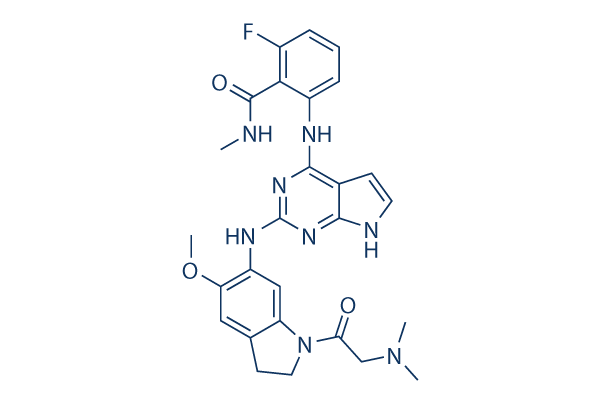
Chemische structuur
Moleculair gewicht: 532.57
Kwaliteitscontrole
| Gerelateerde doelwitten | EGFR VEGFR PDGFR FGFR c-Met Src MEK CSF-1R FLT3 HER2 |
|---|---|
| Overige ALK Inhibitoren | TAE684 (NVP-TAE684) Repotrectinib (TPX-0005) AZD3463 Ensartinib dihydrochloride AP26113-analog (ALK-IN-1) ASP3026 NVL-655 (Neladalkib) Envonalkib Belizatinib (TSR-011) HG-14-10-04 |
Chemische informatie, Opslag en Stabiliteit
| Moleculair gewicht | 532.57 | Formule | C27H29FN8O3 |
Opslag (Vanaf de ontvangstdatum) | |
|---|---|---|---|---|---|
| CAS-nr. | 1116235-97-2 | SDF downloaden | Opslag van stamoplossingen |
|
|
| Synoniemen | N/A | Smiles | CNC(=O)C1=C(C=CC=C1F)NC2=NC(=NC3=C2C=CN3)NC4=C(C=C5CCN(C5=C4)C(=O)CN(C)C)OC | ||
Oplosbaarheid
|
In vitro |
DMSO
: 107 mg/mL
(200.91 mM)
Water : Insoluble Ethanol : Insoluble |
Molariteitscalculator
|
In vivo |
|||||
In vivo Formuleringscalculator (Heldere oplossing)
Stap 1: Voer de onderstaande informatie in (Aanbevolen: Een extra dier voor het geval van verlies tijdens het experiment)
Stap 2: Voer de in vivo formulering in (Dit is alleen de calculator, geen formulering. Neem eerst contact met ons op als er geen in vivo formulering is in het gedeelte Oplosbaarheid.)
Berekeningsresultaten:
Werkconcentratie: mg/ml;
Methode voor het bereiden van DMSO-mastervloeistof: mg geneesmiddel vooraf opgelost in μL DMSO ( Concentratie mastervloeistof mg/mL, Neem eerst contact met ons op als de concentratie de DMSO-oplosbaarheid van de partij geneesmiddel overschrijdt. )
Methode voor het bereiden van in vivo formulering: Neem μL DMSO mastervloeistof, voeg vervolgens toeμL PEG300, mengen en helder maken, voeg vervolgens toeμL Tween 80, mengen en helder maken, voeg vervolgens toe μL ddH2O, mengen en helder maken.
Methode voor het bereiden van in vivo formulering: Neem μL DMSO mastervloeistof, voeg vervolgens toe μL Maïsolie, mengen en helder maken.
Opmerking: 1. Zorg ervoor dat de vloeistof helder is voordat u het volgende oplosmiddel toevoegt.
2. Zorg ervoor dat u het/de oplosmiddel(en) in de juiste volgorde toevoegt. U moet ervoor zorgen dat de verkregen oplossing, bij de vorige toevoeging, een heldere oplossing is voordat u verdergaat met het toevoegen van het volgende oplosmiddel. Fysische methoden zoals vortexen, echografie of een warmwaterbad kunnen worden gebruikt om het oplossen te bevorderen.
Werkingsmechanisme
| Kenmerken |
A small-molecule kinase inhibitor of IGF-1R and the insulin receptor.
|
|---|---|
| Targets/IC50/Ki |
ALK
(Cell-free assay) 0.5 nM
Insulin Receptor
(Cell-free assay) 1.6 nM
IGF-1R
(Cell-free assay) 2 nM
|
| In vitro |
GSK1838705A remt potent en ATP-competitief IGF-1R en IR met appKi waarden van respectievelijk 0,7 nM en 1,1 nM. In cellen remt deze verbinding potent ligand-geïnduceerde fosforylering van IGF-1R en IR met IC50 van respectievelijk 85 nM en 79 nM. Het vertoont een significant anti-proliferatief effect in een panel van cellijnen afgeleid van solide en hematologische tumoren, zoals L-82, SUP-M2, SK-ES en MCF-7 cellen met EC50 van respectievelijk 24 nM, 28 nM, 141 nM en 203 nM. Dit chemische middel toont een accumulatie van MCF-7 en NCl-H929 cellen voornamelijk in de G1 (2N) fase van de celcyclus. Het remt ook ALK met Ki van 0,35 nM en onderdrukt de proliferatie van nucleofosmine (NPM)-ALK fusiecellen met EC50 van 24-88 nM. Deze verbinding remt potent NPM-ALK fosforylering in Karpas-299 en SR-786 cellen, terwijl het een bescheiden effect heeft op STAT3 fosforylering.
|
| Kinase Assay |
Kinase Assays
|
|
Baculovirus-tot expressie gebrachte glutathion S-transferase-getagde proteïnen die het intracellulaire domein van IGF-1R (aminozuren 957-1367) en IR (aminozuren 979-1382) coderen, worden gebruikt voor de bepaling van IC50's door middel van een homogene tijd-geresolveerde fluorescentie-assay. Een filterbindingstest wordt gebruikt voor appKi-bepalingen met geactiveerde IGF-1R en IR kinases. Uitgebreide kinase-selectiviteitsprofilering van deze verbinding wordt uitgevoerd door deze te screenen in het KinaseProfiler-panel.
|
|
| In vivo |
Bij NIH-3T3/LISN tumor-dragende muizen veroorzaakt orale behandeling met GSK1838705A (60 mg/kg) een tumorremming van 77%, zonder significant gewichtsverlies. Bij COLO 205 tumor-dragende muizen bedraagt de remming van de tumorgroei door deze verbinding (30 mg/kg) 80%. Bovendien wordt de antitumorale werkzaamheid van deze chemische stof ook waargenomen bij muizen met HT29-xenograft of BxPC3-xenograft. Bij muizen leidt deze verbinding (60 mg/kg) tot een voorbijgaande 2-voudige toename van de bloedglucosespiegels door IR-signalering te remmen. Het (60 mg/kg) remt de groei van gevestigde Karpas-299 xenografts met 93% tumorremming, zonder effect op het gewicht van de ratten.
|
Referenties |
Technische ondersteuning
Tel: +1-832-582-8158 Ext:3
Als u nog andere vragen heeft, kunt u een bericht achterlaten.

Producten zijn uitsluitend voor onderzoeksdoeleinden. Niet voor menselijk gebruik. Wij verkopen niet aan patiënten.
©Copyright 2013 Selleck Chemicals. Alle rechten voorbehouden.