
Technische gegevens
| Formule | C15H14N2O |
||||||
| Moleculair gewicht | 238.28 | CAS-nr. | 204005-46-9 | ||||
| Oplosbaarheid (25°C)* | In vitro | DMSO (verwarmd met een waterbad van 50 ºC) | 40 mg/mL (167.86 mM) | ||||
| Ethanol | 4 mg/mL (16.78 mM) | ||||||
| Water | Insoluble | ||||||
| In vivo (Voeg oplosmiddelen afzonderlijk en in volgorde toe aan het product.) |
|
||||||
|
* <1 mg/ml betekent licht oplosbaar of onoplosbaar. * Houd er rekening mee dat Selleck de oplosbaarheid van alle verbindingen intern test en de werkelijke oplosbaarheid enigszins kan afwijken van gepubliceerde waarden. Dit is normaal en is te wijten aan lichte batch-tot-batch variaties. * Verzending op kamertemperatuur (Stabiliteitstests tonen aan dat dit product zonder koelmaatregelen kan worden verzonden.) |
|||||||
Voorbereiden van stamoplossingen
Biologische activiteit
| Beschrijving | Semaxanib (SU5416, semaxinib) is een krachtige en selectieve VEGFR(Flk-1/KDR)-remmer met een IC50 van 1,23 M, 20-voudig selectiever voor VEGFR dan PDGFR , en mist activiteit tegen EGFR, InsR en FGFR. Fase 3. Het kan worden gebruikt om diermodellen van chronische intermitterende hypoxie te induceren. | ||
|---|---|---|---|
| Doelen |
|
||
| In vitro | Semaxanib (SU5416) remt VEGF-afhankelijke fosforylering van de Flk-1-receptor in Flk-1-overexpressende NIH 3T3-cellen met IC50 van 1,04 M, en PDGF-afhankelijke autofosforylering in NIH 3T3-cellen met IC50 van 20,3 M. Het remt ook VEGF- en FGF-gedreven mitogenese op een dosisafhankelijke manier met respectievelijk IC50 van 0,04 en 50 M. Behandeling met deze verbinding heeft geen effect op de in vitro groei van C6-glioom, Calu 6-longcarcinoom, A375-melanoom, A431-epidermo de carcinoom en SF767T-glioomcellen (alle IC50's > 20 M). | ||
| In vivo | Semaxanib (SU5416) remt dosisafhankelijk de groei van A375-tumoren in vivo. Een >85% remming van de subcutane tumorgroei wordt waargenomen bij dagelijkse i.p. toediening van deze verbinding in DMSO, zonder meetbare toxiciteit. Het vertoont een breed spectrum aan antitumoractiviteit, waarbij de subcutane groei van 8 van de 10 geteste tumorlijnen (A431, Calu-6, C6, LNCAP, EPH4-VEGF, 3T3HER2, 488G2M2 en SF763T-cellen) significant wordt geremd met een gemiddeld sterftecijfer van 2,5%. Bij 25 mg/kg/dag vertoont het een krachtige antiangiogene activiteit, wat resulteert in een significante vermindering van zowel de totale als de functionele vasculaire dichtheid van de tumormicrovasculatuur. |
Protocol (uit referentie)
| Kinase-assay:[1] |
|
|---|---|
| Celassay:[1] |
|
| Dierstudie:[1] |
|
Referenties
|
Klantproductvalidatie
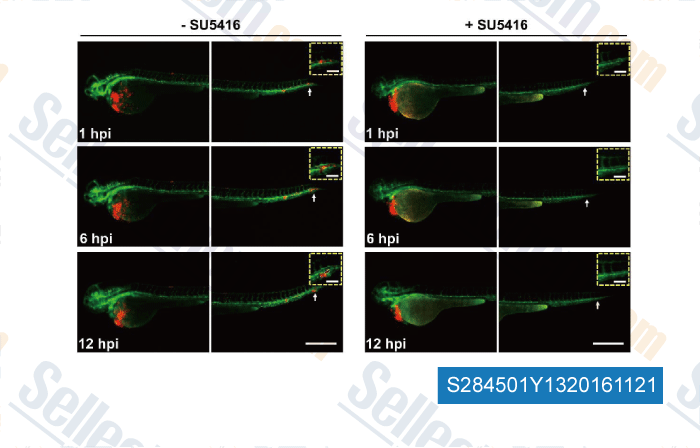
-
Gegevens van [ , , Sci Rep, 2016, 6:19304. ]
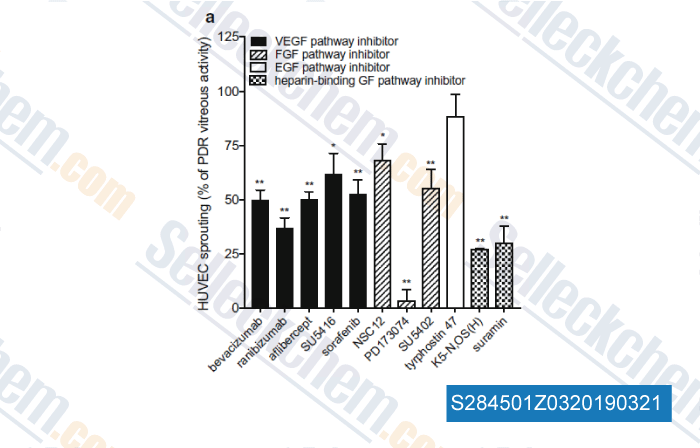
-
Gegevens van [ , , Angiogenesis, 2017, 20(4):629-640 ]
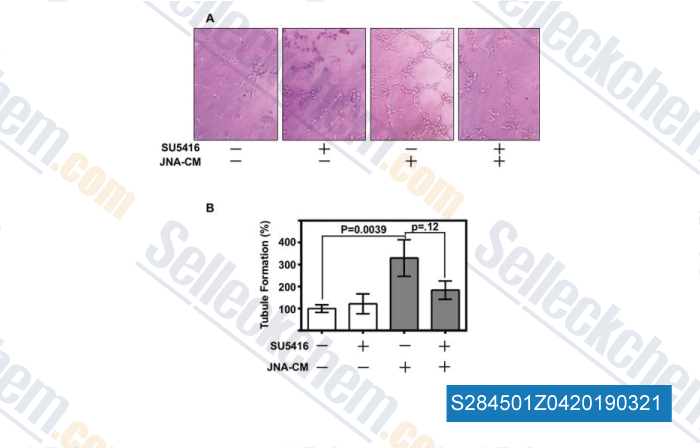
-
Gegevens van [ , , Int Forum Allergy Rhinol, 2017, 7(10):973-979 ]
Sellecks Semaxanib (SU5416) Is geciteerd door 21 Publicaties
| LONP1 facilitates pulmonary artery smooth muscle cell glycolytic reprogramming by degrading MPC1 in pulmonary hypertension [ Clin Sci (Lond), 2025, 139(10)CS20255922] | PubMed: 40332105 |
| APOE- ε4-induced Fibronectin at the blood-brain barrier is a conserved pathological mediator of disrupted astrocyte-endothelia interaction in Alzheimer's disease [ bioRxiv, 2025, 2025.01.24.634732] | PubMed: 39975303 |
| Gliovascular transcriptional perturbations in Alzheimer's disease reveal molecular mechanisms of blood brain barrier dysfunction [ Nat Commun, 2024, 15(1):4758] | PubMed: 38902234 |
| Endothelial Slc35a1 Deficiency Causes Loss of LSEC Identity and Exacerbates Neonatal Lipid Deposition in the Liver in Mice [ Cell Mol Gastroenterol Hepatol, 2024, 17(6):1039-1061] | PubMed: 38467191 |
| A novel twelve-gene signature to predict neoadjuvant chemotherapy response and prognosis in breast cancer [ Front Immunol, 2022, 13:1035667] | PubMed: 36341435 |
| VEGF Modulates Neurogenesis and Microvascular Remodeling in Epileptogenesis After Status Epilepticus in Immature Rats [ Front Neurol, 2021, 12:808568] | PubMed: 35002944 |
| PKR deficiency alleviates pulmonary hypertension via inducing inflammasome adaptor ASC inactivation [ Pulm Circ, 2021, 11(4):20458940211046156] | PubMed: 34540200 |
| Uncovering mutation-specific morphogenic phenotypes and paracrine-mediated vessel dysfunction in a biomimetic vascularized mammary duct platform [ Nat Commun, 2020, 11(1):3377] | PubMed: 32632100 |
| RhoJ integrates attractive and repulsive cues in directional migration of endothelial cells [ EMBO J, 2020, 39(12):e102930] | PubMed: 32347571 |
| Activation of inflammasomes by tyrosine kinase inhibitors of vascular endothelial growth factor receptor: Implications for VEGFR TKIs-induced immune related adverse events [ Toxicol In Vitro, 2020, 71:105063] | PubMed: 33271325 |
RETOURBELEID
Selleck Chemicals onvoorwaardelijke retourbeleid zorgt voor een soepele online winkelervaring voor onze klanten. Als u op enigerlei wijze ontevreden bent met uw aankoop, kunt u elk artikel(en) binnen 7 dagen na ontvangst retourneren. In geval van problemen met de productkwaliteit, zowel protocolgerelateerde als productgerelateerde problemen, kunt u elk artikel(en) binnen 365 dagen na de oorspronkelijke aankoopdatum retourneren. Volg de onderstaande instructies bij het retourneren van producten.
VERZENDING EN OPSLAG
Selleck producten worden bij kamertemperatuur vervoerd. Als u het product op kamertemperatuur ontvangt, wees dan gerust, de Selleck kwaliteitsinspectieafdeling heeft experimenten uitgevoerd om te controleren of de normale temperatuurplaatsing van één maand de biologische activiteit van poederproducten niet beïnvloedt. Na ontvangst dient u het product op te slaan volgens de vereisten beschreven in het gegevensblad. De meeste Selleck producten zijn stabiel onder de aanbevolen omstandigheden.
NIET VOOR HUMANE, VETERINAIRE DIAGNOSTISCHE OF THERAPEUTISCHE DOELEINDEN.