
Technische gegevens
| Formule | C17H11Cl3N2O3 |
||||||||||||||
| Moleculair gewicht | 397.64 | CAS-nr. | 668467-91-2 | ||||||||||||
| Oplosbaarheid (25°C)* | In vitro | DMSO | 11 mg/mL (27.66 mM) | ||||||||||||
| Water | Insoluble | ||||||||||||||
| Ethanol | Insoluble | ||||||||||||||
| In vivo (Voeg oplosmiddelen afzonderlijk en in volgorde toe aan het product.) |
|
||||||||||||||
|
* <1 mg/ml betekent licht oplosbaar of onoplosbaar. * Houd er rekening mee dat Selleck de oplosbaarheid van alle verbindingen intern test en de werkelijke oplosbaarheid enigszins kan afwijken van gepubliceerde waarden. Dit is normaal en is te wijten aan lichte batch-tot-batch variaties. * Verzending op kamertemperatuur (Stabiliteitstests tonen aan dat dit product zonder koelmaatregelen kan worden verzonden.) |
|||||||||||||||
Voorbereiden van stamoplossingen
Biologische activiteit
| Beschrijving | LDN-57444 is een reversibele, competitieve proteasoomremmer voor Uch-L1 met een IC50 van 0,88 μM, met 28-voudige selectiviteit over isovorm Uch-L3. | ||||||
|---|---|---|---|---|---|---|---|
| Doelen |
|
||||||
| In vitro | Behandeling met 50 μM LDN-57444 gedurende 24 uur leidt tot 70% remming van de proteasoomactiviteit. Deze verbinding veroorzaakt een significante en concentratieafhankelijke afname van de cellevensvatbaarheid bij concentraties boven 25 μM en de cellevensvatbaarheid daalde tot 61,81% bij 50 μM. Het is in staat om celdood via de apoptoseroute te veroorzaken door de activiteit van het ubiquitine-proteasoom-systeem te verlagen en de niveaus van sterk geübiquitineerde eiwitten te verhogen, die beide de ongevouwen eiwitrespons kunnen activeren. De apoptose geïnduceerd door deze chemische stof kan worden geactiveerd door de activering van endoplasmatisch reticulum stress (ERS). | ||||||
| In vivo | LDN-57444 veroorzaakt in vivo dramatische veranderingen in de synaptische eiwitdistributie en wervelmorfologie. Behandeling met deze verbinding resulteert ook in een snelle daling van Uch-L1-activiteit, maar proteasoomremming heeft geen effect op cAMP-niveaus over een periode van enkele uren. |
Protocol (uit referentie)
| Kinase-assay:[1] |
|
|---|---|
| Celassay:[1] |
|
Referenties
|
Klantproductvalidatie
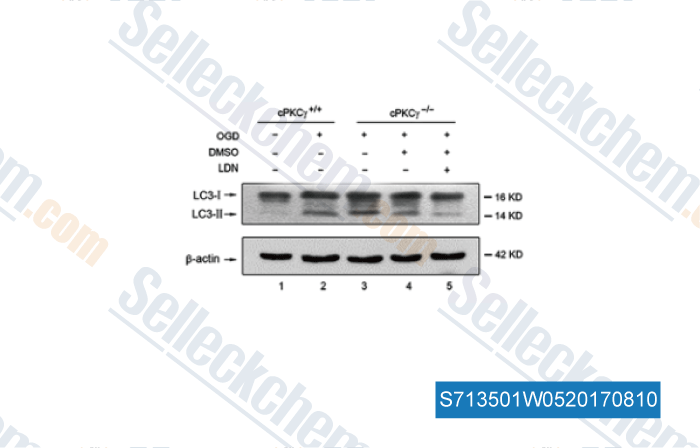
-
Gegevens van [ , , J Cell Mol Med, 2017, 1-16 ]
Sellecks LDN-57444 Is geciteerd door 13 Publicaties
| Ubiquitin C-terminal hydrolase L1 promoted pro-angiogenic capacity of periodontal ligament stem cells via HIF-1α/YAP signaling in periodontitis [ Stem Cell Res Ther, 2025, 16(1):271] | PubMed: 40457476 |
| Deficiency of UCHL1 results in insufficient decidualization accompanied by impaired dNK modulation and eventually miscarriage [ J Transl Med, 2024, 22(1):478] | PubMed: 38769534 |
| The Suppression of Ubiquitin C-Terminal Hydrolase L1 Promotes the Transdifferentiation of Auditory Supporting Cells into Hair Cells by Regulating the mTOR Pathway [ Cells, 2024, 13(9)737] | PubMed: 38727276 |
| Stem Cell Properties of Gastric Cancer Stem-Like Cells under Stress Conditions Are Regulated via the c-Fos/UCH-L3/β-Catenin Axis [ Mol Cells, 2023, 46(8):476-485] | PubMed: 37460253 |
| UCHL1 regulates inflammation via MAPK and NF-κB pathways in LPS-activated macrophages [ Cell Biol Int, 2021, 10.1002/cbin.11662] | PubMed: 34288216 |
| Long-term inhibition of UCHL1 decreases hypertension and retinopathy in spontaneously hypertensive rats [ J Int Med Res, 2021, 49(6):3000605211020641] | PubMed: 34130526 |
| The Deubiquitinating Enzyme UCHL1 Promotes Resistance to Pemetrexed in Non-Small Cell Lung Cancer by Upregulating Thymidylate Synthase [ Theranostics, 2020, 15;10(13):6048-6060] | PubMed: 32483437 |
| Deubiquitination of CD36 by UCHL1 promotes foam cell formation [ Cell Death Dis, 2020, 11(8):636] | PubMed: 32801299 |
| Blockage of UCHL1 Activity Attenuates Cardiac Remodeling in Spontaneously Hypertensive Rats [ Hypertens Res, 2020, 10.1038/s41440-020-0486-1] | PubMed: 32541849 |
| UCH-L1 inhibitor LDN-57444 hampers mouse oocyte maturation by regulating oxidative stress and mitochondrial function and reducing ERK1/2 expression [ Biosci Rep, 2020, 40(10)BSR20201308] | PubMed: 33030206 |
RETOURBELEID
Selleck Chemicals onvoorwaardelijke retourbeleid zorgt voor een soepele online winkelervaring voor onze klanten. Als u op enigerlei wijze ontevreden bent met uw aankoop, kunt u elk artikel(en) binnen 7 dagen na ontvangst retourneren. In geval van problemen met de productkwaliteit, zowel protocolgerelateerde als productgerelateerde problemen, kunt u elk artikel(en) binnen 365 dagen na de oorspronkelijke aankoopdatum retourneren. Volg de onderstaande instructies bij het retourneren van producten.
VERZENDING EN OPSLAG
Selleck producten worden bij kamertemperatuur vervoerd. Als u het product op kamertemperatuur ontvangt, wees dan gerust, de Selleck kwaliteitsinspectieafdeling heeft experimenten uitgevoerd om te controleren of de normale temperatuurplaatsing van één maand de biologische activiteit van poederproducten niet beïnvloedt. Na ontvangst dient u het product op te slaan volgens de vereisten beschreven in het gegevensblad. De meeste Selleck producten zijn stabiel onder de aanbevolen omstandigheden.
NIET VOOR HUMANE, VETERINAIRE DIAGNOSTISCHE OF THERAPEUTISCHE DOELEINDEN.